
Mocius of Amphipolis
The Holy Hieromartyr Mocius, Presbyter of Amphipolis in Macedonia
Hieromartyr · Priest · d. c. 295, at Byzantium
Commemorated 11 May — Martyrdom by beheading at Byzantium
Mocius was a presbyter of Amphipolis in Macedonia who, in the persecution under Diocletian, broke into the drunken festival of Dionysus in his own city and called its worshippers to abandon their vileness for Christ. Tortured at Amphipolis and at Laodicea, thrown into a heated furnace and to the beasts and preserved unharmed, he was at length sent to Perinthus and then to Byzantium, and there beheaded about the year 295 — some thirty-five years before Constantine dedicated the new capital on the same site. Constantine afterwards built a church over his relics, and Mocius became the first and for centuries the most honoured of the martyrs of the City: his memory on May 11 is inseparable from the birthday of Constantinople itself.
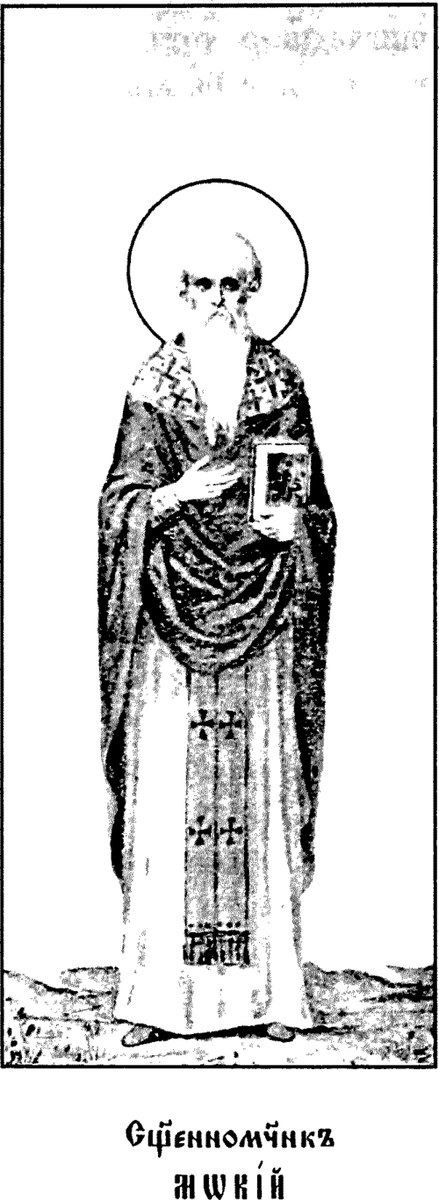
_-_%D0%B8%D0%BA%D0%BE%D0%BD%D0%B0_09111_%D0%9C%D0%BE%D0%BA%D0%B8%D0%B9.png)
Presbyter of Amphipolis
Mocius was, the passion says, of Roman descent but settled in Macedonia, where he served as a presbyter of the church of Amphipolis — the old Athenian colony on the Strymon, near the coast of the Aegean, a city St Paul had passed through on his way to Thessalonica (Acts 17:1). It was a place still deeply attached to its ancestral cults, and above all to Dionysus, whose annual festival was kept there with the sacrifices, drunkenness and licence proper to that god.
The tradition presents Mocius as a priest of great personal severity and fearless speech. When the persecution of Diocletian (284–305) was published, he did not hide; and when the city gathered for the Dionysia he went into the midst of the feast and preached, telling the crowd that what they called worship was the service of demons and the ruin of their souls, and calling them to repentance and to baptism. A number, the account says, were converted. The pagan priests and the magistrates were enraged: the assault had been made not in private but at the heart of the city's public religion.
The tortures at Laodicea
Mocius was arrested and brought before the governor — the passion places the examination at Laodicea — who pressed him first with promises and then with threats. His answer is preserved in substance in the synaxarion: that death for Christ was not a loss to him but his greatest gain. He was scourged and racked, and endured it, the account says, as though the body suffering were another's.
Taken into a temple and commanded to sacrifice, he called upon the name of Jesus Christ, and the idols fell and were broken where they stood. He was then shut into a furnace heated red-hot; the fire did him no harm, but broke out of the mouth of the furnace and burned those who stood by — the governor himself, in the received account, perishing in the flames he had prepared. He was given to wild beasts in the arena, and the beasts would not touch him but lay down at his feet, and the people, seeing it, cried out for the martyr's release.
Martyrdom at Byzantium
Because the miracles were turning the crowds, the authorities moved him away from the scene of them. He was sent under guard to Perinthus (Heraclea) on the Propontis, and from there to Byzantium — the small Greek city on the Bosphorus that had not yet become a capital — where the sentence was at last carried out. He was beheaded there, about the year 295, having prayed, as the passion gives it, that the Lord would receive his spirit in peace and strengthen the faithful he left behind.
Relics and the church of Saint Mocius
The Christians of Byzantium buried him, and his tomb was in the city when Constantine chose that site for his new Rome. The tradition — carried by the synaxaria and echoed in the Byzantine topographers — is that Constantine raised a church over the martyr's relics, one of the earliest sanctuaries of the new capital, and by some accounts built it out of the materials of a demolished temple of Zeus. The Church of St Mocius was thereafter a fixed point of the liturgical topography of Constantinople: the Typikon of the Great Church appoints stations there, and a great cistern of the City, the Cistern of Mocius, took its name from the quarter around the church. The building was damaged in the earthquakes of the eighth and ninth centuries and repeatedly repaired, and it had disappeared by the later Ottoman period; the name survived attached to the cistern.
That the martyr of Byzantium should be commemorated on the very day of the dedication of Constantinople is not a coincidence of the calendar but its logic: the City's birthday and the memory of the City's own martyr-priest were kept together, the martyr's blood being understood as the foundation older than the walls. The Menaion for May 11 accordingly joins the two commemorations, and the synaxarion notices tie them expressly.
Feast and commemoration
May 11 (church date; Old Calendar civil May 24). Mocius is kept on this day by the whole Byzantine rite, and stands first in the Menaion's list for May 11, before the commemoration of the founding of Constantinople and — in later usage — before the joint feast of Cyril and Methodius, which was added to the day in the ninth century and which has since overshadowed him in Slavic lands. In Greek and Antiochian usage the day is still primarily his. He is one of a small group of martyrs whose cultus was native to Byzantium before it became Constantinople, and his church was among the stational churches of the City.
Hymns
Apolytikion — Tone 4
Sharing the manner of life of the Apostles and seated upon their thrones, thou didst find in the practice of virtue the way to the vision of God, O divinely-inspired one; therefore, having rightly divided the word of truth, thou didst contend for the faith even unto blood, O hieromartyr Mocius: intercede with Christ God that our souls may be saved.
Kontakion — Tone 2
Thou didst overthrow the altars of the demons by thy word, O wise Mocius, and the fire and the beasts were made powerless against thee; and giving thy neck to the sword in the City of Constantine, thou wast shown a first-fruits of her martyrs: entreat Christ God for those who honour thee.
Original translation from the Greek
Iconography
Mocius is painted as a priest-martyr: middle-aged to elderly, with a rounded grey beard and high forehead, vested in sticharion, epitrachelion and cross-patterned phelonion, and holding the Gospel-book in his covered or draped left hand while the right is raised in blessing or holds the martyr's cross. He wears no omophorion, since the tradition makes him a presbyter and not a bishop — a detail that distinguishes him from the hierarch-martyrs among whom he is often ranged. In narrative cycles the scene of his passion shows the furnace whose flames turn back upon his persecutors, or the beasts crouching before him in the arena, or the idols falling at his prayer; the beheading is shown against the walls of Byzantium. The stored image is a line engraving after the traditional type, from the illustrated Russian Lives of the Saints of 1903–1911, inscribed in Church Slavonic Сщенномученикъ Мокій ("Hieromartyr Mocius").
Disputed questions
- Date and place of the martyrdom. The passion is a late compilation, and the synaxaria differ over details. The commonest reckoning puts the beheading at Byzantium about 295, under Diocletian; some notices place it under Maximian or in the general persecution of 303–305, which would move the date a decade later. The place of the first interrogation is given as Laodicea, but which Laodicea (Syrian, or the Phrygian city) is not made clear.
- Amphipolis or Byzantium? He is styled indifferently "of Amphipolis" (his see of service) and "of Byzantium" (the place of his death and of his relics). Both are correct; the two epithets do not indicate two saints.
- Not to be confused with the martyr Mucius/Mocius of the Roman martyrologies, nor with the many later bearers of the name in the Byzantine ecclesiastical lists. The Slavonic form of his name is Мокий; the Latinised Mucius occasionally used in older English calendars is the same saint.
- Nor with Mokianus. The martyr Mokianus (Μωκιανός), beheaded with Mark under the eparch Maximus and commemorated on July 3, is a different man of the fourth century; English calendars, including the OCA's, render that pair as "Mark and Mocius," which makes the collision with this saint very easy.