
Moses of Novgorod
Our Father among the Saints Moses, Archbishop of Novgorod
Bishop · b. late 13th century, at Novgorod — d. 1362, at the Skovorodsky Monastery near Novgorod
Commemorated 25 January — Repose of Moses, Archbishop of Novgorod
Moses of Novgorod (died 1362) was Archbishop of Novgorod the Great in the fourteenth century, a builder of churches and monasteries and a shepherd who twice held and twice laid down the archiepiscopal throne to return to monastic silence. Born at Novgorod and tonsured young, he was consecrated archbishop in 1325, resigned in 1330 to withdraw into seclusion, and was recalled to the see in 1352, governing until his final retirement in 1359. In his years as archbishop he raised and adorned many churches and founded or renewed several monasteries about the city, and he is remembered for his care of the poor and for defending the flock of Novgorod in the turbulent politics of the age. He reposed in 1362 at the Skovorodsky Monastery; his relics were found incorrupt in 1686, and he is venerated among the saints of Novgorod.
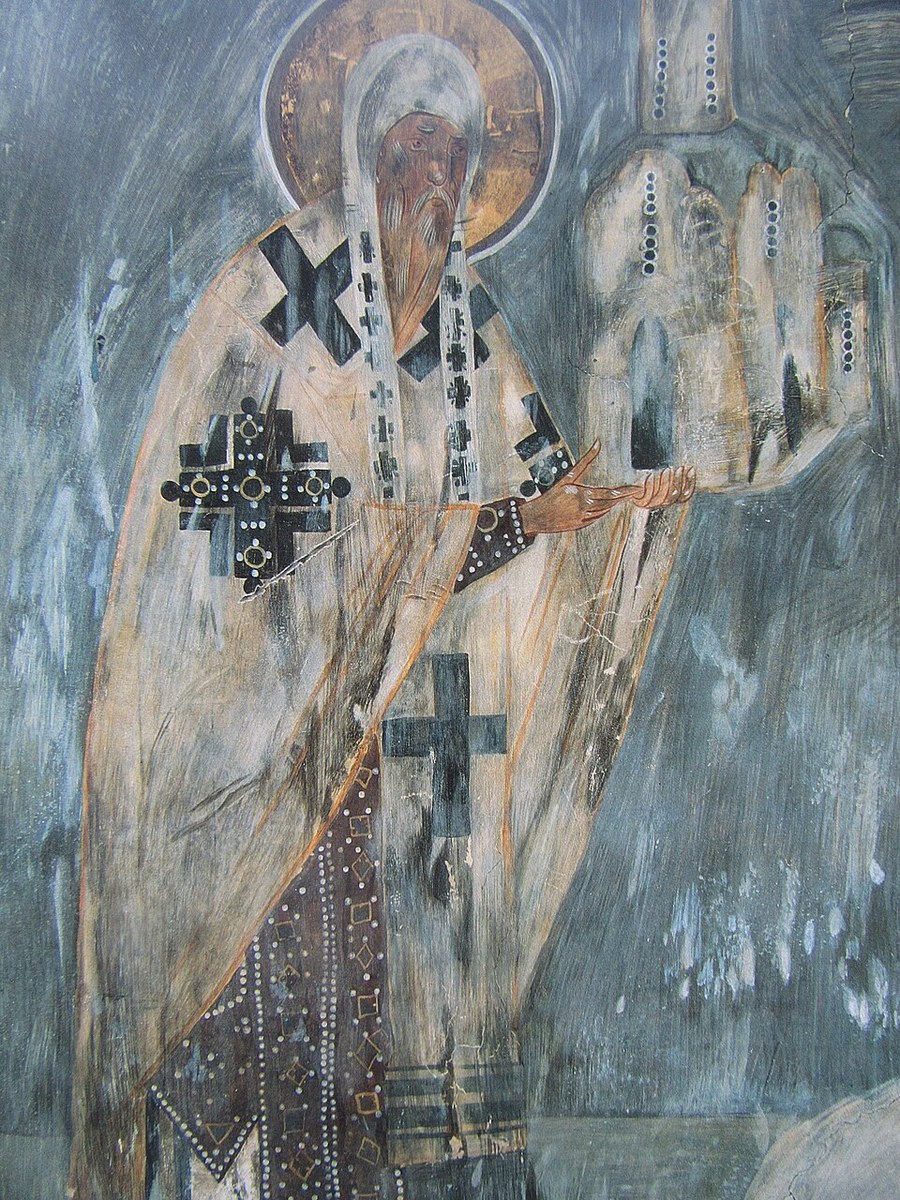

Origins and early life
Moses was born at Novgorod the Great in the later thirteenth century, the son of a pious townsman, and given in baptism the name Mitrophan. Drawn young to the monastic life, he was tonsured — the tradition says at the Tver monastery of the Otroch, or at a Novgorod house — receiving the name Moses, and rose through the degrees of the monastic and priestly life, becoming archimandrite of the Yuriev (St George) Monastery, the chief abbey of the Novgorod land.
Archbishop of Novgorod
On the death of Archbishop David in 1325, the men of Novgorod chose Moses to succeed him, and he was consecrated Archbishop of Novgorod and Pskov at Moscow by the Metropolitan Peter (himself a saint) in 1325. Novgorod in this age was a great mercantile republic, governing itself through its assembly and choosing its own archbishop, who was not only its chief pastor but a leading figure in its civic life; the office carried heavy burdens of statecraft, of mediation between contending parties, and of the defence of the city's interests. Moses, a man of prayer who loved the quiet of the cell, bore these burdens for five years and then, in 1330, weary of the cares of office, resigned the see and withdrew into monastic seclusion, retiring to the monastery he had founded at Kolmovo.
For more than twenty years he lived apart in prayer; but in 1352, after the death of Archbishop Basil (Vasily Kalika), the people again called Moses to the throne, and he consented to resume the archiepiscopate. In this second tenure he governed the church of Novgorod until, aged and failing, he laid down the office a second and final time in 1359 and returned to the monastic life he had never ceased to love.
Builder and shepherd
Moses is remembered above all as a builder. In both his tenures he raised and adorned a great number of churches in Novgorod and its environs, and he founded or renewed several monasteries about the city — among them the Derevyanitsky Resurrection monastery, the monastery at Volotovo Field (whose famous church, built under his patronage, was afterwards covered with celebrated frescoes), and other houses of prayer. He gathered scribes and adorned the churches with books and furnishings, cared for the poor and the stranger, and laboured to keep peace in a city given to faction. His episcopate fell in the years of the Tatar yoke and of Novgorod's delicate balancing among Moscow, Tver, Lithuania, and the Hanseatic world, and the tradition honours him as a steadfast defender of Orthodoxy and of his flock.
Repose and relics
Moses reposed on January 25, 1362, at the Skovorodsky (Skovoroda-Michael) Monastery near Novgorod, which he had founded, and was buried there. His memory was kept locally from soon after his death; and in 1686, his tomb being opened, his relics were found incorrupt, which confirmed and spread his veneration. He is numbered among the Synaxis of the Saints of Novgorod (and of Pskov and Tver), and his relics were honoured in a shrine at the Skovorodsky monastery until the upheavals of the twentieth century.
Feast and commemoration
Moses is commemorated on January 25 (church date; Old Calendar civil February 7), the day of his repose, which he shares with the great Gregory the Theologian; the Russian Church keeps him on this day, and he is also commemorated among the Councils (Synaxes) of the Saints of Novgorod. His is a Russian (and more broadly Slavic) commemoration, not part of the universal Byzantine calendar.
Hymns
Troparion — Tone 4
O God of our fathers, who dealest ever with us according to Thy forbearance: take not Thy mercy from us, but by his supplications govern our life in peace.
Original translation from the Slavonic
Iconography
Moses is depicted as a Russian hierarch of the fourteenth century, vested in the sakkos or phelonion and the omophorion and wearing the white koukoulion (cowl) proper to the archbishops of Novgorod, holding the Gospel-book and blessing, with a greying beard of middling length. The stored image is a portrait figure of Archbishop Moses from the fresco program of the Church of the Dormition at Volotovo Field near Novgorod (the murals dating from the later fourteenth century, soon after his repose), preserved in a copy in the State Russian Museum, Saint Petersburg — a near-contemporary likeness of the saint in his white cowl.