
Myron of Cyzicus
The Holy Hieromartyr Myron the Presbyter, who suffered at Cyzicus
Hieromartyr · Priest · d. 250, beheaded at Cyzicus
Commemorated 17 August — Martyrdom under Decius; beheaded at Cyzicus
Myron was a presbyter in Achaia who was seized at the altar on the feast of the Nativity of Christ and put to death in the persecution of the emperor Decius, about the year 250. The synaxarion remembers him for the particular character of his martyrdom: he suffered not for a private confession but for standing between the governor Antipater and his own congregation, whom the soldiers had come into the church to arrest. Scourged with iron, thrust into a heated furnace which did not consume him, flayed with thongs — one of which he flung back into his tormentor's face — and exposed to beasts which would not touch him, he was at last carried across the Aegean to Cyzicus on the Propontis and there beheaded. He is styled hieromartyr in the Greek books, and his epithet is taken from the city of his death rather than the province of his ministry.
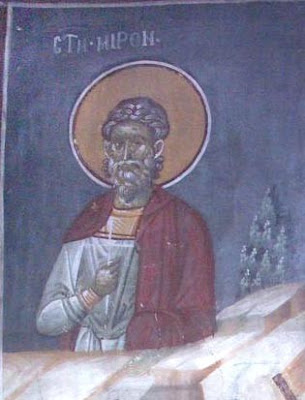

A presbyter in Achaia
Almost everything transmitted of Myron belongs to a single passion, preserved in the Byzantine synaxaria and summarised in the verses of the Menaion. He was a priest of Achaia — the Roman province of southern Greece — and the tradition presents him as a man of two apparently opposite qualities held together: mild and approachable in the ordinary business of a parish, and immovable when his people were threatened. Neither his birthplace nor the name of his city is given. He was, the notice says, of good family and possessed of means, and he used both in the service of the poor of his church.
The date fixes the setting. The edict of Decius, promulgated at the turn of 249–250, required every inhabitant of the empire to sacrifice before a commission and to obtain a certificate of having done so. It was the first genuinely universal persecution, and it fell with peculiar force on the clergy, who were both the most visible Christians and the men whose apostasy would do most to break the resolve of their congregations.
Seized at the Liturgy on the Nativity
The passion places the arrest on the feast of the Nativity of Christ, while Myron was serving the Divine Liturgy — a detail that is itself of interest, since it presumes a distinct December celebration of the Nativity in a mid-third-century Greek church, which the calendar history does not otherwise support for that date and region. Whatever the festal reckoning behind it, the scene is unambiguous: the church was full, and the governor Antipater came in with soldiers to take those praying there.
Myron did not hide, and he did not let his people be taken silently. He came forward, rebuked the governor for entering the house of God with weapons to seize men who had done no wrong, and drew the whole force of the arrest onto himself. He was taken in their place.
The passion
The torments are recounted with the accumulating extravagance characteristic of the genre, and are given here as the tradition gives them, without warranty for each particular:
- He was beaten with iron rods until his body was broken.
- He was thrown into a furnace heated white, and came out unhurt; the flame, bursting outward, is said to have killed about one hundred and fifty of the pagans standing by — a detail the synaxarion offers as a judgement upon the persecutors rather than as a work of the martyr.
- When he still refused to sacrifice, Antipater ordered his skin cut away in strips with leather thongs. Myron took one of the strips of his own flesh and flung it in the governor's face — the single gesture by which he is remembered, and the one the hymnographers seize upon: the martyr's answer to a judge who has run out of arguments.
- He was beaten across the flayed body, then exposed to wild beasts, which would not approach him.
The tradition adds that Antipater, undone by his own failure and by the sight of a man he could not conquer, took his own life. Myron was then put on shipboard and carried to Cyzicus, the great city on the southern shore of the Propontis, and there beheaded by the sword, in the year 250.
Veneration
His cultus is Constantinopolitan and universal: he stands at the head of the synaxarion of August 17 in the Greek, Slavonic, Antiochian and OCA calendars alike, and his service is printed in the Menaion for the day, sung within the afterfeast of the Dormition. The epithet "of Cyzicus" is the usual one, though it names the place where he died rather than the church he served; older Greek notices and the Slavonic Prolog often style him simply Myron the Presbyter, and some Western lists have him as Myron of Achaia.
Feast and commemoration
August 17 (church date; New Calendar civil August 17, Old Calendar civil August 30), within the afterfeast of the Dormition of the Theotokos (August 15–23). Myron is the first-named commemoration of the day in the Greek Menaion, in the Slavonic books, and on the Antiochian and OCA calendars, and his propers are those printed for the day; the service is sung with the Dormition propers taking precedence. The Greek synaxarion gives him the couplet playing on his name — Myron poured out his blood as sweet-smelling myrrh and went with the sword to Christ — the same wordplay (μύρον, "fragrant ointment") that the books use of every saint of this name.
Hymns
Kontakion — Tone 2
Thou didst not flee the flame nor fear the beasts, O all-honoured Myron, but standing before the altar of God thou didst offer thyself for thy flock; and having washed thy priesthood in thy own blood, thou dost intercede without ceasing for us all.
Original translation from the Greek
Apolytikion — Tone 4 (common of a hieromartyr)
As a sharer in the ways and a successor to the thrones of the Apostles, O divinely-inspired one, thou didst find in contemplation the means to ascend to divine heights; rightly dividing the word of truth, thou didst struggle for the faith even unto blood, O hieromartyr Myron: intercede with Christ God that our souls may be saved.
Iconography
Myron is written as a priest-martyr: dark-haired and dark-bearded, of middle years, sometimes in the phelonion and epitrachelion of a presbyter with the Gospel, but more often — in the calendar cycles, where the martyrs are shown in a single register — in the lay tunic and mantle of the martyr, holding the cross of confession in his right hand. Where a scene of his passion is given, the two moments chosen are the furnace and the flaying; the extended martyr-cycles of the Byzantine and Serbian churches occasionally show him casting the strip of his own skin toward the seated governor.
The stored image is the fresco of the Gračanica Monastery in Kosovo, painted for King Milutin about 1318–1321, from the great calendar cycle (menologion) that runs around the church: the saint is inscribed СТН МИРОН ("Holy Myron") above the halo, and is shown half-length, brown-bearded and balding, in a deep red mantle over a pale tunic, the right hand raised holding the martyr's cross. The Gračanica menologion is one of the fullest painted synaxaria to survive and is the principal medieval witness to the iconography of the minor saints of the fixed year.
Disputed questions
- Which name, which place? The double designation — a presbyter of Achaia who dies at Cyzicus — has led to occasional doubling of the saint in secondary lists, as though there were an Achaian Myron and a Cyzicene Myron. There is one. The passion accounts for both names, and the calendars keep one commemoration on one day.
- The Nativity setting. The statement that he was arrested at the Liturgy of the Nativity is difficult to reconcile with what is known of the third-century calendar in the Greek East, where the Nativity was not yet separately kept on December 25. The detail is most probably an editorial retrojection by a later Byzantine redactor, for whom a bishop or priest seized at the Liturgy of the great feast was a natural and vivid frame. It does not touch the substance of the martyrdom.
- The hundred and fifty. The number of pagans killed by the furnace varies in the manuscripts, and some notices omit the incident entirely.
- Not to be confused with Myron the Wonderworker, bishop of Crete (August 8, †c. 350), whose feast falls only nine days earlier in the same month and whose name is identical: the Cretan was a farmer of Raucos who became a bishop and died at a hundred years old in the peace of the Church, and is a wonderworker, not a martyr. Nor with Myron of Tamassos, the deacon of Cyprus (September 17). Three distinct Myrons of three distinct centuries; only this one is a hieromartyr.