
Neophytus of Nicaea
The Holy Martyr Neophytus of Nicaea
Martyr · Child Martyr · Wonderworker · b. c. 290, at Nicaea in Bithynia — d. c. 303–305, at Nicaea
Commemorated 21 January — Martyrdom at Nicaea under Diocletian
Neophytus of Nicaea (†c. 303–305) was a boy-martyr of Bithynia whom the tradition remembers for the gift of wonderworking bestowed on him while he was still a child. Born at Nicaea of devout Christian parents, he was said to have worked miracles from his earliest years — the tradition tells of a dove that spoke to him, of water drawn from a rock, and of his foreknowledge of his mother's death. Withdrawing while still a boy to a cave on Mount Olympus in Bithynia, from which he first drove and then tamed a lion, he came down at the outbreak of the Great Persecution to confess Christ before the persecutors. Though barely fifteen, he endured scourging, fire, and the beasts unharmed, and was at last slain by the sword (or the spear). He is kept on January 21.
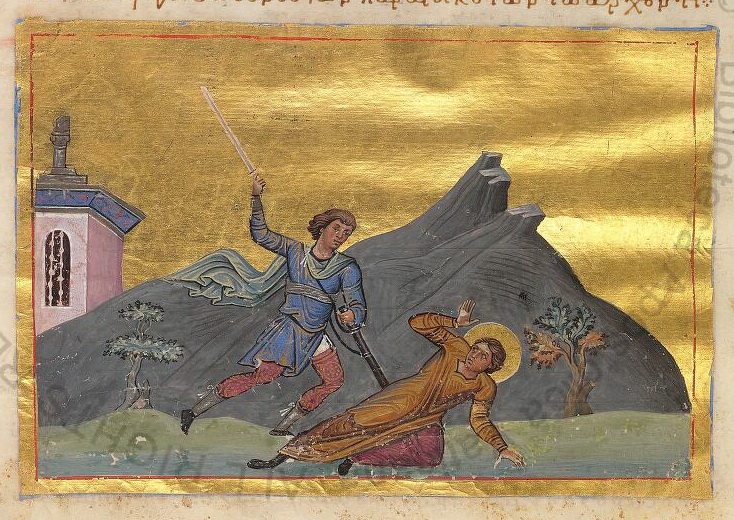

The record of Neophytus is a synaxarion notice, rich in the miraculous, of the kind the Church transmits of the child-martyrs of the Great Persecution. He was born at Nicaea in Bithynia, of Christian parents — his father named in the tradition Theodore, his mother Florentia — who raised him in strict piety. From his earliest childhood, the accounts say, God glorified him with the gift of wonderworking: a white dove, radiant as with the grace of the Holy Spirit, would come to him and speak, guiding him; by his prayer water flowed from a dry rock to relieve the thirsty; and he foretold, and by his prayers eased, the death of his mother, whom he consoled with the promise of the life to come.
Still a boy, drawn by the dove that had so long been his companion, Neophytus withdrew from the town to a cave on Mount Olympus in Bithynia, a haunt of wild beasts. The tradition tells that he first drove out a lion that had its den there, bidding it depart, and afterward, the beast returning tamed, lived at peace with it in the wilderness, given wholly to prayer and fasting in the manner of the desert fathers though he was yet a child.
When the Great Persecution broke out under Diocletian (about 303), Neophytus came down from his mountain to Nicaea to confess Christ openly before the persecutors. Though he was no more than about fifteen years old, he stood unshaken before the governor. He was cruelly scourged; he was cast into a heated furnace, and came out unhurt; he was thrown to the wild beasts, and they would not touch the boy who had lived among the beasts of the mountain. At the last, when neither torture nor fire nor the beasts could overcome him, his tormentors ran him through with a spear (or, in other tellings, beheaded him), and so the child received the martyr's crown, about the year 303–305. The Church honours him as a child-martyr and a wonderworker, whose gifts in so young a life witness that the grace of God is not measured by years.
Feast and commemoration
January 21 (church date; Old Calendar civil February 3), on which the Greek and Slavic calendars and the OCA keep the martyr Neophytus of Nicaea, together with Maximus the Confessor and the other commemorations of the day. He is a synaxarion commemoration; the day's sanctoral office belongs chiefly to Maximus, and Neophytus is sung with the common of a martyr.
Hymns
Troparion — Tone 4 (common of a martyr)
Thy martyr Neophytus, O Lord, in his contest received the incorruptible crown from thee, our God; for possessing thy strength, he cast down the tyrants and broke the feeble insolence of the demons. By his prayers, O Christ God, save our souls.
Original translation from the Greek
Iconography
Neophytus is depicted as a beardless youth — his youthfulness the mark that identifies him — in the martyr's tunic and mantle, often holding the cross of martyrdom; narrative images show him among the beasts of his mountain cave, or in the furnace, or slain by the spear. The stored image is the miniature of the Menologion of Basil II (Constantinople, c. 985; Vat. gr. 1613) for his commemoration, depicting the young martyr.