
Nicephorus of Chios
Our Venerable Father Nicephorus of Chios, the Trainer of Martyrs
Venerable · b. c. 1750, at Kardamyla on Chios — d. 1821
Commemorated 1 May — Memory of the venerable father, kept with his martyr-disciples
Nicephorus of Chios (c. 1750–1821) was a monk, teacher, hymnographer and — the title by which the tradition knows him — a trainer of martyrs. Dedicated as a child to the monastery of Nea Moni on Chios after surviving a plague, educated in the schools of the island, he became the disciple and collaborator of two of the leading figures of the Greek spiritual revival, Macarius of Corinth and Athanasius Parios. Driven from the abbacy of Nea Moni by intrigue, he withdrew to the hermitage of Saint George at Resta, where he planted trees, wrote, and completed the great collection of saints' lives and services which Macarius had entrusted to him, the New Leimonarion. He composed services for a multitude of saints, and above all he prepared repentant apostates for martyrdom, among them the Athonite new martyrs Euthymius, Ignatius and Acacius, with whom he is commemorated on May 1. He reposed in 1821, and his relics were found in 1845.

Origins and Nea Moni
He was born about 1750 at Kardamyla on the island of Chios, and bore in the world the family name Georgios. As a child he came near death in an outbreak of pestilence, and his parents, when he recovered, dedicated him to God: he was given to the great monastery of Nea Moni — the eleventh-century imperial foundation above the plain of Chios, one of the noblest churches in the Greek world — and placed under the elder Anthimus Hagiopateritis. He was educated in the schools of Chios, in particular under the priest Gabriel Astrakaris, and was tonsured a monk of Nea Moni.
Macarius of Corinth and Athanasius Parios
Two encounters formed him. The first was with Saint Macarius Notaras of Corinth, who came to Chios in 1780 and returned in 1790 and made the island one of the centres of the Philokalic revival; Macarius spent his last years in the hermitage country of Chios and died there in 1805. The second was with Saint Athanasius Parios, the theologian and controversialist who directed the celebrated school of Chios. Athanasius, reorganising the school, appointed Nicephorus as one of its teachers, and for years he taught the island's students; the three men — Macarius, Athanasius and Nicephorus — worked together so closely that the tradition speaks of "three saints who made one book about the saints."
Abbot of Nea Moni, and the hermitage at Resta
In 1802 Nicephorus was made igumen of Nea Moni, chiefly to put right a financial mismanagement that was ruining the house. He was not permitted to finish even the two years of his term: opposition and intrigue within the community defeated the reform and he laid down the office. He withdrew instead to the hermitage of Saint George at Resta, in the hills, with the retired priest and composer Father Joseph and with Macarius of Corinth for a neighbour. There he lived out the rest of his life. He planted the hillside with olives and figs, cypresses and pines; he kept the hours; and he wrote.
The New Leimonarion and the hymnographic work
Macarius of Corinth, dying, entrusted to Nicephorus the completion of the great compilation on which he had been working: the New Leimonarion (Néon Leimōnárion, "the New Meadow"), a collection of lives and full liturgical services of saints — many of them recent martyrs — whose memories were in danger of being lost. Nicephorus finished it, with Athanasius Parios's help, and it was printed at Venice in 1819; it remains one of the principal witnesses to the cult of the neomartyres.
He was himself a prolific hymnographer, composing canons, services and encomia for a great number of saints, including saints of Chios who had never had a proper service, and for the new martyrs of his own day. His prose lives are sober, close to their witnesses, and often the only account we have.
The trainer of martyrs
The work for which he is most honoured was pastoral and terrible. Under Ottoman law a Muslim who became Christian was liable to death, and the many Greeks who had been drawn or forced into Islam and afterwards repented could find no public reconciliation. A number of them sought to "wash away the apostasy by shedding their blood" — to confess Christ openly in a Muslim city and accept the consequence. Nicephorus, at Nea Moni and afterwards at Iveron on the Holy Mountain, became the director of such men: he received them, tested their motives at length to exclude despair and vainglory, gave them a rule of prayer and fasting, prepared them sacramentally, and, if he judged the vocation genuine, blessed them to go. Then he wrote their acts and composed their services.
Among his spiritual children were the Athonite new martyrs Euthymius (†1814), Ignatius (†1814) and Acacius (†1816), whose memory is kept with his own on May 1, and a number of other martyrs of Chios and the islands. The Greek tradition's epithet for him, γυμναστὴς μαρτύρων — trainer or coach of martyrs — is not rhetorical: it describes an actual office that a handful of men exercised in the last Ottoman century, and he exercised it more than anyone.
Repose, relics and glorification
Nicephorus reposed, probably in the summer of 1821, near the church of Saint Paraskeve by his hermitage — that is, in the very year of the Greek rising, and the year before the massacre of Chios in which the island's Christian population was destroyed. His relics were discovered in 1845, were placed in the metropolitan cathedral of Chios, and were later transferred to the church of Saint George. His formal veneration dates from that finding; the first icon of him was painted in 1907, and a proper service was composed for him in the same period.
Feast and commemoration
May 1 (church date; New Calendar civil May 1, Old Calendar civil May 14), kept on Chios and in the Greek Church and entered on the American calendar. He is commemorated on the same day as the three Athonite new martyrs he prepared, and on Chios his feast is served with the proper service composed after the finding of his relics. He is also honoured among the Saints of Chios, with Macarius of Corinth, Athanasius Parios, and the island's new martyrs.
Hymns
Troparion — Tone 8 (common of a venerable father)
In thee, O Father, was the divine image kept secure; for taking up thy cross thou didst follow Christ, and by thy deeds thou didst teach us to despise the flesh, for it passeth away, but to care for the soul, a thing immortal. Therefore doth thy spirit, O venerable Nicephorus, rejoice together with the angels.
Original translation from the Greek
Iconography
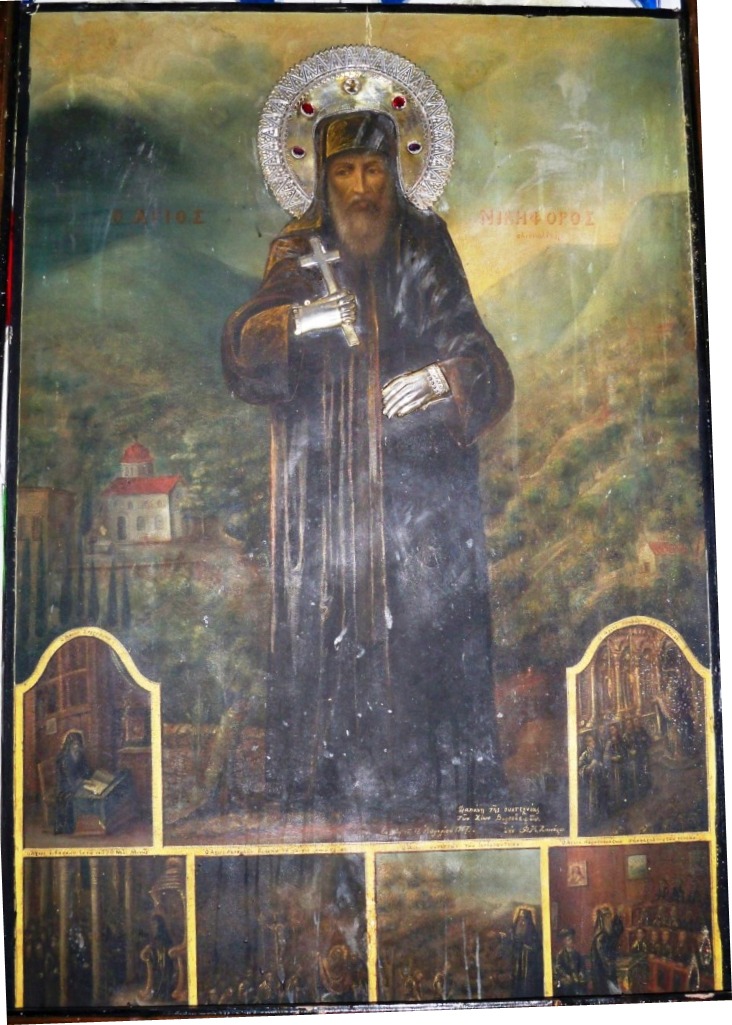
Nicephorus is painted as an Athonite-style elder in the great schema: black rason and mantle, the analavos with its crosses, and the black koukoulion; he holds a hand-cross, and sometimes a scroll or an open book — the natural attribute of a hymnographer and compiler. His distinctive iconographic setting is the landscape of Chios: the hills of the hermitage at Resta, the church of Saint George or of Saint Paraskeve, and the domes of Nea Moni. Vita icons show, in the border scenes, the elder writing at his desk, the reception and preparation of the candidates for martyrdom, and the martyrdoms themselves.
The stored image is the first icon painted of the saint, in 1907, of Chian workmanship: the elder stands full-length in the schema against the hills, holding a silver-mounted hand-cross, with a silver repoussé halo, the inscription Ο ΑΓΙΟΣ ΝΙΚΗΦΟΡΟΣ across the ground, the painter's signature and the date visible at the lower right, and six narrative scenes in panels along the bottom — among them the saint writing at his desk, and the confessions and executions of his martyr-disciples.
Disputed questions
- The date of his repose and the date of his feast. He is commemorated on May 1, but the sources place his death in the summer of 1821, and none of them gives May 1 as the day. The feast is best understood as fixed by association: May 1 is the day of his disciple Acacius and the joint feast of the three new martyrs he formed, and his own memory was attached to theirs. A few Chian sources give other days.
- The year 1821. "Probably the summer of 1821" is as far as the evidence goes; the confusion of that year and the destruction of the island's records in 1822 make certainty impossible, and some accounts give 1820 or 1821 indifferently.
- His authorship. The New Leimonarion is a joint work of Macarius of Corinth, Nicephorus and Athanasius Parios, and the attribution of particular lives and services within it is not always settled; individual services long ascribed to Nicephorus are occasionally reassigned in modern scholarship.
- Not to be confused with Nicephorus the Confessor, Patriarch of Constantinople (†828), with Nicephorus of Antioch, or with the several later Chian saints and elders — among them Saint Nicephorus the Leper (†1964), a different man of the same island.