
Ninety-nine Fathers of Crete
The Ninety-nine Holy Fathers who lived in asceticism on the Island of Crete
Venerable
Commemorated 7 October
The Ninety-nine Holy Fathers were ascetics of the island of Crete, commemorated together on October 7. The synaxarion transmits no date and no names beyond their number; the tradition of Crete makes their chief and elder the hermit John, a wonderworker who prayed on his knees until he could no longer walk upright, and who was shot with an arrow by a hunter who took the crawling figure for a beast. The company, bound by their vow to one life, are said to have died with him — the ninety-eight following their elder in death on the same day. Their memory is kept with devotion on Crete, where the caves and gorges of their struggle are venerated to this day.
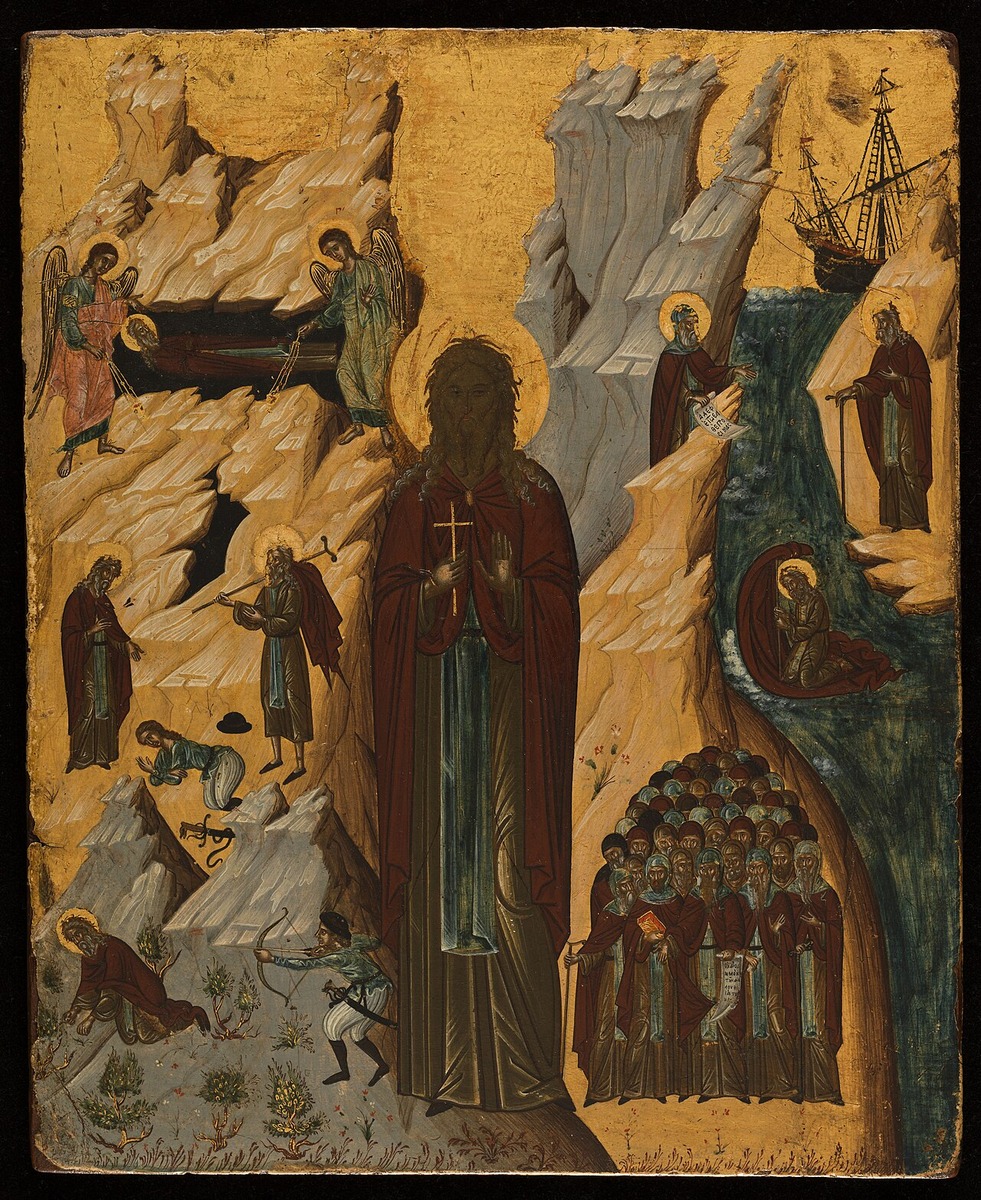

The Constantinople synaxarion for October 7 records the company in one line: "The holy ninety-nine fathers who lived in asceticism on the island of Crete were perfected in peace." No date, no place within the island, and no names are transmitted there; the OCA life states plainly that it is not known when these ascetics lived.
What the calendar leaves bare, the living tradition of Crete fills. The most prominent of the company was called John, known as a wonderworker, the elder of the brotherhood; the fathers — the traditions bring them to Crete from abroad, and the island's lore gathers them at the cave of Azogires in the south-west and in the gorges of Akrotiri in the north — lived in common obedience under a common rule, vowed to one another in one life. John's asceticism took a singular form: he knelt so long and so constantly in prayer that he lost the power to walk, and moved about on his knees. A hunter in the woods, seeing a figure creeping through the brush, took it for a wild animal and loosed an arrow, and so the elder was slain unwitting. The tradition adds that the other ninety-eight fathers died on that same day, the bond of their vow holding to the end — a company that had lived as one man departing as one.
The sites of the tradition are still venerated: the cave of the Holy Fathers near Azogires above Paleochora, the hermit's cave at Marathokefala near Kissamos, and the gorge of Katholiko on Akrotiri near the monastery of Gouverneto, where the feast of the holy hermit and his company draws pilgrims each October. These local attachments are recorded here as the island's received tradition rather than as documented history.
Feast and commemoration
October 7 (church date; Old Calendar civil October 20). The commemoration stands in the Greek Menaion's synaxarion for the day and on the OCA calendar; the Russian calendar (azbyka, October 20 civil) does not list the company, a jurisdictional difference recorded here. On Crete the day is kept with local solemnity, notably in the pilgrimage at the monastery of Gouverneto on Akrotiri. The day's proper service belongs to Sergius and Bacchus, and no proper hymns for the fathers are appointed in the received Menaion.
Hymns
Troparion — Tone 4 (from the common of monastic fathers)
O God of our fathers, who dealest with us ever according to Thine own gentleness, take not Thy mercy from us, but by their entreaties govern our life in peace.
Original translation from the Greek
Iconography
The company is painted in the Cretan manner as a throng of monastic fathers gathered about their elder: John the Hermit stands in schema with cross in hand, and around him the vita scenes — the angels at the cave, the kneeling elder, the hunter loosing his arrow, and the assembled company of the fathers. The stored image is a seventeenth-century Cretan-school icon of Saint John the Hermit with scenes of his life (Musée des Beaux-Arts de la Ville de Paris, Petit Palais, PPP4883), in which both the arrow scene and the gathered company of the fathers are depicted — the fullest pre-modern image of the tradition this entry records.
Disputed questions
- Venerables or martyrs? The Greek synaxarion counts the fathers among the hosioi and says they were "perfected in peace"; the OCA calendar styles them "99 Martyred Fathers of Crete," reflecting the arrow-death of their elder. The classification here follows the Greek books (venerable), with the OCA styling recorded.
- Date. No century is transmitted; Cretan traditions place the company variously, and the entry's record therefore carries no century (the entry indexes under the unknown century).
- John the Hermit. The elder of the company is venerated on Crete in his own right (Ἅγιος Ἰωάννης ὁ Ἐρημίτης, "Saint John the Hermit"), with churches, a famous cave, and Cretan-school icons of his own. If a separate entry for him is warranted by a distinct feast with proper hymns, this group file should link to it; pending that decision his story is told here, where the calendars of this day place him.