
Niphon II of Constantinople
Our Father among the Saints Niphon II, Archbishop of Constantinople, New Rome, and Ecumenical Patriarch
Patriarch · Bishop · Venerable · b. c. 1435–1440, in the Morea — d. 11 August 1508, the Monastery of Dionysiou on Mount Athos
Commemorated 11 August — Repose at the Monastery of Dionysiou on Mount Athos
Niphon II (born Nicholas in the Morea, c. 1435–40; †11 August 1508) was three times elected Ecumenical Patriarch in the first generation of the Church under Ottoman rule, and is the one patriarch of that century whom the Church venerates as a saint. A monk from Epidauros and then a copyist of manuscripts on Mount Athos, he became Metropolitan of Thessalonica and then Patriarch (1486–88, 1497–98, and again by election in 1502, which he declined); between the tenures he was deposed, imprisoned, and freed at the intercession of Radu the Great of Wallachia, whose Church he reorganised from 1503 to 1505 — giving the Romanian lands the metropolitan and diocesan structure they kept for centuries — until he rebuked the prince over an uncanonical marriage and was driven out. He returned to Athos and hid himself, concealing his patriarchal rank and serving as a common labourer at the Monastery of Dionysiou, where he was recognised only by revelation, and where he died. He was glorified in 1517, nine years after his repose — one of the swiftest canonisations in Orthodox history — at the instance of his spiritual son Neagoe Basarab.
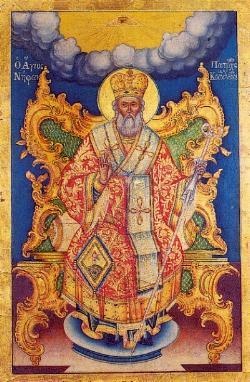

Nicholas of the Morea
He was born Nicholas, of Greek parents, in the Peloponnese — the Morea — about 1435–1440, that is, in the last years of the Byzantine despotate and around the fall of Constantinople. Little is transmitted of his family; the Life written by Gabriel, Protos of Athos, says that his father was of good birth and that the son was given letters early.
He was tonsured at Epidauros under an elder named Antony, and remained with him until the elder's death. He then went to the Holy Mountain, where he lived first at Vatopedi, and where he supported himself and served the community by the copying of manuscripts — a detail worth keeping, because it places him among the men who carried Greek letters through the first Ottoman generation. He was ordained, and in time his gifts made him impossible to hide.
Thessalonica and the patriarchal throne
He was called from the Mountain to be Metropolitan of Thessalonica, the second city of the Greek world and the second see of the patriarchate. From Thessalonica he was elected Ecumenical Patriarch in late 1486.
The patriarchate he entered was an office of terrible instability. Under the Ottoman system the patriarch held a civil as well as an ecclesiastical position, confirmed by berat from the Sultan and subject to deposition by intrigue, by the purchase of the office by a rival, or by the tribute the Porte increasingly exacted at each accession; between 1450 and 1550 the throne changed hands more than twenty times, several men holding it two or three times. It was also the period in which the princes of Wallachia and Moldavia — the only Orthodox rulers left with money and a degree of freedom — began to appear as patrons and, inevitably, as influences in patriarchal elections. Niphon's own first election owed something to the support of Vlad the Monk of Wallachia, and his later career was bound to that country throughout.
He held the throne from late 1486 to early 1488, and again from 1497 to 1498. He was elected a third time in the spring of 1502 and refused the office. Between and after these tenures he was deposed, and at one point imprisoned — by the tradition, in Adrianople.
Wallachia
He was released and given refuge through the intervention of Radu IV the Great, prince of Wallachia, who brought him to his country. From about 1503 to 1505 Niphon was the de facto head of the Church of Wallachia, and used the years to do what no one else was then in a position to do: he gave the Romanian Church a canonical organisation. He held a synod at Târgovişte, established the metropolitan see on a regular footing and set under it the two bishoprics of Râmnic and Buzău, regulated the clergy, and enforced the canons on marriage and on ordination. The structure he laid down outlasted every prince of the age.
Enforcing the canons is what ended it. Niphon forbade the marriage of a Moldavian boyar who had left a living wife, and — in the sharper telling of the Life — rebuked Radu himself for allowing it and for the marriage of the prince's own sister into the same irregular union. The prince, who had rescued him, now expelled him. Niphon left Wallachia under a rebuke of his own, and the country's later memory of the quarrel was that the saint had been in the right and that the prince's house suffered for it.
The hidden patriarch of Dionysiou
He returned to the Holy Mountain, and there did the thing for which the monks of Athos remember him above all his offices. He went first to Vatopedi and then to the monastery of St John the Forerunner — that is, Dionysiou — and presented himself as an ordinary monk, saying nothing of his rank. He was given the lowest work of the house: by the tradition, the care of the mules and the fetching of wood. He kept the deception for a considerable time, an ex-patriarch of Constantinople standing in the last place in the refectory.
The Life says he was discovered by a revelation granted to the abbot, and that when the truth was known the whole brotherhood went out along the road to meet him as he came back from the forest with a load of firewood, and greeted him as Patriarch. He accepted the honour without altering his life: he went on with the same obediences and the same place among the brethren until his death, on 11 August 1508, at about seventy years of age.
Glorification, relics, and Neagoe Basarab
Neagoe Basarab, who became prince of Wallachia in 1512, had known Niphon in his youth and counted him his spiritual father — the Teachings of Neagoe Basarab to his son Theodosius, the first great work of Romanian literature, is steeped in him. In 1517 Neagoe procured the saint's glorification, nine years after his repose, and had the relics brought with great solemnity to Curtea de Argeş for the consecration of the new monastery church there. The Romanian tradition records that the relics were carried to the tomb of Radu the Great and that the dead prince's excommunication was thereby loosed — the reconciliation of the two men being, in Wallachian memory, the point of the whole ceremony.
Neagoe afterwards returned the greater part of the relics to Dionysiou, which had been the saint's last home and which he endowed richly; a portion — by the usual account the head and a hand — remained in Wallachia, and relics of St Niphon are venerated at Curtea de Argeş to this day. At Dionysiou the relic is kept in a shrine and there is a chapel under his name; his feast is one of the monastery's own.
Feast and commemoration
August 11 (church date; New Calendar civil August 11, Old Calendar civil August 24), the day of his repose, within the afterfeast of the Transfiguration and the Dormition Fast (August 1–14).
He is kept with a full office at Dionysiou, where his relic and his chapel are, and throughout the Holy Mountain; in the Romanian Church, where he is one of the most honoured of the non-Romanian saints and is titular of churches, the feast is a considerable one, and Curtea de Argeş keeps it as a patronal day; in the Greek calendars generally; and in the Orthodox Church in America's synaxarion. A second commemoration of the translation of his relics to Wallachia in 1517 is kept in some Romanian usage in mid-August, but the principal feast is the day of repose.
Hymns
Troparion — Tone 4 (common of a hierarch, adapted)
Thou wast a rule of faith to the Church in a time of servitude, O hierarch Niphon, and having thrice been called to the throne of the New Rome, thou didst prefer the last place in a monastery to the first among men; wherefore, having ordered the Church in the land of the Romanians and hidden thy dignity beneath the labour of thy hands, thou dost intercede with Christ our God that our souls may be saved.
Original translation from the Greek
Iconography
Niphon is painted as a hierarch of the highest rank and, characteristically for a post-Byzantine patriarch-saint, enthroned: he sits frontally on a high-backed throne in the full pontifical vesture — the sakkos of figured brocade, the crossed omophorion, the epigonation, and (in the later icons) the mitre in the form the Ottoman-period Church had adopted — blessing with the right hand and holding the Gospel-book or a scroll in the left. He is an old man, with a long white beard divided at the point. The inscription is Ο ΑΓΙΟΣ ΝΗΦΩΝ ΠΑΤΡΙΑΡΧΗΣ ΚΩΝΣΤΑΝΤΙΝΟΥΠΟΛΕΩΣ. Romanian icons often set beside him a model of the church of Curtea de Argeş, or show him with Neagoe Basarab kneeling as donor; Athonite ones may show him instead in the monastic mantle, carrying firewood, the episode of his concealment at Dionysiou.
The stored image is a Greek panel icon of the enthroned patriarch, inscribed Ο ΑΓΙΟС ΝΗΦΩΝ at the left and ΠΑΤΡΙΑΡΧΗΣ Κ(ΩΝΣΤΑΝΤΙΝΟΥΠΟ)ΛΕΩΣ at the right — the identity is therefore secure from the inscription itself. It shows him seated on an elaborately carved and gilded throne beneath a band of cloud, in a red-and-gold brocade sakkos with the omophorion and mitre, blessing. The Wikimedia Commons file page gives an unhelpfully wide date, "18th to 20th century," and names no author; the ornamental idiom — the rococo gilt throne, the painted cloud-band, the dense brocade — is that of Greek and Athonite panel painting of roughly 1750–1850 and is not the manner of any twentieth-century revival, and the image is stored on that basis as a pre-1900 work. The dating rests on style rather than on the file page, and is flagged for the coordinator.
Disputed questions
- The year of death, and a confusion in the English calendars. The date 11 August 1508 is fixed by the Athonite tradition, the Life by Gabriel the Protos, the Romanian record of the 1517 glorification, and the Wikidata entry verified for this collection. The English Lives of the Saints of the Orthodox Church in America gives instead "11 August 1460, at ninety years of age," which cannot be reconciled with a patriarchate beginning in 1486 or with the reign of Radu the Great (1495–1508); the OCA notice is nevertheless plainly describing this saint, since it names Thessalonica, the patriarchate, the primacy in Wallachia, Vatopedi, and "the monastery of St John the Forerunner," which is Dionysiou. The 1460 date should be treated as a transmission error.
- How many patriarchates. The standard reckoning is three elections — 1486–88, 1497–98, and 1502 — with the third declined, so that he in fact reigned twice. Some lists count him as patriarch three times; the difference is one of bookkeeping about 1502 and not of fact.
- The circumstances of the quarrel with Radu. The Life is a hagiography written under Neagoe Basarab's patronage and is not disinterested about the reputations of the princes. That Niphon left Wallachia in 1505 over a canonical dispute concerning a marriage is common to all accounts; the details of whose marriage, and how far the prince was personally implicated, differ between the Life and the later Romanian chronicles.
- Not to be confused with Niphon of Athos of Kavsokalyvia (June 14, fourteenth century), the hesychast of the Holy Mountain, nor with Niphon of Constantia in Cyprus (December 23), nor with the two later patriarchs of the same name. The confusion with the Kavsokalyvite is the one to guard against, both being Athonite saints named Niphon.