
Pamphilus of Caesarea and his Companions
The Holy Martyrs Pamphilus the Presbyter, Valens the Deacon, Paul, and those with them, of Caesarea in Palestine
Martyr · Priest · Deacon · b. c. 240, at Berytus (Beirut) in Phoenicia — d. 16 February 309 (some reckon 310), at Caesarea in Palestine
Commemorated 16 February — Martyrdom at Caesarea in Palestine under Maximinus
Pamphilus (c. 240 – 309) was the learned priest of Caesarea in Palestine — the keeper and restorer of the great library that Origen had founded there, the teacher and dearest friend of the historian Eusebius (who out of love took the name "Eusebius Pamphili"), and, with him, author of an Apology for Origen composed from prison. Arrested in the persecution of Maximinus and held two years in chains, he was beheaded at Caesarea on February 16 together with a company of eleven: Valens the aged deacon of Jerusalem and Paul of Jamnia, five Egyptian brethren who had taken the names of the prophets — Elias, Jeremiah, Isaiah, Samuel and Daniel — and the youths and confessors Porphyrius, Seleucus, Theodulus and Julian, who were drawn into their crown for honouring the martyrs' bodies. Their acts are told by an eye-witness, Eusebius himself, in his Martyrs of Palestine.

Origins and the school of Caesarea
Pamphilus was born about the middle of the third century at Berytus (Beirut) in Phoenicia, of a rich and honourable family, and gave himself first to the studies for which that city was famous. Turning wholly to Christ, he distributed his wealth to the poor and went to Alexandria, where he studied under Pierius, the head of the catechetical school there and a devoted heir of Origen's learning. From Pierius Pamphilus received both the discipline of scriptural scholarship and the lifelong love of Origen's writings that would mark all his work. He settled at last at Caesarea Maritima, the seat of the Roman governor of Palestine and the city where Origen had spent his later years, and there he was ordained presbyter of the church.
The library of Origen and the labour of the Scriptures
At Caesarea Pamphilus became "the chief among the biblical scholars of his generation" (as Eusebius's memory of him runs), and the centre of his life's work was the library. Origen, dwelling at Caesarea after leaving Alexandria, had gathered there a collection of Christian books unequalled in the East, and had laboured over the Hexapla — the six-columned edition of the Old Testament in Hebrew and the Greek versions side by side. Pamphilus made himself the guardian, the restorer, and the enlarger of this treasure: he copied and corrected manuscripts with his own hand, maintained a scriptorium of scribes, and lent and gave away books freely to any who would study. Copies of the Scriptures "corrected by the hand of Pamphilus" were prized for centuries — several surviving biblical manuscripts carry colophons noting that they were checked against Pamphilus's own emended text of the Caesarean library. Through this work the text of the Greek Old Testament and much of Origen's corpus were transmitted to later ages; it is not too much to say that a great part of what survives of early Christian learning passed through Pamphilus's hands.
Eusebius Pamphili
The bond for which Pamphilus is best remembered outside the calendar is his friendship with Eusebius, the future bishop of Caesarea and father of Church history. Eusebius was Pamphilus's pupil, fellow-labourer in the library, and so inseparable a companion that he called himself "Eusebius Pamphili" — Eusebius, Pamphilus's own — carrying the martyr's name as a son carries a father's. From prison the two together composed an Apology for Origen in five books, defending their master's memory against the charges already gathering against him; Eusebius added a sixth book after Pamphilus's death. Eusebius also wrote a Life of Pamphilus in three books — now lost, but drawn on in his own Ecclesiastical History and Martyrs of Palestine — and it is to this eye-witness devotion that we owe almost everything we know of the martyr and his companions. Pamphilus is thus doubly a father of Christian letters: in his own scholarship, and in the historian he formed.
Arrest and imprisonment
The persecution begun under Diocletian in 303 fell with special violence on Palestine under the Caesars Galerius and then Maximinus (Maximinus Daia), and its instrument at Caesarea was the governor Urbanus and, after him, Firmilianus. About November 307 Pamphilus was seized, brought before Urbanus, and — refusing to sacrifice — was cruelly tortured, his sides torn, and then committed to prison. There he remained some two years, and the prison became a kind of school: he continued to teach, to encourage the confessors, and, with Eusebius, to write. The long imprisonment only deepened the veneration in which the church of Caesarea held him.
Martyrdom
In the seventh year of the persecution, on February 16, Pamphilus was at last brought out with two who shared his confession and his death. Eusebius, who was present, names them and those who followed:
- Pamphilus, presbyter of Caesarea, the "ornament" of that church;
- Valens, deacon of the church of Aelia (Jerusalem), a venerable old man grey with age and so versed in the Scriptures that he could recite them from memory;
- Paul, of the city of Jamnia, fervent in spirit, who had already borne the cautery of the confessors in an earlier trial.
These three, after a last refusal to sacrifice, were sentenced to be beheaded. While sentence was being carried out, there came to the gate of the city five Egyptian brethren who had escorted a company of confessors condemned to the mines of Cilicia and were returning home. Stopped and questioned, they confessed Christ and were seized. When Firmilianus demanded the name of their leader, the man — refusing his Egyptian name — answered with the name of a prophet, and so his companions after him; and thus the record keeps them as Elias, Jeremiah, Isaiah, Samuel and Daniel, for, Eusebius says, they had put off the names their parents gave them, taken perhaps from the idols, and put on the names of the prophets of God. They too were beheaded.
Then the martyrdom drew in others by the very act of honouring it:
- Porphyrius, a youth not yet eighteen, the beloved servant and disciple of Pamphilus, skilled in letters, who — hearing the sentence — came forward and asked for the bodies of the slain that they might be buried. For this he was seized, torn, and, when he would not yield, burned alive over a slow fire, crowned before his master;
- Seleucus, a Cappadocian, once a distinguished soldier who had been scourged and discharged for his confession, who witnessed Porphyrius's end and ran to tell Pamphilus, and who, saluting the martyrs, was at once taken and beheaded by the governor's command;
- Theodulus, a grave and pious old man of the very household of Firmilianus the governor, honoured by all, who embraced one of the martyrs as he was led past; brought before his master, he was condemned to the death of the Lord and crucified;
- Julian, another Cappadocian, newly come to the city, who kissed the bodies of the martyrs where they lay; caught in the act, he was led away and burned upon a slow fire.
The bodies were left unburied, exposed by day and guarded by night, that beasts and birds might devour them; but — the tradition, following Eusebius, records — for days no creature touched them, until at last the Christians were suffered to take them and lay them to rest. Twelve in all, they are kept together on the day of Pamphilus their head.
Veneration and legacy
Pamphilus was venerated at once and everywhere his name was known. His pupil Eusebius made his memory a lasting monument in the Martyrs of Palestine and the Ecclesiastical History, and carried his name as his own to the end of his life. Jerome, who used the Caesarean library and prized the manuscripts corrected by Pamphilus, praised his humility and his boundless generosity with books, and reckoned him among the illustrious men of the Church. The Greek Menaion and the Synaxarion keep him on February 16 as the leader of the company of Caesarea, and the Roman martyrology commemorates him on June 1. Above the particular details of his passion, he is remembered as the type of the scholar-martyr: the man who spent his life over the sacred text and sealed it with his blood.
Feast and commemoration
The company is kept on February 16 (church date; Old Calendar civil March 1), led by Pamphilus the presbyter; the Greek Menaion styles the day "Pamphilus and those with him," and the Synaxarion gives the roll of the twelve. The date falls within the Lenten season most years and, in the year 2026, on the very Sunday of Orthodoxy — a fitting coincidence for the martyr who gave his life to the guarding of the Church's books. The Latin West keeps Pamphilus (with Porphyrius) on June 1. Some reckonings, following Eusebius's own year-count in the Martyrs of Palestine, date the martyrdom to 310 rather than 309; the day, February 16, is constant.
Hymns
Troparion — Tone 4
Thy Martyrs, O Lord, in their contest received crowns of incorruption from thee our God; for possessed of thy might, they cast down the tyrants and broke also the feeble insolence of demons. By their prayers, O Christ our God, save our souls.
Original translation from the Greek
Kontakion — Tone 2
Having loved the divine will of Christ, thou didst keep his law with a ready heart, and shining in the contest, O all-blessed Pamphilus, thou didst prevail together with thy fellow-athletes; with whom cease not to intercede on behalf of us all.
Original translation from the Greek
Iconography
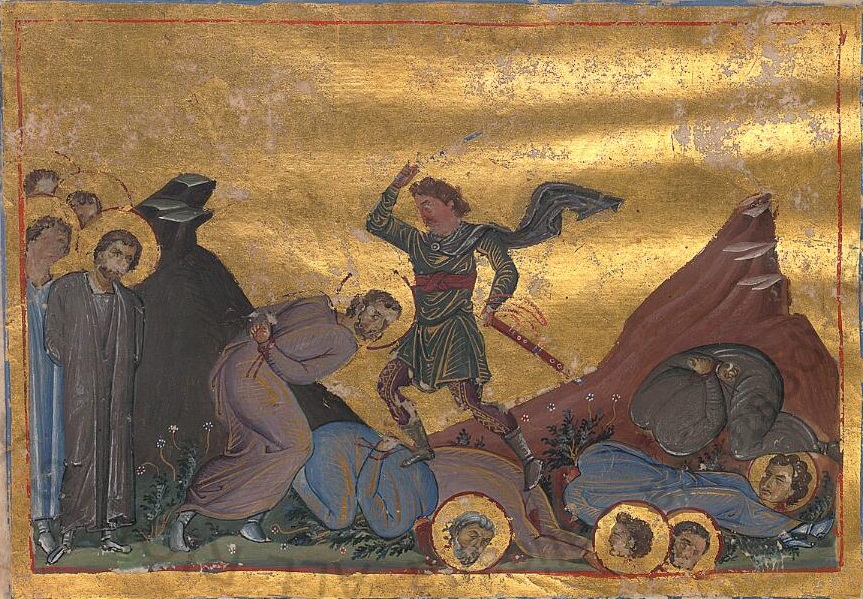
Pamphilus is depicted as a priest — in the phelonion, without the omophorion of a bishop, often holding a Gospel-book or a scroll, in token of his labour over the Scriptures — a middle-aged or elder figure with a dark, pointed beard. Because his company suffered together, the narrative type shows the martyrdom of the twelve: the several deaths — the beheadings, the crucifixion of Theodulus, the slow fires of Porphyrius and Julian — gathered into one scene, with Pamphilus at its head.
The stored primary image is the miniature for February 16 from the Menologion of Basil II (Constantinople, c. 985; Vatican, Vat. gr. 1613), showing Pamphilus the presbyter (source, public domain, pd-old-work).
A second stored image is an Athonite fresco (1547) of the Monastery of Dionysiou, depicting the martyrdom of Pamphilus and his companions — the company of Caesarea suffering together (source, public domain, pd-old-work).