
Paphnutius of Borovsk
Our Venerable Father Paphnutius, Abbot of Borovsk
Venerable · b. 1394, at Kudinovo near Borovsk — d. 1 May 1477
Commemorated 1 May — Repose at the Borovsk monastery
Paphnutius (1394–1477) is one of the great abbots of the northern Russian revival that descended from Saint Sergius of Radonezh. Grandson of a baptised Tatar tax-collector, he was tonsured at twenty in the Protection monastery on the Vysokoye near Borovsk, served there some thirty years and became its abbot; then at fifty-one, after an illness he had thought mortal, he left his own house and began again in the forest at the mouth of the Isterma on the Protva, founding the monastery of the Nativity of the Theotokos that has borne his name ever since. He was a builder, a strict ascetic who ate nothing at all on Mondays and Fridays, and a spiritual father of the first rank: it was Paphnutius who tonsured the young John Sanin and gave him the name Joseph — Saint Joseph of Volokolamsk. He reposed on May 1, 1477, and was glorified in 1531.

Origins and early life
He was born in 1394 in the village of Kudinovo, about three miles from Borovsk in the Serpukhov lands, and was baptised Parthenius. His grandfather Martin had been a baskak — a Tatar collector of the Horde's tribute — who received holy baptism, and the family tradition of that conversion is preserved in the Life; his parents were John and Photina. The generation into which he was born was the generation of Sergius of Radonezh's disciples, when monastic foundations were multiplying through the forests north and west of Moscow, and the boy grew up with that movement.
Thirty years in the Vysokoye monastery
At the age of twenty, in 1414, Parthenius entered the Protection (Pokrov) monastery on the Vysokoye near Borovsk and was tonsured with the name Paphnutius by its abbot Marcellus, himself of the tradition of Saint Sergius. He remained there some thirty years, passing through every obedience, and was ordained priest about 1426 by Photius, Metropolitan of Kiev and All Rus; on the death of Marcellus the brethren elected him abbot, and under him the small house prospered and became known.
The Protva foundation
In 1444, at fifty-one, Paphnutius fell so gravely ill that he received the great schema and was thought to be dying; he recovered on April 23, and took the recovery as a summons to begin again. He laid down the abbacy, left the monastery he had governed for years, and with a single companion went about three miles off, to the place where the little river Isterma falls into the Protva. There he built a cell, and then a wooden church of the Nativity of the Theotokos, and a community gathered — the monastery which the Russian Church knows as the Nativity-of-the-Theotokos Paphnutius-Borovsk monastery. The wooden church was replaced in stone in his lifetime, and the great Dionysius, the leading icon-painter of the age, worked on its decoration, so that the new house became a centre of art as well as of prayer.
His personal rule was severe even by the standards of the Russian north. He ate nothing at all on Mondays and Fridays, took the plainest food on the other days, wore poor clothing, worked with the brethren at the heaviest tasks, and was the first at the church services. The Life records his charity in the famines and his fearlessness with the powerful, and notes that he was granted foreknowledge and the gift of discerning souls. His counsel was sought by princes; he interceded for the poor and for prisoners.
Joseph of Volokolamsk
Among the young men who came to him was John Sanin, of a landowning family of Volok Lamsky. Paphnutius received and tonsured him with the name Joseph, formed him for some eighteen years, and made him his successor as abbot. This is Joseph of Volokolamsk (September 9, not yet authored in this corpus), the founder of the Volokolamsk monastery, the great adversary of the heresy of the Judaisers and the head of the "possessors" party in the Russian monastic debates of the next generation. Through Joseph and through Joseph's brothers — Vassian, who became archbishop of Rostov, and Acacius, bishop of Tver — the discipline of Borovsk shaped a whole school of Russian churchmanship.
Repose and glorification
Paphnutius foreknew his end. He set the monastery in order, appointed his successor, prayed and blessed the brethren, and fell asleep in the Lord on 1 May 1477, in his eighty-third year. He was buried in his own monastery, where his relics remained and where healings were reported at his tomb. The Life was written within living memory — the Tale of the Repose of Paphnutius by his disciple Innocent, who was present at his death, and a fuller Life by Vassian Sanin, Joseph's brother — which makes his biography one of the better documented of fifteenth-century Russian sanctity. He was glorified in 1531 at a council in Moscow under Metropolitan Daniel. His monastery, sacked in the Time of Troubles and suppressed in the Soviet period, has been restored, and the commemoration of May 1 is kept there with the greater rank.
Feast and commemoration
May 1 (church date; New Calendar civil May 1, Old Calendar civil May 14) — the day of his repose. The feast is Russian and is kept on the American calendar; it is served with a proper troparion and kontakion in the Russian Menaion, and with a full service at his own monastery and in the Kaluga diocese, of which he is one of the chief patrons. He is also commemorated among the Synaxis of the Saints of Kaluga.
Hymns
Troparion — Tone 4
Having loved Christ from thy youth, O venerable one, and taken his yoke upon thee, thou didst make thy dwelling in the wilderness and there raise up a house to the Mother of God; and having gathered a flock of monks, thou wast to them a rule of fasting and a pattern of humility. O our father Paphnutius, entreat Christ God that our souls may be saved.
Original translation from the Slavonic
Kontakion — Tone 8 (common of a venerable father)
Having from childhood offered thyself wholly to God, and despising the ease of the flesh, thou wast shown forth as a lamp of the desert and a father of monks; wherefore we cry to thee: Rejoice, O Paphnutius, unshaken pillar of the monastic life.
Original translation from the Slavonic
Iconography
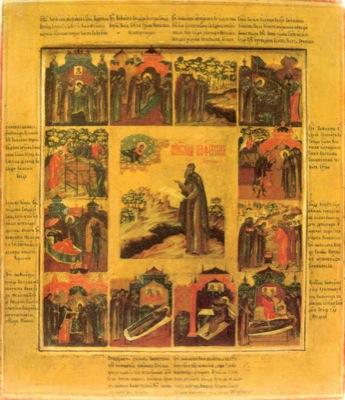
Paphnutius is painted as an aged Russian monk, long grey beard, in the dark mantle and koukoulion of the schema, one hand raised in blessing or in prayer and the other holding a scroll — most often inscribed with a word of monastic counsel — and frequently with a model or a view of his monastery on the Protva at his side or beneath his feet, the mark of a founder. He appears in the ranks of the Russian venerables and in the great compositions of the Saints of Kaluga and of the Saints of All Russia. Vita icons (icons with the life), in which scenes from the biography surround the central figure, were made for him from the seventeenth century onward and are his most characteristic type; the scenes shown are usually the tonsure, the ordination by Metropolitan Photius, the arrival at the Isterma, the building of the church, the tonsure of Joseph, the repose, and the healings at the tomb.
The stored image is such a vita icon, Russian, of the first half of the nineteenth century, now in the Central Andrei Rublev Museum of Early Russian Culture and Art in Moscow: the saint stands at the centre in the schema before a landscape, with twelve narrative scenes in the borders and long Slavonic captions filling the margins. The photograph available is of low resolution, so that the border inscriptions cannot be read; the identification rests on the museum's own description of the panel.
Disputed questions
- The place-name. Russian sources say "Borovsk" and older English calendars "Borov"; they are the same town in the Kaluga region. The monastery is variously called the Paphnutius-Borovsk, the Borovsk Nativity, or the Pafnutyev monastery.
- His teacher's lineage. The Life makes Marcellus, and thus Paphnutius, a spiritual descendant of Saint Sergius of Radonezh; some notices compress this into calling Paphnutius himself "a disciple of Saint Sergius," which is impossible chronologically — Sergius died in 1392, two years before Paphnutius was born. The relation is one of tradition, not of acquaintance.
- Not to be confused with the Egyptian bishop and confessor Paphnutius of the Council of Nicaea, with the hieromartyr Paphnutius, or with Paphnutius the Recluse of the Kiev Caves, all of whom the calendar keeps on other days.