
Paramon and the 370 Martyrs of Bithynia
The Holy Martyr Paramon and the Three Hundred and Seventy Martyrs with him
Martyr · d. c. 250
Commemorated 29 November — Martyrdom in Bithynia under Decius
Paramon and the 370 Martyrs of Bithynia suffered around the year 250, in the persecution of the emperor Decius. According to the tradition, the governor of the Eastern provinces, Aquilinus, had imprisoned a great company of some three hundred and seventy Christians and led them out to sacrifice at a pagan shrine by the warm springs of Bithynia. A local man named Paramon, watching the confessors driven to the altar, cried out aloud against the governor and confessed the one true God. He was seized and put to death with lances, and the whole company of 370 was beheaded on the same day. They are commemorated together on November 29.
_-_%D0%B8%D0%BA%D0%BE%D0%BD%D0%B0_03292_%D0%9F%D0%B0%D1%80%D0%B0%D0%BC%D0%BE%D0%BD.png)
The persecution of Decius
The martyrdom belongs to the general persecution ordered by the emperor Decius (reigned 249–251), whose edict of 250 required all citizens of the empire to offer sacrifice to the gods and obtain a certificate of having done so. It was the first empire-wide and systematic assault on the Church, and it filled the prisons of every province with confessors. The Bithynian account is preserved in the Byzantine synaxaria and menaia, and its details, while sparse, are consistent across the tradition.
The 370 confessors
The governor named in the sources — Aquilinus in the Greek notices, Aquianus in some later retellings — is styled the ruler of the Eastern regions. He is said to have come to a place of hot springs in Bithynia, sacred to the pagan gods and frequented for their supposed healing power. There he learned that a large body of Christians, three hundred and seventy in number, were being held for refusing the imperial sacrifice. He had them brought out and pressed them, by threats and by torture, to abandon Christ and worship the idols; when they held firm, he condemned the entire company to death by the sword.
Paramon
Paramon was an inhabitant of the district, a layman with no office in the Church. As the 370 were being led past a temple to be sacrificed — the shrine is identified in part of the tradition with a temple of Isis, though the notices vary and several simply speak of the idol-altar by the springs — Paramon saw the multitude driven to their death and was seized with holy zeal. He denounced the governor openly for his cruelty and declared himself, then and there, a true servant of Christ, offering himself of his own accord to share their lot. For this confession he was arrested at once. The synaxarion relates that his tormentors ran him through with lances — the tradition speaks of his body pierced many times over, so that later writers imagined a wound for each of the martyrs he had joined. The 370 were beheaded, and Paramon with them, on the twenty-ninth of November.
Feast and commemoration
November 29 (church date; Old Calendar civil December 12), kept universally in the Byzantine rite, within the Nativity Fast. In the Greek Menaion the day is Paramon's: he receives a proper service with stichera and a full canon (acrostic, by Joseph the Hymnographer), while the 370 are named with him in the synaxarion. On the same day the calendars also commemorate the martyr Philumenus of Ancyra and the venerable Acacius of Sinai. Because the martyrs form a single company glorified together, they share one entry; Paramon, the named leader with his own hymnography, stands at its head.
Hymns
Troparion — Tone 4
Thy martyr Paramon, O Lord, in his contest received the crown of incorruption from Thee our God; for possessed of Thy strength, he cast down the tyrants and broke the feeble insolence of the demons. By his intercessions, O Christ God, save our souls.
Original translation from the Greek
Kontakion — Tone 2
As a bright and unerring star thou didst appear to the world, heralding by thy radiance Christ the Sun of righteousness; and having quenched every deception, O passion-bearer Paramon, thou bestowest light upon us, praying without ceasing for us all.
Original translation from the Greek
Iconography
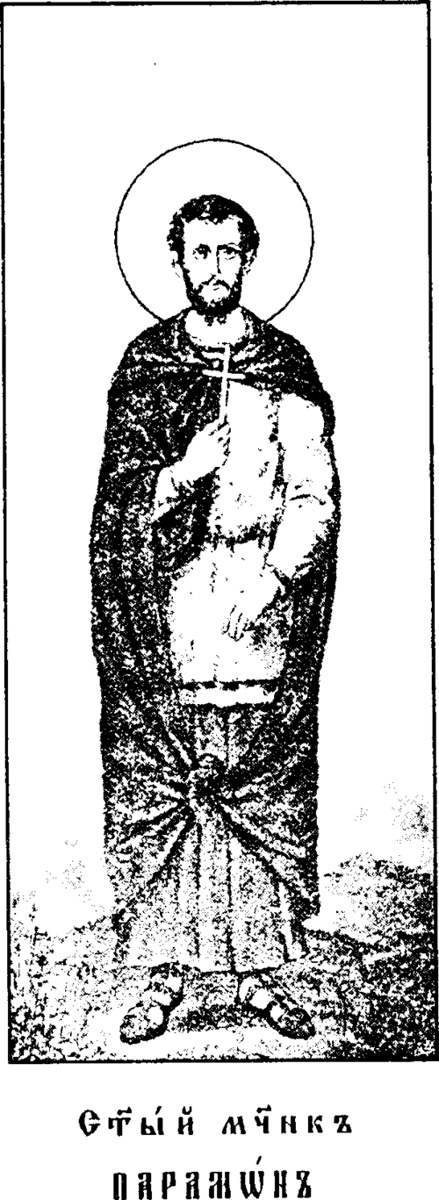
Paramon is depicted as a young or middle-aged martyr, beardless or lightly bearded, in a tunic and himation, holding the cross of martyrdom in his right hand — the standard type of a lay martyr. The company of the 370 has no fixed individual iconography; where the martyrdom is shown in full, they appear as a crowd of the condemned before the idol-shrine. The stored image is a Russian line engraving from the illustrated Lives of the Saints (1903–1911), showing Paramon standing with the martyr's cross and named in Church Slavonic; a pre-modern painted icon of the saint is still sought.