
Patapius of Thebes
Our Venerable Father Patapius of Thebes, the Wonderworker
Venerable · Wonderworker · d. 7th century
Commemorated 8 December — Repose; within the forefeast of the Conception of the Theotokos by Anna
Patapius (7th century, by the common Greek reckoning) was an Egyptian ascetic from Thebes who withdrew as a young man into the desert, and — when his renown for holiness broke his solitude — travelled to Constantinople, where he lived as a recluse in a cell by the city wall near the Blachernae church. There a gift of healing made him one of the great wonderworkers of the capital; the tradition remembers in particular a woman freed of a devouring cancer at his word. He reposed in peace and was buried in a church of Saint John the Baptist. His relics, later carried to a cave in the Geraneia mountains above Loutraki near Corinth, were found incorrupt there and remain the treasure of the monastery that bears his name. He is commemorated on December 8, within the forefeast of the Conception of the Theotokos by Anna.
.jpg)
Origins and withdrawal to the desert
Patapius (Greek Πατάπιος) was born at Thebes in Upper Egypt, of pious Christian parents, in whose faith he was raised. Coming to manhood, he weighed the transience of the world against the life of the soul and chose the second: he left Thebes for the Egyptian desert, the classic school of Christian asceticism, and there gave himself to prayer, fasting and the labour of self-conquest until he was counted among the notable ascetics of the wilderness. His aim was stillness — to be hidden and unknown — but the very holiness that stillness bred defeated it. Word of him spread, and the desert paths to his cell filled with visitors seeking counsel; to every wearied pilgrim he gave rest, hospitality, and words for the salvation of the soul.
The recluse of Constantinople
Fleeing the honour that his fame in Egypt had brought him, Patapius went to Constantinople. There he shut himself in a cell built against the city wall, near the great church of the Theotokos at Blachernae — one of the holiest shrines of the capital — hoping again for the anonymity of the crowd. Again it eluded him. The sick began to gather at his door, for God had granted him the gift of healing, and he turned none away. The synaxaria preserve the memory of a woman wasted by a cancer of the breast, whose flesh, in the stark language of the account, was being eaten by worms before she was in the grave, and whom the physicians had abandoned. She fell at the saint's feet begging to be cured. Patapius answered that if she believed without doubting she would be healed; and when she had confessed her faith in the Lord who knows all hidden things, he looked on the ravages of her disease, told her to go in peace, and at his word she was made whole. She went home glorifying God and published the miracle through the city. Other healings and wonders followed, so that Patapius became one of the wonderworkers whose memory Constantinople cherished.
Repose
After a life "adorned with virtue and miracles," in the words of his life, Patapius fell asleep in the Lord in great old age and was buried in a church dedicated to Saint John the Baptist (the Forerunner). No year is transmitted; the Byzantine tradition places him, by its most common reckoning, in the seventh century, though an older strand of the record — reflected in some reference works — sets his life as early as the fourth (see Disputed questions).
Relics and translations
The lasting fame of Patapius rests on his incorrupt relics. His body was kept at Constantinople until, according to the monastic tradition of Loutraki, it was carried westward at the time of the Ottoman conquest and hidden in a cave sanctuary high on the slopes of the Geraneia mountains, above the town of Loutraki near the Corinthian Gulf. There it lay forgotten until the early twentieth century, when the relic — found whole and incorrupt, with a lead-sealed cross and coins that fixed its antiquity — was rediscovered in the cave. A women's monastery grew up around the shrine, the Holy Monastery of Saint Patapios at Loutraki, where the saint's incorrupt body is venerated to this day and is the goal of continual pilgrimage; December 8 draws great crowds to the mountain. His incorruption and the healings reported at the shrine have kept alive his ancient reputation as a wonderworker, and he is invoked especially against cancer and grave illness.
Feast and commemoration
December 8 (church date; Old Calendar civil December 21). The day falls within the Nativity Fast and is the forefeast of the Conception of the Most Holy Theotokos by the righteous Anna (December 9); the Menaion joins Patapius's service to the forefeast propers, and the Orthros canon of the day is the forefeast canon in Tone 2. Patapius is the celebrated saint of December 8 across the Byzantine-rite calendars — Greek, Slavic and Antiochian — and is kept with a proper apolytikion, kontakion and canon. At Loutraki the feast is observed with especial solemnity as the monastery's patronal day.
Hymns
Troparion — Tone 8
In thee, O Father, was the divine image preserved with exactness; for taking up thy cross, thou didst follow after Christ, and by thy deeds thou didst teach us to despise the flesh, for it passeth away, but to care for the soul, a thing immortal. Therefore, O venerable Patapius, thy spirit rejoiceth together with the Angels.
Original translation from the Greek
Kontakion — Tone 3
Finding thy church, O holy one, to be a hospital of the spirit, the peoples come to it in haste and ask to receive the healing of their sicknesses and the loosing of the transgressions of their life; for thou, O venerable Patapius, hast been shown to be a protector of all who are in need.
Original translation from the Greek
Iconography
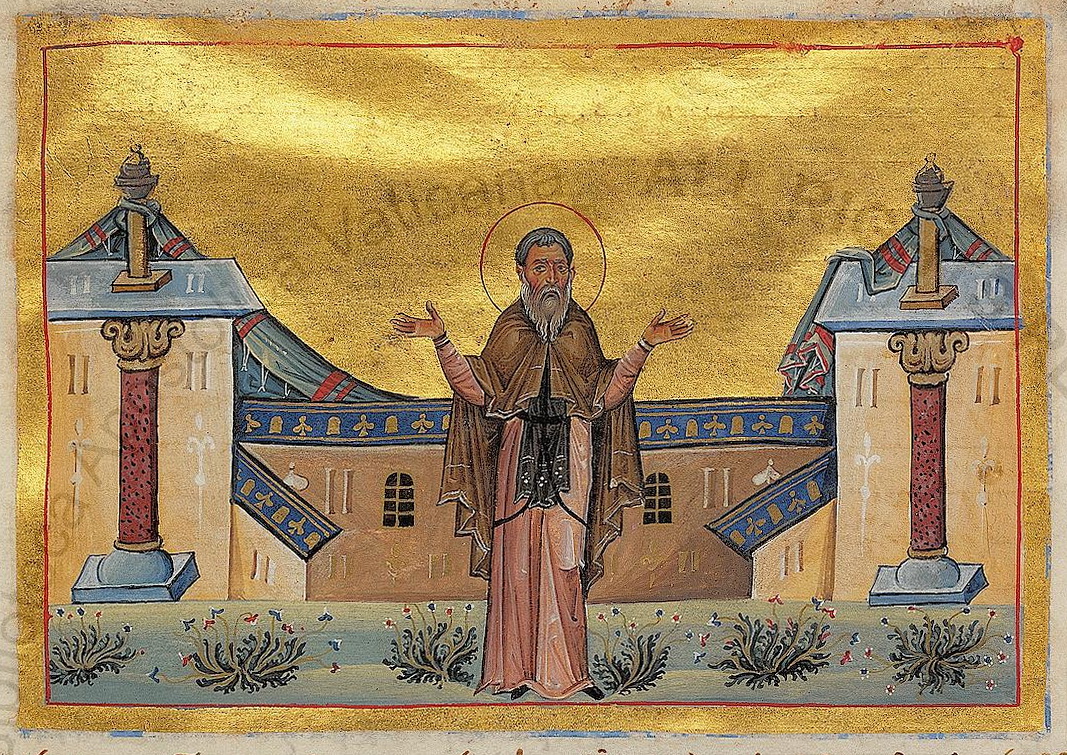
Patapius is depicted as a desert monk of great age: a long, tapering grey beard, the monastic mantle and analavos, sometimes bareheaded, sometimes cowled. The oldest surviving image is the miniature in the Menologion of Basil II (c. 1000), which shows him standing in the orans posture, arms raised in prayer, before a domed church — an allusion at once to his life of prayer and to the church-shrine of his healings. Later Greek icons of the Loutraki tradition portray him full-length in the monastic schema, often holding a scroll, and reliquary icons show his incorrupt body. The stored image is the Menologion miniature (Vatican, Vat. gr. 1613, fol. 254); a faint watermark from the Vatican Library digitisation is visible across the gold ground.
Disputed questions
- Century. The Greek liturgical tradition and the Great Synaxaristes place Patapius in the seventh century, and this collection follows that reckoning. Some reference notices, however, date him to the fourth century (the Wikidata entity assigns a birth c. 350). The sources transmit no fixed year of birth or repose; the discrepancy is recorded rather than resolved.
- Thebes. "Thebes" here is Egyptian Thebes (the Thebaid of Upper Egypt), consonant with his flight into the Egyptian desert, and not the Boeotian Thebes of Greece.