
Paul and Juliana of Ptolemais
The Holy Martyrs Paul and his sister Juliana of Ptolemais
Martyr · d. c. 273, at Ptolemais in Phoenicia
Commemorated 4 March — Martyrdom at Ptolemais under Aurelian, 17 August — Second commemoration in Greek usage
Paul and Juliana were a brother and sister martyred at Ptolemais (Akko/Acre) on the coast of Phoenicia under the emperor Aurelian (270–275), about the year 273. When the emperor came to the city, Paul openly made the sign of the Cross at the passing of the pagan procession, and was seized; his sister Juliana, seeing him tortured, cried out against the judge and confessed Christ at his side. After cruel torments — in the course of which, the tradition holds, several of the soldiers set to torture them were themselves converted by the constancy of the martyrs and put to death — Paul and Juliana were beheaded, receiving together the crown of martyrdom. They are commemorated on March 4.
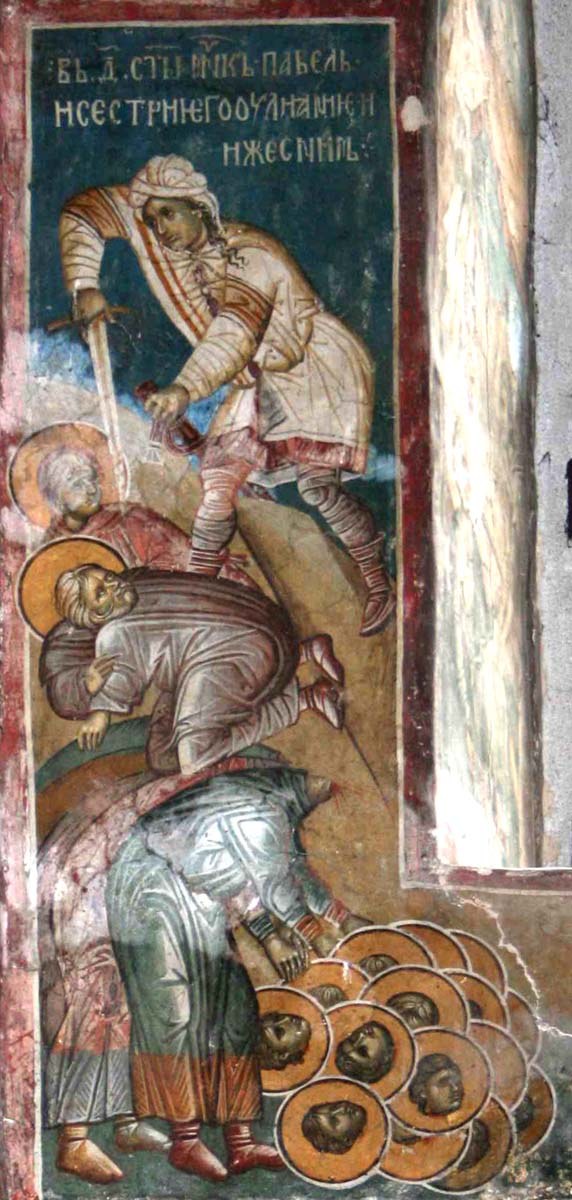

The passion of Paul and Juliana belongs to the last great wave of pagan persecution before the peace of the Church, under the emperor Aurelian. The synaxaria set the scene at Ptolemais, the ancient port of Phoenicia (the biblical Accho, later Acre), which the emperor entered in the course of his progress through the East.
As the imperial procession passed, with its sacrifices and its idols, a young man named Paul, a Christian, signed himself with the Cross — an open confession of Christ in the face of the pagan rite, and a public refusal of the idols. He was at once denounced and haled before the tribunal. His sister Juliana, learning of his arrest and seeing him subjected to torture, could not be silent: she came forward, rebuked the judge for his cruelty and injustice, and confessed herself a Christian with her brother, so that she too was seized.
Brother and sister endured a succession of savage torments together, sustaining one another in their confession. The tradition preserved in the synaxarion adds that three of the soldiers appointed to torture them — moved by the martyrs' courage and by the signs that attended their sufferings — themselves believed in Christ and were beheaded for it, joining the martyrs they had been set to destroy. At the last, Paul and Juliana, unbroken through every torture, were beheaded, and so finished their course. Their martyrdom is placed about the year 273.
Feast and commemoration
Paul and Juliana are commemorated on March 4 (church date; Old Calendar civil March 17). Theirs is a universal commemoration of the ancient synaxarion, kept in the Greek, Slavic and Antiochian calendars, and it falls almost always within the Great Fast. The companions converted at their martyrdom are commemorated with them.
Hymns
Troparion — Tone 4
Thy martyrs, O Lord, in their contest received crowns of incorruption from Thee our God; for possessing Thy strength, they cast down the tyrants and shattered the powerless insolence of demons. By their supplications, O Christ God, save our souls.
Original translation from the Greek
Iconography
Paul and Juliana are depicted together as a young man and a young woman in the dress of the martyrs, each bearing the cross of martyrdom in the hand — Paul signing himself with the Cross, the act for which he suffered, and Juliana beside him; the scene of their common beheading serves as their narrative type. The stored image is exactly this scene from the menologion fresco cycle of Visoki Dečani (Serbian, c. 1338–1348), inscribed in Church Slavonic "the holy martyr Paul and his sister Juliana and those with them": the executioner's sword falls on the kneeling martyrs while the severed, haloed heads of the company — the soldiers and companions who believed through them — are gathered below. A second 14th-century fresco of the same beheading, from the sister cycle at Gračanica (c. 1320), likewise inscribed, is stored as a variant (icons/p/paul-and-juliana-of-ptolemais-2.jpg).