
Peter and Paul of Nicaea
Our Fathers among the Saints Peter and Paul, Bishops of Nicaea
Bishop · Confessor · d. after 823 (Peter); Paul unknown
Commemorated 10 September — Joint memory of the two bishops of Nicaea
Peter and Paul (9th century and earlier) were bishops of Nicaea in Bithynia, joined in a single commemoration on September 10. Peter is a documented confessor of the second iconoclast persecution: he suffered for the holy icons under the emperor Leo the Armenian, and four letters addressed to him by Theodore the Studite survive from the years 816–823; he reposed no earlier than 823. Of Paul nothing is recorded — his name first appears beside Peter's in an eleventh-century Greek prologue. The pairing is a fixture of the calendar rather than a companionship in life: two holy bishops of one see, remembered together.
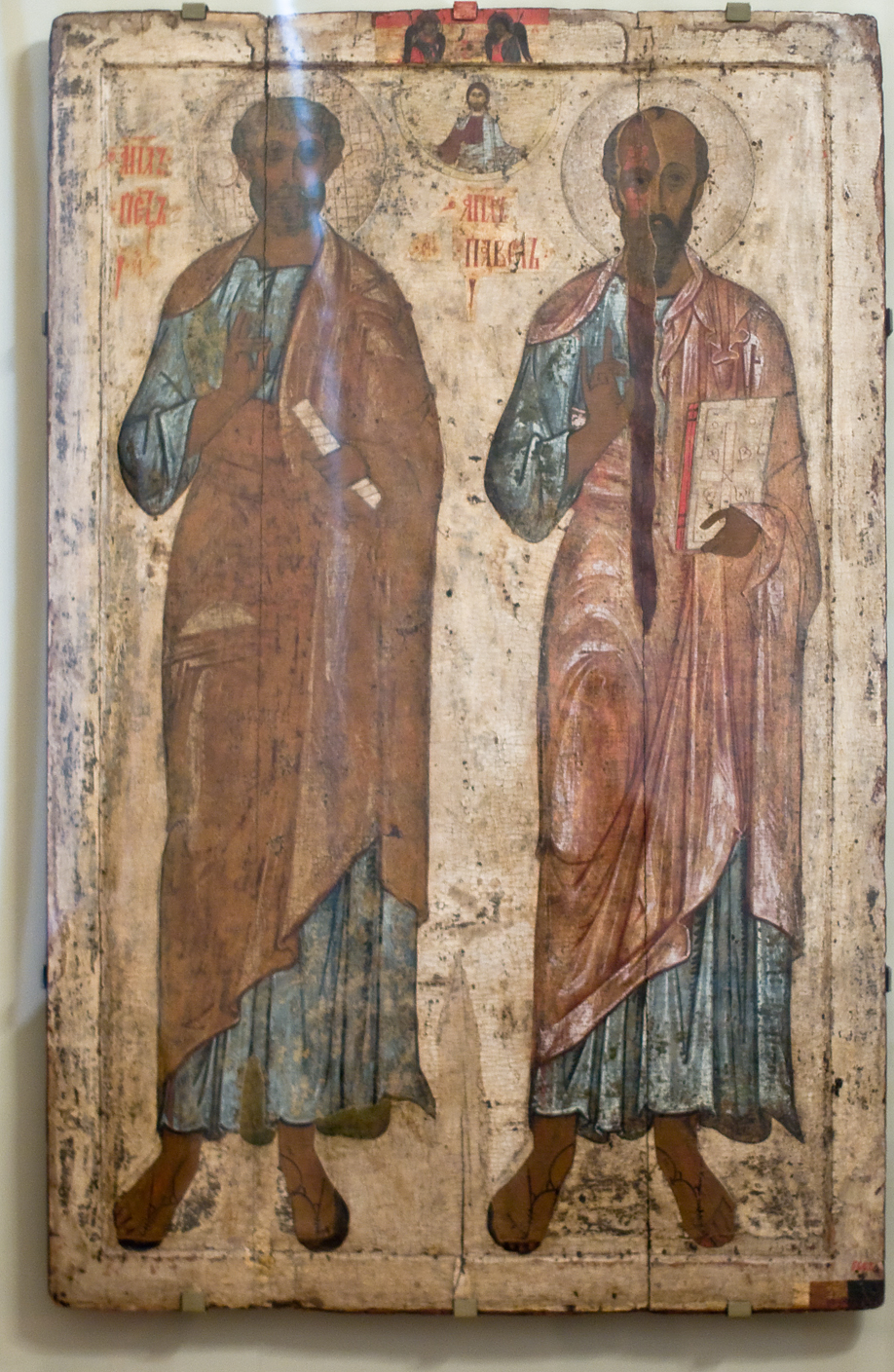

Peter, bishop of Nicaea, belongs to the generation of confessors who withstood the revival of iconoclasm under Leo V the Armenian (813–820). Holding the see whose city had hosted the Seventh Ecumenical Council (787) — the council that vindicated the veneration of the icons — Peter refused the renewed heresy and endured suffering for the icons' sake. His firmest historical anchor is the correspondence of Theodore the Studite, the great confessor-abbot of the same struggle: four of Theodore's letters addressed to Peter survive, written between 816 and 823, counting him among the hierarchs faithful under persecution. Since the correspondence runs to 823, his repose is placed no earlier than that year; whether he lived to see the restoration of the icons in 843 is not recorded.
Paul, bishop of the same see, is a name without a history: no account of his life has been preserved, and his commemoration first appears, paired with Peter's, in the so-called "Petrine" Greek prologue of the eleventh century. Whether he preceded or followed Peter in the see, and in what century he lived, cannot now be said.
Feast and commemoration
September 10 (church date; Old Calendar civil September 23), within the afterfeast of the Nativity of the Theotokos. The joint memory is carried by the OCA and the Slavic calendars; the received Greek Menaion's synaxarion for the day does not include the two bishops, a difference recorded here per the source policy.
Hymns
Troparion — Tone 4
O God of our fathers, who ever dealest with us according to thy kindness, take not thy mercy from us, but by their supplications direct our life in peace.
Original translation from the Greek
Iconography
The two would be painted as Byzantine hierarchs, in phelonion (or the polystavrion) and omophorion, holding Gospel books — Peter, as a confessor of the icons, fittingly shown holding an icon of Christ. No pre-modern icon of either bishop has been identified on the open repositories.
Disputed questions
- Which Leo? The OCA's published life names the persecutor "Leo the Isaurian" while giving the regnal years 813–820, which belong to Leo V the Armenian; the second iconoclasm, and the Studite correspondence, fix Peter's confession under Leo V. Leo III the Isaurian (717–741) belongs to the first iconoclasm, a century earlier.
- The pairing. The two bishops are commemorated as a pair by calendar convention, not because the sources join their lives; this entry keeps them in one file because neither has any transmitted cultus apart from the joint listing — Paul, indeed, has no transmitted record at all. The Kiev Caves ascetic Paul the Obedient is kept on this day precisely as the namesake-day of Paul of Nicaea.