
Philotheus the Presbyter
Our Venerable Father Philotheus the Presbyter, Wonderworker, of Asia Minor
Priest · Wonderworker
Commemorated 15 September
Philotheus the Presbyter was a tenth-century parish priest and wonderworker of the village of Myrmex (Slavonic Mravin) in Bithynia, in the Opsikion region of Asia Minor. A married priest with children, he served his village in prayer, fasting and works of mercy, feeding the hungry and helping the needy, and received from God the gift of working miracles. He died in peace, and myrrh flowed from his relics. He is commemorated on September 15.
.jpg)
The record of Philotheus is brief but distinctive: among the monks, hierarchs and martyrs of the calendar he stands out as a saint of the ordinary parish clergy — a married priest with children, sanctified in the daily exercise of his ministry. He lived in the tenth century in the Bithynian village called Myrmex ("the Ant"; the Slavic books render the name Mravin, translating it), in the Opsikion district of northwest Asia Minor. Ordained presbyter, he gave himself to prayer and fasting beyond his obligations, and above all to charity: the notices remember him continually feeding the hungry and relieving the needy. For the holiness of his life God granted him the grace of wonderworking, and the Greek calendar styles him "presbyter and wonderworker." He died in peace, and his sanctity was confirmed after his repose: myrrh flowed from his relics. The synaxarion's couplet plays on his name ("friend of God"): "Having lived as Philotheus — a friend to God — he found life unending with the friends of God."
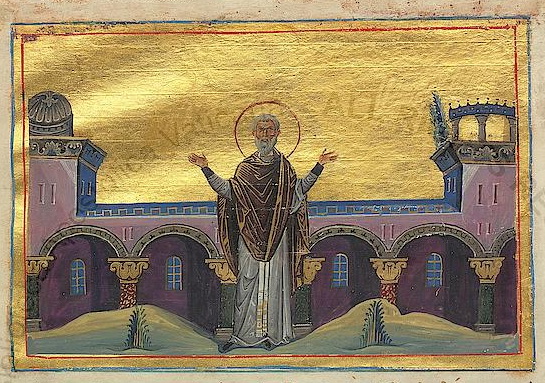
The Menologion of Basil II, compiled within living memory of the tenth century, already includes his memory with a full-page miniature — an indication that his veneration established itself quickly.
Feast and commemoration
September 15 (church date; Old Calendar civil September 28), within the afterfeast of the Elevation of the Cross; a synaxarion commemoration without proper hymns, kept universally. The Greek books style him ὅσιος ("venerable"), and the Russian calendar likewise counts him among the venerable (прп.), although he was not a monastic but a married priest — an instance of the broader, older use of the title for ascetic holiness in any state of life; the OCA heads him simply "Saint Philotheus the Presbyter."
Hymns
Troparion — Tone 8 (from the common of a venerable one)
In thee, O Father, that which is according to the image was preserved exactly: for taking up the cross, thou didst follow Christ, and by thy deeds thou didst teach that the flesh is to be despised, for it passes away, but the soul cared for, as a thing immortal; wherefore with the angels thy spirit rejoices, O venerable Philotheus.
Original translation from the Slavonic
Iconography
The Menologion of Basil II (c. 985) gives the saint a serene full-page miniature: the presbyter stands in the orans posture, in priestly mantle over his sticharion, between the arcaded walls and towers of his village — the image stored here, verified against the Vatican digitisation of the manuscript (Vat. gr. 1613, p. 38, under the heading of "our venerable father Philotheus the presbyter"). Later iconography is rare; he would be shown as a priest in phelonion with a cross or Gospel book.