
Phocas of Sinope
The Holy Hieromartyr Phocas the Wonderworker, Bishop of Sinope
Hieromartyr · Bishop · Wonderworker · d. 117
Commemorated 22 July — Translation of the relics to Constantinople (404); the Greek books keep July 23, 23 July — Translation of the relics of the hieromartyr bishop (Greek usage), 22 September — Martyrdom at Sinope under Trajan
Phocas was bishop of Sinope, the great harbour city of the southern Black Sea coast, and died a martyr there in the year 117, in the persecution at the end of Trajan's reign: refusing to renounce Christ, he was tortured and shut into a bath-house heated to fury, where he gave up his spirit. Styled "the Wonderworker" in the synaxaria, he became one of the most beloved saints of the Black Sea world — the patron of seafarers, invoked daily by those in peril on the waters, and a defender against fire and drowning. His relics were translated to Constantinople in 404, and his feast is kept on September 22.

Origins and episcopate
The tradition places Phocas's whole life at Sinope, the ancient Milesian colony on the Paphlagonian coast of the Euxine, in his day a flourishing Roman harbour. From youth he is said to have lived in Christian virtue, and in mature years he was made bishop of the city — one of the earliest hierarchs of the Pontic coast whose name the calendars preserve. His episcopate was remembered as apostolic in character: the hymnography of his feast praises him for casting down "the vanity of the idols," confirming unstable hearts in the faith by his sacred word, and guiding the pagans of the coast to life. The synaxaria give him the epithet "Wonderworker" (Θαυματουργός), and his canon speaks of healings wrought by the invocation of Christ, of idol-temples overthrown, and of whole cities and peoples delivered from the deceit of the enemy.
Martyrdom
Under the emperor Trajan (98–117) persecution reached Sinope. The Passio relates that the governor demanded of the bishop a public renunciation of Christ; Phocas refused, confessing the incarnation of the Master "before the tyrant's judgement-seat," as his canon sings. He was subjected to fierce tortures — the hymns speak of his body rent with wounds, of scourging upon the wood, and of a burning lime-kiln in which he was preserved unharmed — and was strengthened, the tradition says, by the appearance of angels and a voice from on high. At the last his persecutors enclosed him in a bath-house fired to an extreme heat, and there, in the year 117, he surrendered his soul to God. The verses of the Greek synaxarion play upon the manner of his death: "Receive, O Phocas, a bath that cleanses every stain — for it was the bath of thy contest, not of washing."
Relics and translations
In the year 404 the relics of the hieromartyr were solemnly translated from Pontus to Constantinople; the event is kept by the Slavic calendars on July 22, and the Greek synaxaria commemorate the hieromartyr Phocas on July 23. The reception of relics of Phocas at the capital is witnessed by a homily of John Chrysostom on the martyr Phocas, describing a festival in which the whole city poured out and the Bosphorus blazed with the lamps of a nocturnal procession of boats — a scene fitting the sailors' saint. A church of Saint Phocas stood at Constantinople, and his cult spread along every coast of the Byzantine world; churches and dedications to the saint of Sinope are attested from the Black Sea to Italy.
Veneration: the patron of seafarers
Phocas of Sinope became above all the seamen's saint of the Christian East. His service in the Menaion returns constantly to the sea: "thou helpest each day those upon the deep"; he is "a most calm harbour to all who sail"; his exapostilarion names him "great protector of them that sail." Sailors of the Black Sea and the Aegean invoked him in storm, and an ancient custom — described by Asterius of Amasea about the year 400 — set aside "the portion of Phocas" at the common table of a ship's crew: each day one sailor bought the saint's share, and the accumulated price was given to the poor when the ship came to port. (On the question of which Phocas this earliest witness describes, see Disputed questions.) The OCA notes his veneration also as a defender against fires — a memory, perhaps, of the fiery bath of his contest — and as a helper of the drowning.
Feast and commemoration
September 22 (church date; Old Calendar civil October 5) is the principal feast, kept by the Greek, Antiochian, Slavic, and OCA calendars alike. In the received Greek Menaion the service of this day joins the hieromartyr with the Apostle Quadratus of the Seventy (September 21), whose service is transferred here because his own day is wholly occupied by the leavetaking of the Elevation of the Cross. The Russian calendar keeps on the same day the Prophet Jonah and Jonah the Presbyter, whom the Greek books commemorate on September 21. The translation of the relics is kept on July 22 (Slavic usage; the Greek books July 23).
Hymns
Troparion — Tone 4
As a sharer of the ways of the Apostles and a successor to their throne, thou didst find thy practice, O God-inspired one, to be a passage unto contemplation; wherefore, rightly dividing the word of truth, thou didst suffer for the faith even unto blood, O Hieromartyr Phocas: intercede with Christ God that our souls may be saved.
Original translation from the Greek
Kontakion — Tone 6
As a hierarch offering sacrifices, O father, at the end thou didst offer thyself a living sacrifice; having borne witness lawfully to Christ God, strengthened by angels and choosing death, thou art with them that cry to thee: Come, O Phocas, be with us, and none shall be against us.
Original translation from the Slavonic
Stichera
From infancy thou becamest a lover of the Lord, O all-blessed Phocas, hieromartyr of Christ; taking up the weapon of the Cross upon thy shoulders, thou didst walk unswervingly the way of salvation; wherefore thou becamest a companion of the angels, an adversary of the demons, and wast shown a fervent intercessor for the world.
Iconography
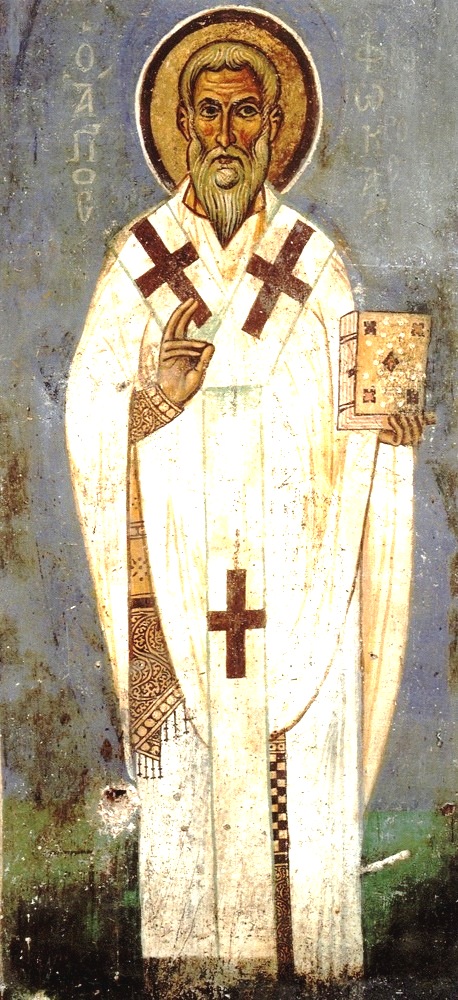
Phocas is depicted as a hierarch: grey-bearded, in phelonion (often the cross-covered polystavrion) and omophorion, blessing and holding the Gospel book. His sea-patronage sometimes adds an oar or a small ship to his image — attributes shared with, and easily confused with, those of Phocas the Gardener, whose beheading (not the bishop's fiery bath) is what the Menologion of Basil II miniature of this day depicts. The stored image is a Greek fresco of the 11th–12th century: the saint full-length in white polystavrion and omophorion, Gospel in hand, inscribed Ο ΑΓΙΟC ΦΩΚΑC. A Cretan-school icon of the 16th–18th century inscribed "Phocas the Wonderworker" — the synaxarion's own epithet for the bishop — is also on Wikimedia Commons.
Disputed questions
- The two Phocases of Sinope. The calendars of the Church venerate two saints of this name and city: the hieromartyr bishop (†117 under Trajan), the chief saint of September 22, and Phocas the Gardener — a poor market-gardener of Sinope who lodged strangers by the city gate, was sought by soldiers sent to kill him for his faith, entertained them unawares, dug his own grave in the night, revealed himself in the morning, and persuaded his reluctant executioners to behead him. The gardener's martyrdom is the subject of the earliest surviving witness to any Sinopean Phocas: a homily of Asterius of Amasea (c. 400), which knows him only as a gardener — not a bishop — and describes his shrine at Sinope, his fame among sailors, and the shipboard custom of "the portion of Phocas." Hagiographic scholarship since the Bollandists (Delehaye among them) has therefore suspected that the "bishop under Trajan" of the later Passio and the gardener of Asterius are one martyr doubled — the one historical cult of Phocas of Sinope having generated, through divergent tellings, two calendar figures. The liturgical evidence leans the same way: the Menaion service of the bishop is saturated with the sailor-patronage that Asterius attaches to the gardener. The calendars, however, keep the two distinct, and this collection follows the calendars: the Greek synaxarion of September 22 lists both ("On the same day, the memory of Saint Phocas the gardener"), as do the Slavic books and the OCA, while modern Greek calendars commemorate the gardener separately on September 23. The gardener's death is dated variously — the Russian calendar says about 320, other traditions place him under Diocletian (c. 303) or even under Trajan. He is to receive his own entry at his own day, cross-referenced to this one; he should not be merged with the bishop, nor the two confused.
- The Menologion miniature. The miniature of the Menologion of Basil II for this day (Vat. gr. 1613, p. 80) shows a haloed saint in plain garments beheaded by the sword beside a burning fire — the gardener's death, not the bishop's bath; Wikimedia Commons files it under the gardener's name. It is therefore not used for this entry (see Iconography).
- Date of the relic translation. The Slavic tradition and the OCA give July 22, 404, for the translation to Constantinople; the Greek synaxaria keep the summer memory of the hieromartyr on July 23. The Chrysostom homily witnesses a reception of relics of Phocas at the capital c. 400–404 without dating it to the day.