
Pulcheria the Empress
The Holy Right-Believing Pulcheria the Empress
Righteous · Queen · Virgin · b. 399 — d. 453
Commemorated 10 September — Peaceful repose
Pulcheria (399–453) was the empress who, more than any other lay person, steered the Church of the fifth century through its two greatest storms. Daughter of the emperor Arcadius, she was proclaimed Augusta at fifteen and governed the East as guardian of her brother Theodosius II, having taken with her sisters a public vow of perpetual virginity. She upheld the title Theotokos against Nestorius and stood behind the Council of Ephesus (431); widowed of no one, she accepted a nominal marriage to Marcian on condition her virginity be preserved, and with him convoked the Council of Chalcedon (451), whose fathers acclaimed her a "new Helen." Builder of the great Marian churches of Constantinople, she died in peace in 453, having given her wealth to the poor.
_-_%D0%B8%D0%BA%D0%BE%D0%BD%D0%B0_01102_%D0%9F%D1%83%D0%BB%D1%8C%D1%85%D0%B5%D1%80%D0%B8%D1%8F.png)
Origins and early life
Aelia Pulcheria was born on 19 January 399, the second daughter of the emperor Arcadius and the empress Eudoxia, and granddaughter of Theodosius the Great. Of the imperial children — Pulcheria, her sisters Arcadia and Marina, and the one boy, Theodosius — she was the strongest character by every account. Orphaned young (Eudoxia died in 404, Arcadius in 408), the children grew up in a palace governed by ministers while the seven-year-old Theodosius II reigned in name.
Pulcheria received an unusually thorough education — Greek and Latin, Scripture, and the arts of government — and matured early. On 4 July 414, aged fifteen, she was proclaimed Augusta by the senate, and took into her own hands the guardianship of her thirteen-year-old brother, supervising both his education and, in large measure, the government of the East.
The vow of virginity
At about the same time Pulcheria took the step that shaped her whole life and her later veneration: with her sisters she publicly vowed perpetual virginity, dedicating herself to Christ. The historian Sozomen, her contemporary, records the vow and the altar she dedicated in token of it in the Great Church of Constantinople, inscribed with the dedication of her own virginity. Piety and prudence met in the act — it also closed the palace to ambitious suitors and would-be regents — but its effect on the court was profound: under Pulcheria the palace took on the character of a monastery, with fixed hours of prayer, psalmody, fasting, and works of charity, and the sisters occupied themselves with weaving and the care of churches and the poor. Contemporaries traced to her influence the piety of Theodosius II himself.
Empress and church-builder
For a decade Pulcheria was the effective centre of the Eastern government, and even after Theodosius came of age and married the Athenian Athenais — baptised Eudocia, a match Pulcheria herself had promoted — her influence remained great, though the rivalry of the two empresses would later divide the court. Under the eunuch Chrysaphius, who dominated Theodosius in the 440s and favoured her rival, Pulcheria was gradually edged from power and withdrew to the palace of Hebdomon outside the city, living quietly in prayer until events recalled her.
To Pulcheria the tradition ascribes the foundation of the great Marian churches of Constantinople: the church of the Theotokos at Blachernae, which came to house the precious Robe of the Mother of God; the church of the Chalkoprateia, which received her Girdle; and the church of the Hodegoi (the Hodegon), with which the icon of the Theotokos Hodegetria — sent from Jerusalem, tradition says, by the empress Eudocia — was associated. She built and endowed many other churches, monasteries and hospices. In 438 she shared with the Patriarch Proclus in the solemn return of the relics of John Chrysostom — the bishop who had clashed with her mother Eudoxia — to Constantinople, an act of public reconciliation; and around 446 the relics of the Forty Martyrs of Sebaste were uncovered through her devotion, an event with which Sozomen closes his history in her praise.
Against Nestorius; Ephesus and Chalcedon
When Nestorius became archbishop of Constantinople in 428 and began to preach against calling the Virgin "Theotokos," Pulcheria became his most formidable opponent in the capital. The sources record open friction between them: Nestorius barred the Augusta from receiving communion within the sanctuary as she had been accustomed, removed her image and repudiated the honours the church of the capital paid her consecrated virginity — and disparaged that virginity itself. Pulcheria threw her weight behind Cyril of Alexandria; the Third Ecumenical Council at Ephesus (431) confessed the Mother of God to be Theotokos and deposed Nestorius. In the popular acclaim of the capital, the vindication of the Theotokos and the piety of the virgin empress were felt as one cause.
Theodosius II died of a riding injury on 28 July 450, leaving no heir. Pulcheria, recalled to power, first had the intriguer Chrysaphius removed, then — to secure the succession — consented to be married to the general and senator Marcian, on the publicly stated condition that her vow of virginity be honoured; they reigned as husband and wife in name, living, as the church historians put it, as brother and sister. Crowning Marcian, she became the instrument of the Fourth Ecumenical Council: she and Marcian convoked the bishops to Chalcedon in 451, where the tome of Leo of Rome was received and the two natures of Christ in one person confessed against Eutyches and Dioscorus. When the imperial pair attended the council's sixth session, the fathers acclaimed Pulcheria a "new Helen," guardian of the faith. The correspondence of Leo the Great includes letters to Pulcheria crediting her zeal for the orthodox faith.
Repose
Pulcheria died in peace in July 453, aged fifty-four, and was buried in the church of the Holy Apostles, the mausoleum of the Theodosian house. She had given away her wealth to the poor and to the Church; the distribution of her estate to the needy was, by her own direction, her last public act.
Feast and commemoration
September 10 (church date; Old Calendar civil September 23), within the afterfeast of the Nativity of the Theotokos — a fitting placement for the builder of Constantinople's Marian churches. The Greek synaxarion notes her with the distich: "Truly Pulcheria stands, as the psalm says, at Thy right hand, O my Christ, as Queen" (cf. Psalm 44:9 LXX). Some calendars (Greek among them) also join her memory to that of her husband Marcian on February 17. The Roman Martyrology likewise keeps her on September 10.
Iconography
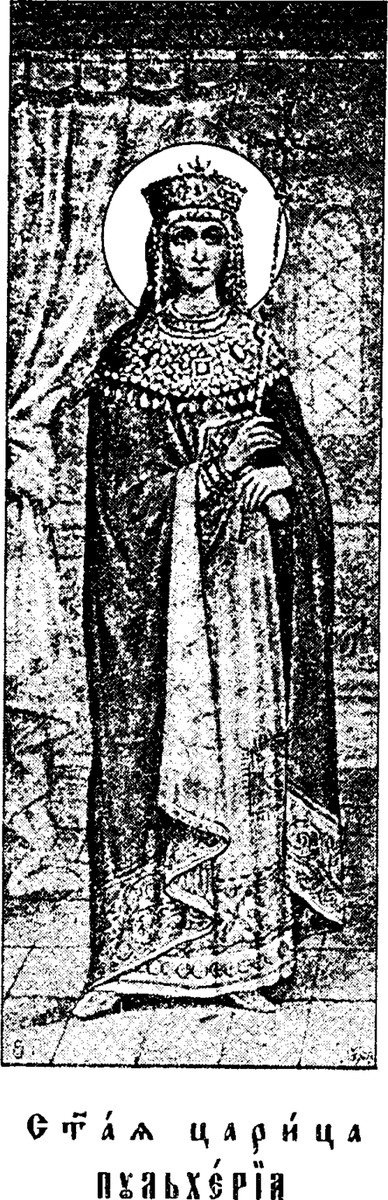
Pulcheria is painted in the full dress of a Byzantine Augusta: crown with pendilia, jewelled collar and loros over purple, often with a cross or a church-model in hand — the iconography of the royal builder-saint. She appears in menologion cycles for September 10 and, fittingly, among the figures of the Council of Chalcedon. The stored image is an engraved plate from the illustrated Moscow edition of the Lives of the Saints (Zhitiya Svyatykh, 1903–1911), inscribed in Church Slavonic "the holy Queen Pulcheria," showing the empress crowned and standing in palace vesture.
Disputed questions
- The measure of her role. The synaxarion tradition (followed by the OCA life) credits Pulcheria with the convening of both Ephesus (431) and Chalcedon (451). Historically, Ephesus was summoned in the name of Theodosius II, and Pulcheria's part there was exercised through influence rather than decree; Chalcedon she and Marcian convoked directly. The Church's memory compresses this into a single guardianship of the faith — not unjustly, but the mechanisms differed.
- Hostile traditions. The non-Chalcedonian churches remember Pulcheria as the power behind the council they reject, and later Nestorian and miaphysite polemic retailed slanders against her vow; Orthodox hagiography records the vow as kept to death, and the Chalcedonian fathers' acclamations honour her precisely as virgin and empress.
- Not to be confused with her aunt Pulcheria (†385), the young daughter of Theodosius the Great, who died in childhood and is not a saint of the calendar.