
Rhais of Alexandria
The Holy Virgin-Martyr Rhais of Alexandria
Martyr · Virgin · d. c. 308
Commemorated 23 September
Rhais (Irais, Iraida; in Russian usage Raisa) was a virgin of Alexandria who suffered martyrdom in Egypt around the year 308, in the last great persecution. Going to a well to draw water, she saw at the shore a ship crowded with Christian prisoners — men, women, clergy and monastics in chains — and, casting her pitcher aside, freely joined the confessors and was fettered with them. Carried with the company to the city of Antinoe (Antinopolis) on the Nile, she was the first to be tortured and beheaded, and the rest sealed their confession after her. She is commemorated on September 23.
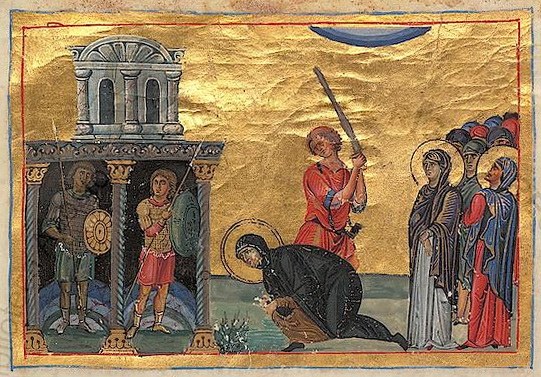

The synaxaria tell Rhais's story in a single luminous scene. A virgin of Alexandria — the Russian tradition calls her also "of Antinopolis," from the place of her contest, and some accounts make her a consecrated virgin of a community near the city — she went out to a well for water and found at the landing a ship laden with prisoners for Christ: a whole cross-section of the Egyptian church in chains, presbyters, deacons, monks, women. Asking and learning the cause, she made the martyr's choice on the spot: she threw down her water-jar, declared herself a Christian, and was chained among them. The ship carried the confessors up the Nile to Antinoe (Antinopolis), seat of the persecution's tribunals in the Thebaid; there Rhais, foremost in eagerness, was the first to endure the torments and was beheaded with the sword, and after her the others accomplished their martyrdom. The era is that of the great persecution in Egypt under Diocletian's successors — the synaxaria's reckoning, c. 308, falls under Maximinus Daia, whose tribunals filled the Thebaid with martyrs. The verses of the Greek synaxarion catch the tradition's reading of her: longing to look upon the beauty of God, Rhais gave over the beauty of her flesh to the sword.
Feast and commemoration
September 23 (church date; Old Calendar civil October 6), with the Conception of John the Forerunner. Kept on the same day across the Greek and Slavic calendars (OCA: "Virgin Martyr Irais (Rhais) of Alexandria"); she has no proper service in the Menaion, and no proper hymns are transmitted.
Iconography
Until this sweep no image of Rhais had been identified; She would be depicted as a virgin-martyr — veiled, in tunic and maphorion, with the martyr's cross — and her proper scene, the cast-down water-jar at the well before the prisoners' ship, is her ready attribute where narrative treatment is attempted.
The stored image is the miniature of the Menologion of Basil II (Constantinople, 985): the martyr kneels for the sword before the witnessing women, the manuscript's beheading scene for her day.
Disputed questions
- Rhais and the Herais of Eusebius. Eusebius (Ecclesiastical History 6.4.3) records among the pupils of Origen at Alexandria a catechumen named Herais, who "received the baptism of fire" — martyred c. 202–206 under Severus, a century earlier and by fire, not the sword. The identity or distinctness of the two virgins of Alexandria has been discussed since the Bollandists; the Byzantine synaxaria for September 23 transmit the ship-and-well narrative with the fourth-century dating, and this entry keeps the two apart while recording the question. The Eusebian Herais is entered in this collection with her fellow-pupils at Plutarch and Companions, commemorated on June 28.
- Name-forms. Ῥαΐς / Ἡραΐς / Irais / Iraida are one name in the manuscripts; the Russian calendar's Raisa has made her a widely loved patronal saint among Slavic women bearing that name.