
Sadoth of Persia
The Holy Hieromartyr Sadoth (Sadoc), Bishop of Seleucia-Ctesiphon, and the 128 Martyrs with him
Hieromartyr · Bishop · Martyr · d. c. 342
Commemorated 20 February — Second commemoration in the synaxaria, near the season of his martyrdom, 19 October — Byzantine fixed commemoration, with his company of martyrs
Sadoth (Syriac Shahdost, "friend of the king"; Slavic Sadoc) was the second bishop of Seleucia-Ctesiphon, the royal city of Persia, succeeding Symeon Barsabae when that first great martyr of the Persian church was slain at the outbreak of Shapur II's persecution. Warned in a vision of a ladder — Symeon calling from its summit, "I climbed yesterday; do thou climb today" — he was arrested in the persecution's second year with his clergy, monks and consecrated virgins, held five months in chains, tortured, and commanded to worship the sun; refusing, he was taken to Beth Lapat and beheaded, about the year 342, and his company — 128 in the Slavic count, 120 in the Greek — died by the sword. He is commemorated on October 19 and again on February 20.
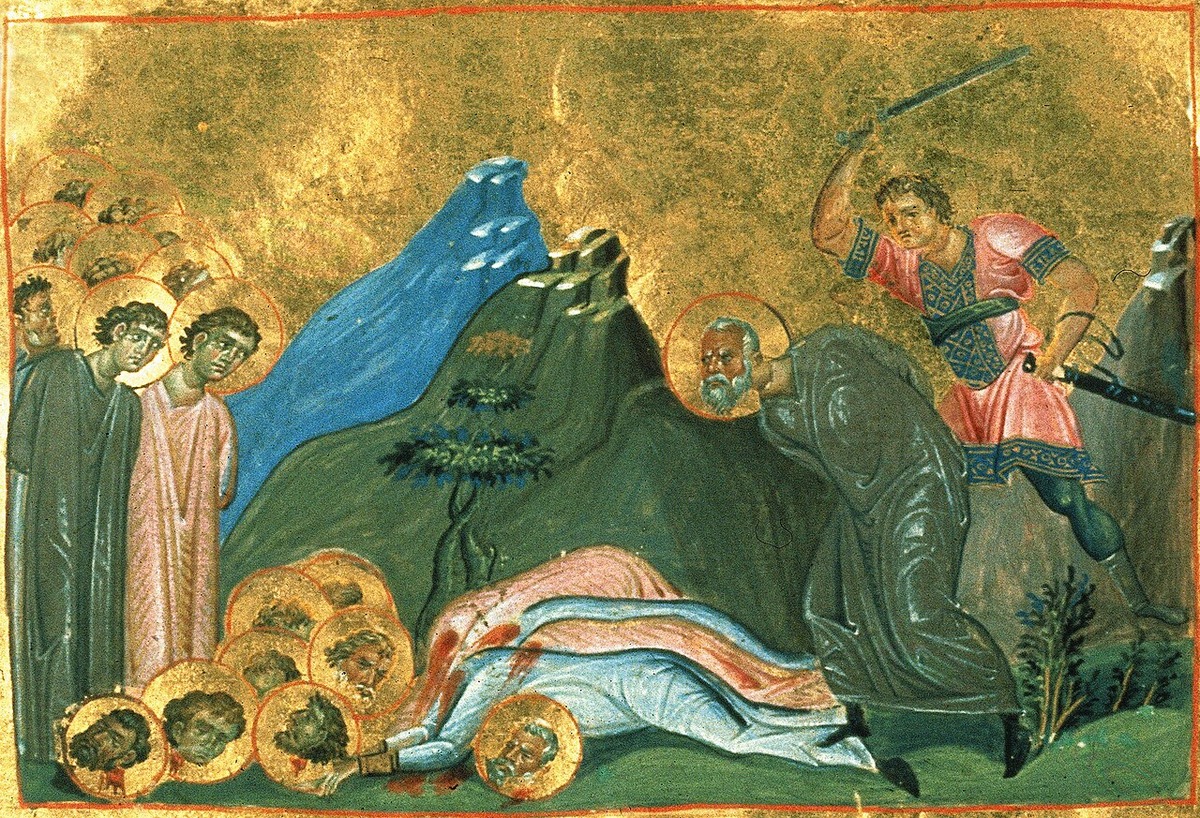
,_Bishop_of_Persia,_and_128_martyrs_with_him_(Menologion_of_Basil_II).jpg)
The church of Persia under the sword
The great persecution of the Christians of Persia broke out under Shapur II around 340, when war with the newly Christian Roman empire made every Persian Christian suspect of treason and the magian priesthood pressed the king to act: a double tax first, then the destruction of churches, then death for the clergy. Its first and greatest victim was Symeon Barsabae, bishop of the twin royal cities of Seleucia-Ctesiphon, executed with a great company; and it continued for some four decades, filling the Syriac martyrologies with thousands of names — the Church's remembrance of an eastern martyrdom that rivalled anything suffered under Rome.
Upon Symeon's death the perilous throne of Seleucia-Ctesiphon passed to Shahdost — the name, ironically under such a king, means "friend of the king" — whom the Greek books call Sadoth and the Slavic books Sadoc. He could shepherd his flock only in hiding, moving among the villages and hamlets with a remnant of his clergy.
The vision of the ladder
The Acts relate that in the second year of the persecution Sadoth saw in a dream a ladder set up to heaven, reaching from earth to the height, and at its top Symeon his predecessor in glory, who called down to him: "Climb up, Sadoth, and fear not: I climbed yesterday, and thou shalt climb today." He awoke and told the vision to his clergy as a plain announcement of his martyrdom, and prepared himself and his church for it.
Arrest, confession and martyrdom
Soon afterward Shapur came to Seleucia, and Sadoth was seized with a great company of his church — clergy, monks, and daughters of the covenant, the consecrated virgins of the Persian church; the Byzantine tradition numbers the company 128 (the Greek synaxarion, 120). For five months they lay in chains, tortured repeatedly, and were pressed with the standard demand of the persecution: worship the sun, the visible god of the Zoroastrian state, and live. The transmitted answer of Sadoth and his company is the Persian martyrs' constant confession: they would worship the God who made the sun, and not the creature; death for them was not dying but going to life. The company were condemned and put to the sword; Sadoth himself was taken apart, in chains, to Beth Lapat (Gundeshapur) in Huzistan, and there beheaded — about the year 342 in the received chronology (some place it 344). The Greek distich plays on his name: Sadoth, beheaded by the sword, now stands before the throne of the God of Sabaoth.
Veneration
The Persian martyrs entered the Greek calendar early — Sozomen already recounts the persecution and names Sadoth among its bishops-martyr — and the Menologion of Basil II gives the company of Sadoth its miniature for October 19. The Syriac Acts of the Persian Martyrs preserve the fullest account, and the Church of the East keeps its own commemorations of Shahdost among its catholicos-martyrs. In the Byzantine books he appears twice in the year, on October 19 with his company and again on February 20.
Feast and commemoration
October 19 on the church calendar (Old Calendar civil November 1), with his company — the placement witnessed by the Menologion of Basil II, the Greek synaxarion, the Slavic books (which give him a proper kontakion this day), and the OCA. The synaxaria commemorate him again on February 20 (Old Calendar civil March 5), likewise on the OCA calendar; the October day, as the fuller and hymned commemoration, is ranked primary here and the February day secondary. The Church of the East's own calendar of the Persian martyrs commemorates him separately.
Hymns
Kontakion — Tone 4
Eagerly and in his very likeness didst thou follow the word of the Master: as a good shepherd thou didst lay down thy life for the sheep of Christ, O hieromartyr Sadoth. We entreat thee, much-suffering one: pray to Christ, the Chief Shepherd, that we too be numbered among the sheep that stand at his right hand, that we may sing to thee: Rejoice, holy father Sadoth, who didst shed thy blood for Christ.
Original translation from the Slavonic
Iconography
Sadoth is painted as an eastern bishop-martyr — omophorion over the polystavrion, grey-bearded — and, in the narrative type, at the head of his great company under the sword. The stored image is the miniature of the Menologion of Basil II (Constantinople, c. 985; Vat. gr. 1613, p. 122, verified by folio autopsy): the aged bishop bowed beneath the executioner's blade on a mountainside, the haloed heads of his beheaded company heaped in the foreground while the survivors stand awaiting their turn — one of the manuscript's starkest martyrdom scenes.
Disputed questions
- The number of the company. The Slavic books and the OCA give 128 martyrs; the Greek synaxarion of October 19 counts 120 ("a tenfold ten of fellow-martyrs, and twice ten, slain by the sword," its verse runs). The divergence is recorded, not resolved.
- Date of martyrdom. c. 342 in the received reckoning, 344 in chronologies that set Symeon Barsabae's death in 344; the sequence — Sadoth's death in the persecution's second year, a year or so after Symeon's — is firmer than the absolute year.
- See and title. The OCA styles him loosely "bishop of a Persian district"; the Syriac tradition is precise that Shahdost succeeded Symeon in the primatial see of Seleucia-Ctesiphon. Both stylings are recorded; the entry follows the Syriac precision.