
Sebastian of Rome
The Holy Martyr Sebastian of Rome, Captain of the Praetorian Guard, and his Companions
Martyr · b. mid-3rd century, Narbonne (Gaul) — d. c. 288
Commemorated 18 December — Martyrdom at Rome, with his companions
Sebastian (d. c. 288) was, by the tradition received in both East and West, an officer of the Roman army under Diocletian — captain of the imperial guard — who concealed his Christianity in order to strengthen the persecuted brethren. His Passion makes him above all an encourager of martyrs: he steadied the wavering brothers Marcellinus and Mark, converted their jailers and a whole company of prisoners and officials, and when at last denounced was tied to a stake and shot with arrows. Surviving that ordeal, he confronted the emperor a second time and was beaten to death with clubs. He is commemorated on December 18 together with the many companions who suffered in the same cycle — Zoe, Tranquillinus, Nicostratus, Castorius, Claudius, Victorinus, Symphorian, Tiburtius, Castulus, and the deacons Marcellinus and Mark.

Origins and early life
The received Passion places Sebastian's birth at Narbonne in Gaul and his upbringing and schooling at Mediolanum (Milan) — whence the Slavonic books style him "Sebastian of Mediolanum," while the Greek and Latin traditions name him from the city of his death, Rome. Entering the army, he rose under the co-emperors Diocletian and Maximian (284–305) to command of the praetorian guard. He was esteemed for courage, sound judgement, and fidelity, and stood high in the favour of the court; and precisely this standing he turned to the secret service of the Church, keeping his faith hidden "not out of fear, but so that he might help the brethren in the time of persecution."
Encourager of the martyrs
The heart of Sebastian's Passion is not his own death but his ministry to others. Two brothers, Marcellinus and Mark, imprisoned and condemned for the faith, began to give way under the weeping of their pagan parents, Tranquillinus and Marcia, and of their own wives and children. Sebastian came to the house of the treasurer where they were held and exhorted them not to trade their crowns for their kinsfolk's tears — bidding them keep their feet on the necks of the enemies who lay prostrate, and raise their standard above every earthly affection. As he spoke, the tradition relates, his face shone as an angel's; and Zoe, the mute wife of the jailer Nicostratus, cast herself at his feet and was healed of a six-year loss of speech when he signed her with the Cross, whereupon she declared that she had seen an angel holding an open book in which all his words were written.
The miracle broke open the prison. Nicostratus and Zoe sought baptism; the priest Polycarp was summoned and prepared the household, the prisoners, and their kin; the deputy Claudius brought his sick sons Symphorian and Felix, and they too were healed. Brought before the city eparch (prefect) Chromatius, Nicostratus so recounted these things that Chromatius himself, with his son Tiburtius, believed and was baptised, resigned his office, and — blessed by Gaius, bishop of Rome — withdrew to safety in southern Italy with Polycarp and those unable to face martyrdom. The Passion swells the number of the converted to many hundreds. Of those who remained in Rome, Gaius ordained Tranquillinus priest and his sons Marcellinus and Mark deacons.
Martyrdom
The companions were taken in a short and terrible sequence. Zoe was seized first, at prayer by the tomb of the Apostle Peter, and died suffocated in the smoke of a foul fire, her body cast into the Tiber; she appeared afterwards in a vision to Sebastian to tell of her end. Tranquillinus the priest was stoned at the same tomb and likewise thrown into the river. Nicostratus, Castorius, Claudius, Victorinus, and Symphorian, seized while searching the bank for the martyrs' bodies and refusing to sacrifice, were drowned in the sea with stones about their necks. Tiburtius, betrayed by the false Christian Torquatus, walked unharmed over burning coals and was then beheaded; Castulus was buried alive in a pit; the deacons Marcellinus and Mark had their feet nailed to a stump and, having stood the night in prayer, were run through with spears.
Sebastian was the last. Diocletian himself questioned him, and, meeting only constancy, ordered him led outside the city, bound to a stake, and shot with arrows until he was left for dead. Irene, widow of the martyr Castulus, came by night to bury him and found him yet living; she took him to her house, where he recovered. Urged to flee Rome, he refused, and instead placed himself where the emperors would pass and openly denounced their impiety. This time Diocletian had him taken to the Circus Maximus and beaten to death with clubs, his body flung into the great sewer (the cloaca). He appeared in a vision to a devout woman, Lucina, directing her to recover his body and lay it in the catacombs on the Via Appia — where, the tradition concludes, his basilica stands to this day.
Veneration and later cultus
Sebastian is among the most anciently and widely venerated of the Roman martyrs. His grave on the Via Appia gave its name to one of the catacomb complexes and to the basilica San Sebastiano fuori le mura, one of the seven pilgrimage churches of Rome; his cult was firmly established there by the fourth century, when Bishop Damasus honoured the martyrs of the city. Belonging to the age before the schism, he was received throughout the Christian East as well as the West, and kept his place in the Byzantine synaxaria on December 18. In the medieval and early-modern West he became, with Roch, one of the two great protectors invoked against plague — the arrows of his martyrdom read as the arrows of pestilence turned aside — which accounts for the flood of Western images of the arrow-pierced saint; the Orthodox iconographic tradition, by contrast, keeps to the fuller narrative of the arrows and the clubbing.
Feast and commemoration
December 18 (church date; Old Calendar civil December 31). The Byzantine books commemorate "the holy Martyr Sebastian and those with him," gathering the whole company of the Passion into the one day. The Greek Menaion carries a proper canon of the martyr by Joseph the Hymnographer, whose acrostic runs Θεῖον σέβας σοι Μάρτυς ἐμφρόνως νέμω. Ἰωσήφ ("Devoutly I render sacred reverence to thee, O Martyr — Joseph"), but appoints for the apolytikion the common of a martyr; the Slavonic books likewise use the common of the martyrs for the company, some adding a proper troparion. In the West several of the companions keep their own days (Marcellinus and Mark on June 18, Tiburtius on August 11, Castulus on March 26), while the East keeps them together with Sebastian here.
Hymns
Troparion
Thy Martyr, O Lord, in his contest received the crown of incorruption from Thee, our God; for possessing Thy strength, he cast down the tyrants and shattered the feeble insolence of the demons. By his supplications, O Christ God, save our souls.
Original translation from the Greek
Kontakion
Having shone forth as radiant lamps, O divine martyrs, ye illumine all creation with the splendour of your miracles, loosing infirmities and ever driving away the deep darkness, as ye unceasingly entreat Christ God on behalf of us all.
Original translation from the Greek
Iconography
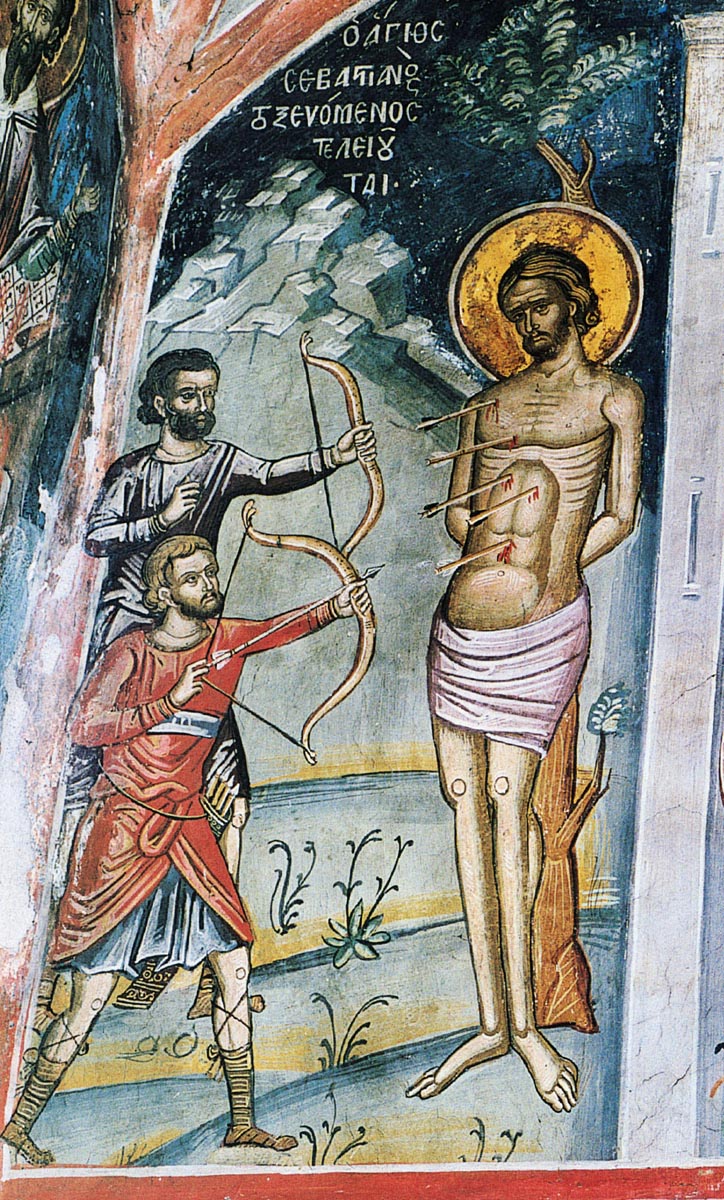
Orthodox iconography shows Sebastian as a young soldier-martyr, beardless or lightly bearded, in a martyr's mantle, holding the cross of witness; narrative images depict his double martyrdom — bound to a stake and pierced with arrows, and afterwards beaten with clubs. The stored image is a 1547 fresco from the Monastery of Dionysiou on Mount Athos showing the martyrdom by arrows, a reminder that the Christian East kept the whole of his Passion and not only the arrow-scene that dominates Western art.
Disputed questions
- Historical core. The Passio is a fifth-century composition of the legendary type; the martyr and his ancient Roman cult are historical, but the elaborate cast of companions and conversions is hagiographic narrative, and the figures are treated here as the tradition transmits them rather than as documented biography.
- Date. The martyrdom is placed in the Diocletianic persecution, conventionally c. 288 (Wikidata gives 256–288 for his life); the year is not securely fixed.
- Not to be confused with the martyr Sebastiana of Heraclea (a woman disciple of the Apostle Paul, feast September 16), nor with Sebastian of Pshekhonye (a 16th-century Russian abbot of Vologda, also commemorated on December 18 — a distinct saint, not yet authored).