
Serapion of Novgorod
Our Father among the Saints Serapion, Archbishop of Novgorod
Bishop · b. c. 1450, at Pekhorka near Moscow — d. March 16, 1516, at the Trinity-Sergius Lavra
Commemorated 16 March — Repose at the Trinity-Sergius Lavra
Serapion (c. 1450 – 1516) was a Russian monastic saint and hierarch — hegumen of the Trinity-Sergius Lavra and afterwards Archbishop of Novgorod — best remembered for his part in the great controversy over the monastic estate that divided the Russian Church in his day. Born near Moscow, married and briefly a parish priest, he was widowed and took the monastic habit, rising through the Dubensk and Trinity-Sergius houses to the see of Novgorod in 1506. His excommunication of the abbot Joseph of Volokolamsk (Joseph of Volotsk), who had removed his monastery from Novgorod's jurisdiction to the Grand Prince's, brought Serapion himself before a council in 1509, which deposed him from his see; he withdrew to the Trinity-Sergius Lavra, was reconciled, and reposed there in peace on March 16, 1516. He was later glorified, and his relics rest at the Lavra.

Origins and monastic beginnings
Serapion was born about the middle of the fifteenth century in the village of Pekhorka, not far from Moscow, of pious parents. In the ordinary way of Russian secular clergy he was married and ordained a priest, serving a village church; but within a year or so of his ordination his wife died, and Serapion, left a widower, gave himself wholly to God. He received the monastic tonsure at the Dubensk Monastery of the Dormition (a house associated with Saint Sergius), where his ascetic life so distinguished him that he was in time made its hegumen (abbot).
His reputation for holiness and sound governance drew him to the greatest of Russian monasteries, the Trinity-Sergius Lavra founded by Saint Sergius of Radonezh, and about the year 1495 the brotherhood there chose Serapion as their archimandrite. In these years his counsel was valued at the court of the Grand Prince Ivan III, and he took part in the church councils of the reign.
Archbishop of Novgorod
In 1506 Serapion was raised to one of the senior sees of the Russian Church, the archbishopric of Novgorod the Great, and consecrated at Moscow. He governed the vast northern diocese in a time of hardship — the sources remember his care for his flock through famine and plague — as a shepherd austere in his own life and firm in the defence of the Church's order.
The conflict with Joseph of Volokolamsk
The event that fixed Serapion's memory, and the trial of his sanctity, was his clash with another saint. The Monastery of Volokolamsk, founded by the abbot Joseph of Volokolamsk, lay within the territory and the jurisdiction of the see of Novgorod. In a dispute with the local prince who was its patron, Joseph, in 1507, sought and obtained the protection of the Grand Prince Vasili III, transferring his monastery directly to the Grand Prince's authority — and so removing it from Serapion's jurisdiction without the consent of his own bishop. Serapion held this an offence against the canonical order of the Church, and in 1509 he laid Joseph under excommunication.
The matter was carried to Moscow. A council convened by the Grand Prince and the metropolitan took Joseph's part: it judged that Serapion had exceeded his authority — some accounts stress that he had acted without first informing the metropolitan — and it deposed him from the see of Novgorod, holding him under censure. Serapion accepted the sentence without bitterness and withdrew to the Trinity-Sergius Lavra, the house he had once governed, there to live out his days as a simple monk. In time the breach was healed: Serapion and Joseph were, the tradition holds, reconciled before the end, each acknowledging the other's holiness, and the whole episode came to be remembered not as the fault of either saint but as one of the hard collisions of conscience and canon that mark the history of the Russian Church in that age.
Repose and glorification
Serapion reposed in peace at the Trinity-Sergius Lavra on March 16, 1516. He was buried within the monastery, and miracles were soon reported at his grave; his relics were found incorrupt and came to rest in the Lavra, where he is venerated among the saints of that great house and of the Church of Russia. His local glorification followed, and his memory is kept on the day of his repose.
Feast and commemoration
Serapion is commemorated on March 16 (church date; Old Calendar civil March 29), the day of his repose, in the Russian Church (Moscow Patriarchate) and the OCA; he is a Russian commemoration rather than a universal one. Because the date falls within Great Lent, his memory ordinarily lands on a weekday of the Fast, when the full Liturgy is not served; his office is joined to the Lenten order or kept with solemnity at the Trinity-Sergius Lavra, where his relics lie. He is also numbered among the Synaxis of the Saints of Radonezh (kept July 6) and of the Saints of Novgorod.
Iconography
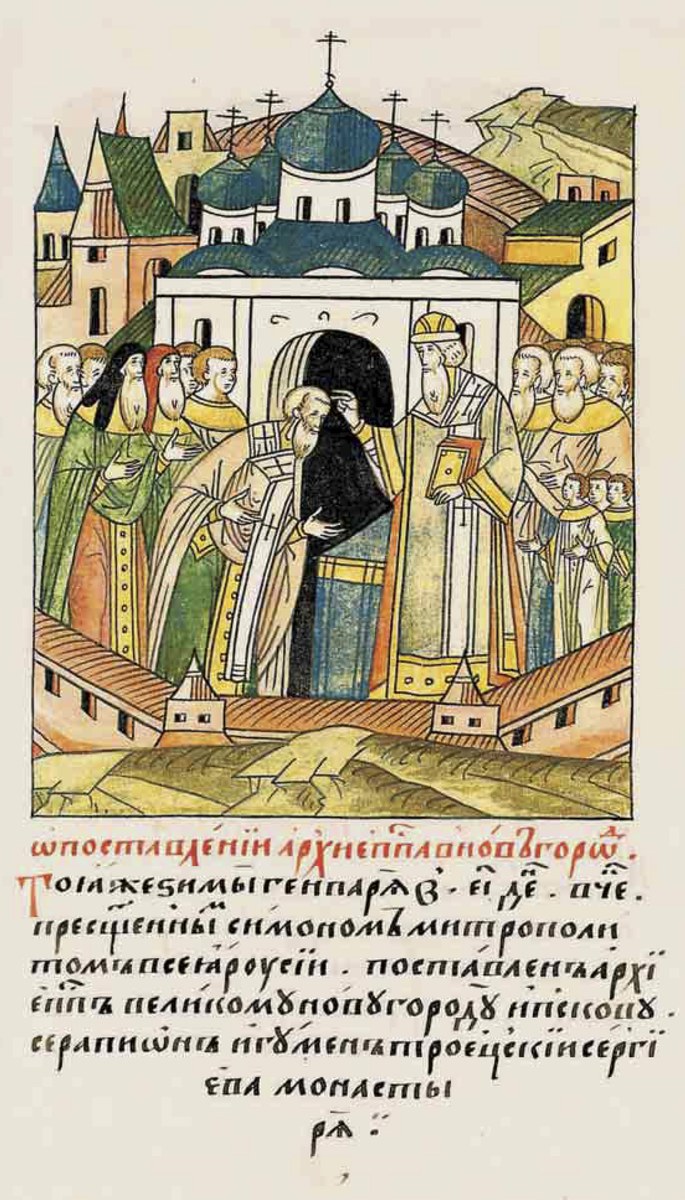
Serapion is depicted in the settled type of a Russian hierarch-saint — an elderly bishop, grey-bearded, vested in the sakkos or phelonion with the omophorion and the mitre, holding the Gospel-book and raising his hand in blessing — and appears among the ranks of the Saints of Radonezh and the Saints of Novgorod in the assembly-icons of those companies. As a saint of the Muscovite sixteenth century he belongs to the world of the great Russian icon, but no securely identity-verified pre-1900 portrait icon of him (as distinct from the several other Serapions and from group compositions) was located for storage at the time of authoring — a want since supplied by the chronicle miniature below, which names him in its own caption.
The stored image is the miniature of the Illustrated Chronicle of Ivan the Terrible (16th century) for his elevation, the folio's own caption naming "Serapion, hegumen of the Trinity monastery of Sergius, made Archbishop of Great Novgorod and Pskov by Metropolitan Simon."