
Seven Youths of Ephesus
The Holy Seven Youths (the Seven Sleepers) of Ephesus
Confessor · b. early 3rd century — d. c. 250 (sealed in the cave under Decius); awoke and reposed under Theodosius II, c. 446
Commemorated 4 August — The first falling-asleep in the cave, 22 October — The second and final falling-asleep
The Seven Youths of Ephesus — Maximilian, Iamblichus, Martinian, John, Dionysius, Exacustodianus (also called Constantine), and Antoninus — were young Christians of noble family who, rather than sacrifice to the idols under the emperor Decius (c. 250), hid in a cave on Mount Ochlon, where the emperor ordered them sealed in to die. God laid them instead in a miraculous sleep of nearly two centuries; they awoke under Theodosius II (408–450), at a moment when the resurrection of the dead was being denied, so that their waking became a living proof of it. Having borne this witness they lay down and reposed. Popularly the "Seven Sleepers," they are among the few saints venerated by both Christians and Muslims, the story being retold in the Qur'an.
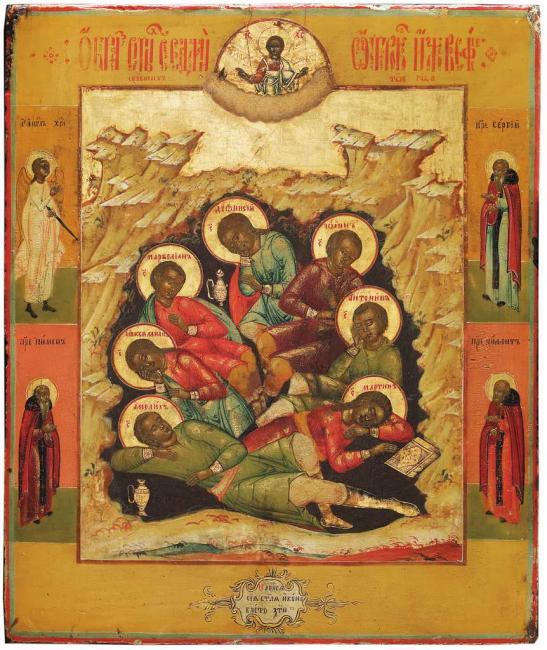

The confession under Decius
The account, transmitted in Greek and (through Gregory of Tours) in Latin, sets the youths at Ephesus in the reign of Decius (249–251). Maximilian was son of the city's administrator, and the other six were sons of illustrious citizens; friends from childhood, they served together in the army. When Decius came to Ephesus and required all to offer sacrifice on pain of torture and death, the seven confessed Christ before him and were stripped of their military belts and insignia. The emperor, leaving on campaign, gave them time to reconsider. Instead they distributed their goods to the poor and withdrew to a cave on Mount Ochlon (Celion) outside the city, there to pray and prepare for martyrdom; the youngest, Iamblichus, went down into the city in the dress of a beggar to buy bread and to bring back word. Learning on his return that the emperor had come back and was seeking them, they committed themselves to God. Decius, finding where they were, ordered the mouth of the cave walled up with stones, that they should perish of hunger and thirst. Two of the officials who sealed it were secret Christians; wishing to preserve the memory of the youths, they hid within the wall a sealed casket containing two metal plaques inscribed with the seven names and the manner of their sealing.
The sleep and the awakening
The Lord did not let them die, but laid them in a sleep in which their bodies and even their garments were kept from decay, and so they lay for nearly two hundred years while the persecutions ended and the Empire became Christian. In the reign of Theodosius the Younger there had arisen those who denied the bodily resurrection of the dead, saying that after so long a time, when the very dust was gone, no body could rise again. To confound this error the Lord awakened his seven saints. The owner of the mountain, needing stone, had his workmen open the sealed wall, and the youths awoke — supposing they had slept a single night, and that Decius still sought them. Again they sent Iamblichus to buy bread. He was astonished to see a cross above the city gate and to hear the name of Christ spoken openly, and doubted he had come to the right city; when he paid with coins stamped with the head of Decius, he was seized as one who had found buried treasure and brought before the authorities, among them the bishop of Ephesus. From his bewildered answers, and going with him to the cave, the bishop found and opened the sealed casket, read the plaques, and going in beheld the youths alive: and all understood that God had shown, in them, the mystery of the resurrection. The emperor Theodosius himself came and spoke with them in the cave. Then, their witness given, the seven bowed their heads to the ground before all and gave up their spirits, this time to sleep until the General Resurrection. Theodosius wished to enshrine them in coffins of gold, but they appeared to him and asked to be left lying on the ground of their cave.
The relics and the two feasts
The cave near Ephesus became a pilgrimage site, and in the twelfth century the Russian abbot Daniel, on pilgrimage to the Holy Land, records seeing the relics of the seven youths there. Their veneration is kept on two days, whose relation the sources themselves debate. According to the tradition that entered the Russian Prologue, the youths fell asleep the second and final time on October 22; the Greek Menaion of 1870, by contrast, holds that they first fell asleep on August 4 and awoke on October 22. The Church keeps both commemorations. There is also a short prayer of the Seven Sleepers appointed in the Great Book of Needs (Trebnik) for the sick who cannot sleep, and they are named among the saints in the service for the Church New Year on September 1.
Shared veneration and the Qur'an
The story travelled far beyond the Byzantine world. It is told in the eighteenth sura of the Qur'an (al-Kahf, "The Cave"), where the sleepers and their dog Qitmir rest in the cave for a great span of years as a sign of God's power to raise the dead; on this account the Seven Sleepers are among the very few saints honoured in both Christian and Islamic devotion, and sites associated with them are venerated across the eastern Mediterranean. The Church has always read the wonder in one key: not as a curiosity but as a God-given icon of the resurrection of the body, granted at the moment the faith needed it.
Feast and commemoration
October 22 (church date; Old Calendar civil November 4), kept together with Abercius of Hierapolis and, in the Greek books, headed as the day of "the holy seven Youths who are in Ephesus." A second commemoration falls on August 4. The two dates preserve the two moments of the story — the falling asleep and the awakening — which the Greek and Slavonic traditions assign to the days in the reverse order (see the Life); the Church keeps both without resolving the question. Although the youths reposed in peace and were not in fact put to death, the service borrows the common troparion of the holy martyrs, honouring the confession they made before Decius and their willingness to die for it.
Hymns
Troparion — Tone 4
Great is the wonder of faith: in the cave, as in a royal chamber, the seven holy youths abode, and died without corruption, and after many years arose as from sleep, unto the assurance of the resurrection of all men. By their prayers, O Christ God, have mercy on us.
Original translation from the Greek
Kontakion — Tone 4
Having despised the corruptible things of the world, and received the gifts that know no corruption, they died and yet abode beyond decay; therefore they arise after many years, burying all the bitter unbelief of the heretics. Praising them today, O faithful, let us hymn Christ.
Original translation from the Greek
Iconography
The seven are shown as a close group of beardless or young men, sometimes in the short tunics and chlamyses of their rank, lying or reclining asleep within the arch of their cave; in narrative icons the sealing of the cave, Iamblichus at the city gate with the ancient coin, and the bishop and emperor discovering them awake are set around the central scene. The stored image is a nineteenth-century Russian icon of the Seven Sleepers of Ephesus, the youths grouped within the cave and framed by peripheral saints.