
Silouan the Athonite
Our Venerable Father Silouan the Athonite
Venerable · b. 1866 — d. 1938
Commemorated 24 September — Repose (1938); glorified 1987
Silouan the Athonite (1866–1938) is the great monastic saint of the twentieth century: a barely lettered Russian peasant from Tambov province who spent forty-six years as a simple monk of the Russian monastery of St. Panteleimon on Mount Athos, was granted a vision of the living Christ, endured fifteen years of dereliction and demonic warfare, and received from the Lord the word that has become his signature — "Keep thy mind in hell, and despair not." His writings on the love of enemies, prayer for the whole world, and Adam's lament, published after his death by his disciple Archimandrite Sophrony (Sakharov), carried Athonite hesychasm to every corner of the modern world. He was glorified by the Ecumenical Patriarchate in 1987.

Origins and early life
Semyon Ivanovich Antonov was born in 1866 in the village of Shovskoye, Lebedyan district of Tambov province, into a large family of Russian peasants. His father Ivan, poor, illiterate and profoundly devout, remained for Silouan all his life the model of the meek and wise man of God: the saint loved to tell how his father, discovering that Semyon had once fed the family pork on a fast day, waited half a year before mentioning it gently, so as not to shame him at the time. Semyon received barely two winters of village schooling. As a young man he was a carpenter's apprentice and then a farm-worker, of enormous physical strength — the record preserves both his feats (eating and working for three) and his sins, which he never minimised: he drank, he courted, and in a village brawl he once struck the village cobbler a blow that nearly killed him, a deed that weighed on him ever after.
The first call came early — after a period of fervour at nineteen the wish to become a monk faded into ordinary village life — and was renewed terribly: he dreamt that a serpent entered his mouth, and awoke to hear a voice of unearthly sweetness, which he was convinced to the end of his days was that of the Mother of God, saying that she was pained to see his deeds. The compunction of that hour never left him. He served his military term in a sapper battalion of the Imperial Guard near St. Petersburg, where his comrades noticed that his mind was already on Athos; on his way home he visited Kronstadt to ask the prayers of the famous John of Kronstadt, and, not finding him, left a note: "Batiushka, I wish to become a monk; pray that the world may not hold me back." The power of those prayers, he said, he felt the next day, as if the flames of hell were roaring around him.
Athos: grace given, grace withdrawn
In the autumn of 1892 he arrived at the Russian monastery of the holy Great-martyr Panteleimon (the Rossikon) on Mount Athos, then at the height of its size — some two thousand monks. He passed through the ordinary obediences of a novice: first at the mill, later at the storehouses and workshops, where in time he was made steward over the monastery's hired workmen. He was tonsured to the mantle in 1896 with the name Silouan (Silvanus, after the companion of the apostles), and to the great schema in 1911.
His inner history was extraordinary from the first months. Given while still a novice the unceasing Jesus Prayer, he was assailed almost at once by temptations of pride and despair alternating; after some months he reached the conviction that God would not hear him — "God is inexorable" — and his soul sank for an hour into the darkness of the abandoned. That same evening, at Vespers in the chapel of the Prophet Elias attached to the mill, as he turned his eyes to the icon of the Saviour, he saw the living Christ: the icon, as it were, gave place to the Lord Himself, filling him with a fire of grace so overwhelming that, as he later wrote, had it lasted a moment longer he would have died. He knew from that hour, with a knowledge that never admitted doubt again, that Jesus Christ is God, that His humility and meekness surpass all telling, and that His love is boundless.
What followed proved the harder school. The tangible grace of the vision withdrew, returning at prayer and withdrawing again, and for some fifteen years Silouan wrestled — often through whole nights standing at prayer — with demonic apparitions and with the subtler despair of one who had known God and lost the sense of Him. The crisis resolved in a single night around 1906: worn out by the assaults, he sat in his cell and said, "Lord, Thou seest that I desire to pray to Thee with a pure mind, but the demons hinder me. Teach me what I must do that they may not hinder me." And the answer came in his soul: "The proud always suffer thus from demons." — "Lord, teach me what I must do that my soul may become humble." And in his heart he heard God's answer: "Keep thy mind in hell, and despair not."
From that word Silouan's whole later life and doctrine unfolded. He understood it as the weapon given him personally against pride: to hold himself, in sober self-condemnation, worthy of hell — and at the same time to hang all upon the mercy of God, refusing despair as itself a form of pride. Practised so, the fearful formula became in him not gloom but the deepest peace; the grace that had come and gone learned, as he put it, to abide.
The staretz
Outwardly nothing distinguished him. He held no office beyond his stewardship (where his rule was to pray for the workmen in his charge, and their affection for him was noted), was neither priest nor spiritual father by appointment, attended the long Athonite services, wrote slowly in a large peasant hand. A few discerning visitors recognised what he was; most of the brethren did not, and some learned monks condescended to him. Yet ascetics of the Mountain sought his word, and his written meditations — begun in secret notebooks — ripened into one of the purest expressions of the hesychast tradition since the ancient fathers, the more striking for being couched in the simplest Russian.
The axis of his teaching is love. The surest criterion of true faith and of the presence of the Holy Spirit, he taught, is love for enemies: "he who does not love his enemies has not yet come to know God as He ought to be known." Grief for those who do not know God pressed him into unceasing intercession — prayer for the whole world, for "all Adam," which he regarded as the monk's proper work: "to pray for the whole world is to shed blood." He wept over the separation of Christians; he taught that the brother is our life; and in the meditation Sophrony titled "Adam's Lament" he gave the twentieth century one of its few genuinely new pieces of spiritual literature: the first-formed man weeping at the gates of paradise for the God he had lost — the figure of every soul that has known grace and grieves its withdrawal.
Repose, writings, glorification
Silouan fell ill in early September 1938 and died quietly in the monastery infirmary in the small hours of September 24 (September 11 O.S.), 1938, as unremarked in death as in life. His notebooks passed to his closest disciple, the Russian hieromonk Sophrony (Sakharov), who had been his confidant in his last years. Sophrony's book — the saint's life and theology together with the complete writings — appeared in Russian in Paris (first circulated in 1948, printed 1952) and in ever-widening translation thereafter (in English first as The Undistorted Image, 1958, later expanded as Saint Silouan the Athonite); it made the unknown monk one of the most read spiritual authors of the age, and figures as different as Thomas Merton and generations of Orthodox monastics acknowledged the debt. Sophrony's own monastery of St. John the Baptist at Tolleshunt Knights, Essex — founded 1959, now a stauropegion of the Ecumenical Patriarchate — became the chief centre of his veneration in the West.
The Ecumenical Patriarchate glorified Silouan among the saints on November 26, 1987; the Russian Church entered him in her calendar in 1992, and his memory is now kept by all the Orthodox Churches, the Antiochian Archdiocese included, with particular love — a saint of the industrial twentieth century who can be seen in photographs, yet stands recognisably in the line of Anthony and Macarius. His principal relic, his head, is kept at the Panteleimon monastery; portions of relics have been given to Essex and elsewhere.
Feast and commemoration
His feast is kept on the day of his repose, September 24 of the church calendar — so observed by the New Calendar jurisdictions, including the Antiochian Archdiocese. A calendrical subtlety attends him, worth spelling out: he died on September 24, 1938 of the civil (Gregorian) calendar, which was September 11 O.S.; the Russian Church accordingly keeps his memory on her church date of September 11, which falls on the same civil day, September 24. All Orthodox thus commemorate him on the one civil day, under two different church dates; this collection, keyed to the New Calendar church date, carries him here (the mechanical Old Calendar civil equivalent of this church date, October 7, is not in practice his feast anywhere — see the note in the September 11 calendar file).
Iconography
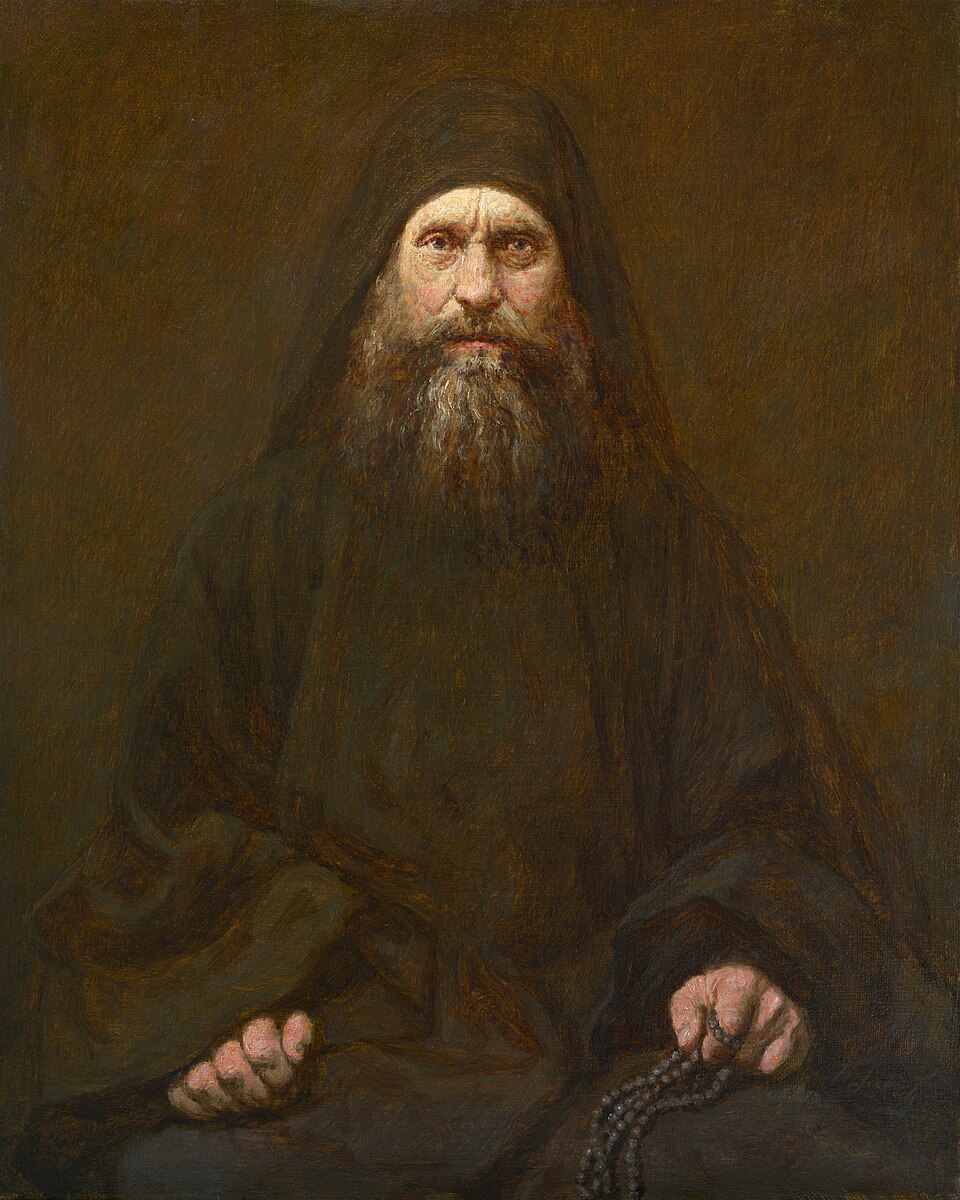
Icons of Silouan — necessarily a modern iconography, formed since 1987 but guided by the surviving photographs of the saint — show a schemamonk of strong, deeply lined features and long grey beard, in klobuk or schema-cowl, often holding a scroll with one of his sayings, most commonly "My soul yearneth after the Lord, and I seek Him with tears" or "Keep thy mind in hell, and despair not"; some icons show him half-figure with hands crossed or in prayer before Christ. Because that iconography is the work of living or recently deceased artists, no traditional icon of him can yet be stored here under the repository's licence policy. The stored image is a free-licensed oil portrait of 2018 by the Russian painter Andrey N. Mironov, closely following the best-known photograph of the saint: the aged monk in schema, prayer rope in hand.