
Silvester of Rome
Our Father among the Saints Silvester, Pope of Rome
Bishop · d. December 31, 335, at Rome
Commemorated 2 January — Commemoration (repose 335)
Silvester of Rome (†335) was bishop of Rome from 314 to 335, through the whole reign of Constantine the Great after the peace of the Church — the pope under whom the persecuted community of the city emerged into freedom, built its great basilicas, and saw the First Ecumenical Council gather at Nicaea in 325, where his legates sat. A confessor who had endured the last of the pagan persecutions, he governed the Roman church for twenty-one years and was remembered in both East and West as a model hierarch of the Constantinian age. Around his name a rich body of legend gathered — the baptism of Constantine, a disputation with the learned Jews before the emperor, the healing of a poisoned bull, and the sealing of a devouring dragon beneath Rome — which shaped his medieval cultus more than the thin historical record. He reposed at Rome and is commemorated on January 2, within the forefeast of the Theophany.

Origins and accession
Silvester was a Roman by birth, the son (the tradition says) of one Rufinus, and was ordained to the priesthood of the Roman church in the years of the Diocletianic persecution — the last and fiercest of the pagan assaults on the Church — in which he is honoured as a confessor who stood firm and, by some accounts, withdrew for a time to Mount Soracte outside the city. On the death of Pope Miltiades (Melchiades) he was chosen bishop of Rome in 314, the year after the Edict of Milan had granted the Church her peace, and he held the see until his death in 335 — one of the longest Roman episcopates of the early centuries, and one wholly contained within the reign of Constantine.
The Church at peace under Constantine
Silvester's episcopate spans the decisive turn from persecution to imperial favour. Under him the church of Rome, so lately hunted in the catacombs, came into the open and into wealth: the Lateran basilica and baptistery, the first Saint Peter's over the Apostle's tomb on the Vatican, and other great churches were founded and endowed by the emperor in these years. It was an age of building, of the ordering of the Church's worship and discipline in freedom, and of the first councils summoned by a Christian sovereign. The historical record of Silvester's own acts is thin — he is a quiet figure beside the towering emperor — but the Roman tradition remembered his reign as the springtime of the Church's liberty.
The legends: Constantine, the Jews, and the dragon
Far more than the sober record, it was a cycle of legends — gathered in the Vita Silvestri, widely diffused in Greek and Latin from the fifth century — that carried Silvester's fame through the Middle Ages, and it is these that the Byzantine synaxaria chiefly relate. The best known makes Silvester the one who baptised Constantine, cleansing the emperor of a leprosy that his pagan physicians could not heal after he refused, out of mercy, to bathe in the blood of slaughtered children; Constantine, the story runs, saw Peter and Paul in a vision, sent for the hidden bishop, was instructed, baptised, and healed. A second tells of a disputation before Constantine and his mother Helen — who inclined toward Judaism — in which Silvester overcame twelve learned rabbis in debate; when the last, a magician named Zambri, killed a bull by whispering the name of a demon in its ear and challenged Silvester to raise it, the bishop restored the bull to life in the name of Christ, and many were converted. A third relates that Silvester sealed the mouth of a dragon (or great serpent) that lived in a pit beneath the Tarpeian rock and poisoned the air of the city, binding it with the sign of the Cross. These tales are honoured as legend: the tradition of the Church keeps them for the truths they picture — the victory of Christ over paganism, magic, and death in the age of Constantine — while the history beneath them is another matter (see Disputed questions).
The First Ecumenical Council
In 325 the First Ecumenical Council met at Nicaea to condemn the heresy of Arius and to confess the Son "of one essence with the Father." Silvester, now aged, did not travel to Bithynia in person but was represented by his legates, the presbyters Vitus (Vito) and Vincent (Vincentius), who signed the acts among the fathers — so that the see of Rome had its voice in the great Council that stands at the head of the Church's dogmatic tradition. The Roman church kept the memory of its part at Nicaea as one of the glories of Silvester's reign.
Repose and veneration
Silvester reposed at Rome, full of years, on the last day of 335, and was buried in the cemetery of Priscilla on the Via Salaria, in a church he had built there. His veneration was early and wide. In the West his feast is December 31, the day of his death, which by long custom closes the civil year; in the Byzantine East, and so in the Antiochian, Greek, and Slavic calendars, he is kept on January 2, within the forefeast of the Theophany, and is styled hierarch (hierarches) — a holy bishop of the undivided Church, honoured East and West alike as a father of the Constantinian peace.
Feast and commemoration
Silvester is kept on January 2 (church date; Old Calendar civil January 15) in the Byzantine calendars, within the forefeast of the Theophany, and on December 31 in the West, the day of his repose. The East, styling him hierarch, sings his office with the forefeast hymns of the coming Baptism of the Lord. He shares his Eastern day with the great Russian elder Seraphim of Sarov and, in the Slavic books, with a namesake of the Kiev Caves.
Iconography
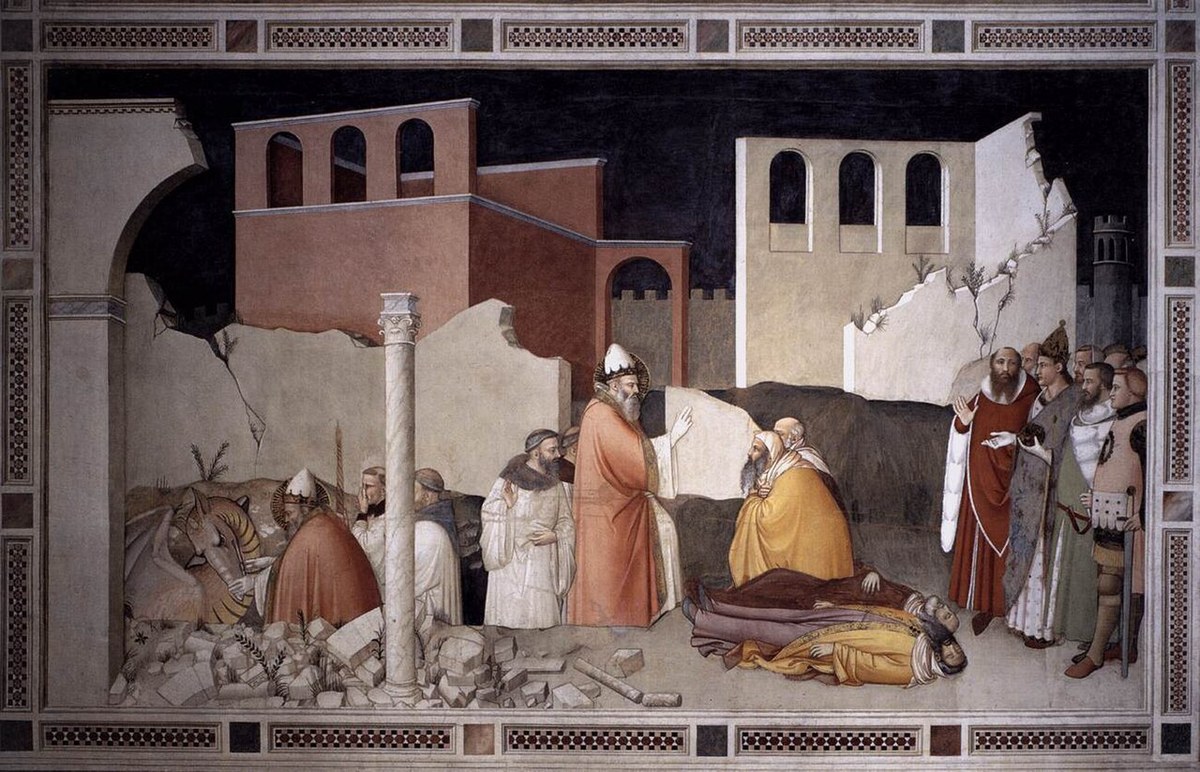
Silvester is depicted as an aged bishop in the Eastern manner — grey-bearded, vested in the phelonion and omophorion, holding or blessing over the Gospel — of the settled hierarch type; where the Roman connection is shown he may wear the papal insignia of Western art. His narrative iconography follows the legends of his Vita: the baptism of Constantine, the disputation with the Jews and the raising of the bull, and above all the taming of the dragon beneath Rome.
The stored image is a fresco of about 1340 by Maso di Banco in the Bardi di Vernio Chapel of Santa Croce in Florence, depicting the saint's most famous miracle: Silvester, vested and enthroned, sealing the mouth of the dragon with his blessing while the two sorcerers slain by its breath are raised to life at his word — the visual summary of the legendary Vita, in a Western medieval hand, reproduced here as a public-domain work by age (source, pd-old-work). A Byzantine or Cretan-school portrait icon of the hierarch is wanted to complement it.
Disputed questions
- The baptism of Constantine. The legend that Silvester baptised Constantine at Rome and cured his leprosy is not historical: the emperor was baptised only near the end of his life, in 337, at Nicomedia, and by Eusebius of Nicomedia, a bishop of Arian sympathies — two years after Silvester's death. The Silvester-baptism belongs to the fifth-century Vita and afterward furnished the medieval West with the forged "Donation of Constantine," which claimed that the grateful emperor had ceded Rome and the West to Silvester and his successors — a document exposed as a forgery by Lorenzo Valla in the fifteenth century. The Byzantine synaxaria relate the baptism as received tradition; it is recorded here as legend, with the history noted.
- The disputation and the dragon. The debate with the rabbis and the raising of the bull, and the sealing of the dragon beneath the Capitol, are likewise elements of the legendary Vita, not of the historical record; they are kept as the pious imagery of his cultus.
- Not to be confused with the later popes Sylvester II (Gerbert of Aurillac, †1003) and Sylvester III (11th c.), who belong to the Latin West and are not saints of the Orthodox calendar; nor with Silvester of the Kiev Caves (12th century), the Russian chronicler-monk kept on the same day.