
Sisoes the Great
Our Venerable Father Sisoes the Great, of the Mountain of Anthony
Venerable · Wonderworker · b. c. 332 — d. 429
Commemorated 6 July — Repose on the mountain of Anthony the Great
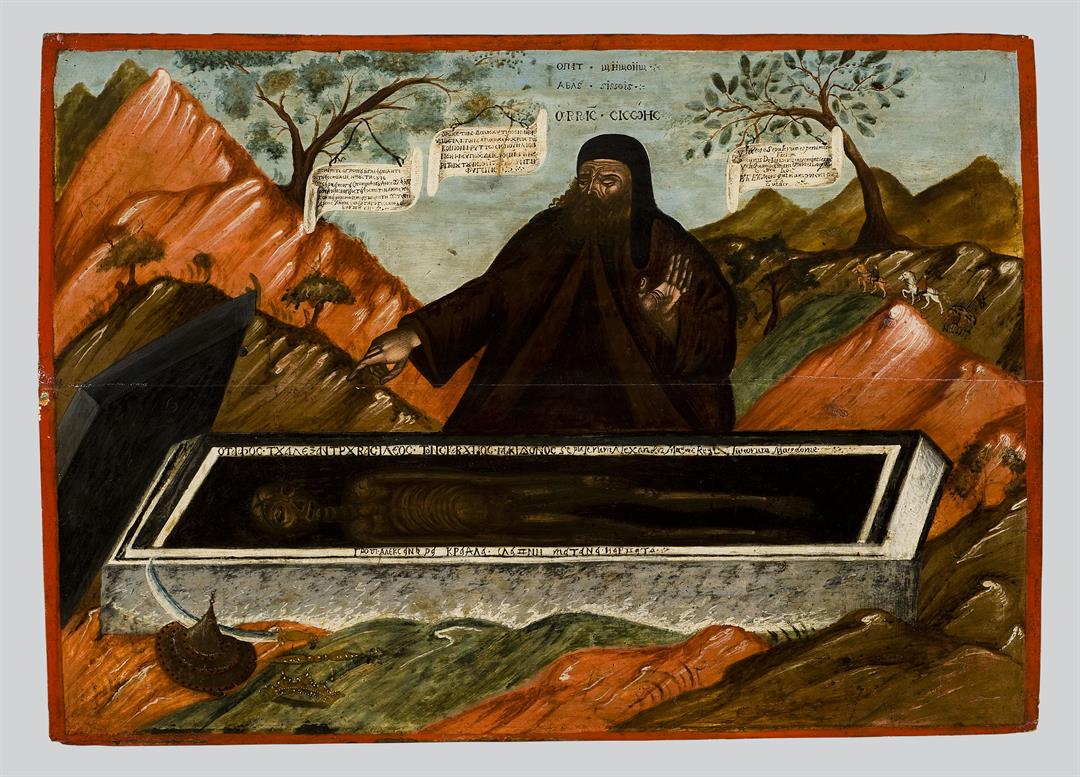
Sisoes the Great (†429) is among the most beloved of the Egyptian desert fathers, a monk of Scetis who after the repose of Anthony the Great withdrew to Anthony's own mountain by the Red Sea and dwelt there some seventy years. The Apophthegmata Patrum preserves a long chapter of his sayings, whose whole burden is humility: to a brother who boasted of the unceasing remembrance of God he answered that it is a far greater thing to reckon oneself beneath every creature. He raised a dead child by his prayer and hid the miracle; and at his repose, as the prophets, the apostles and Anthony himself came to receive him and his face shone like the sun, he begged the angels for a little more time to repent, saying he did not think he had yet begun. From that word grew the icon-type in which he stands appalled before the opened tomb of Alexander the Great.
.jpg)
Origins and the desert of Scetis
Sisoes was an Egyptian, born about the year 332 into a poor and numerous family. The Greek tradition relates that he was called to the monastic life while still young, and went down into Scetis — the great salt valley south-west of the Nile Delta where Macarius the Great had gathered the first disciples, and which in the fourth century was the schoolroom of Egyptian monasticism. There he was formed among fathers whose names the Apophthegmata sets beside his own: he is associated in the sayings with Abba Or (Hor), who is remembered as his elder, and he converses with John the Dwarf, Poemen, Ammoun of Ray, Amoun of Nitria, and Abraham, his own disciple and the reporter of much that survives of him.
The desert of Scetis in that generation was already becoming crowded. Sisoes belonged to the generation for whom the eremitical ideal was under pressure from its own success: seekers came in numbers, monasteries multiplied along the Nile, and the fathers of the strictest sort went looking for emptier ground. Asked why he had gone away to a harsher place, Sisoes is said to have answered simply that where he had been there was no longer any solitude.
The mountain of Anthony
Anthony the Great reposed in 356 on his inner mountain — the crag above the Red Sea coast known later as Mount Colzim (Qulzum), the site of the present Monastery of St Anthony — having made his two disciples swear to hide his grave. Some while after, Sisoes went up to that mountain and settled there, and remained on it, by the reckoning preserved in the Greek tradition, about seventy-two years, so that his whole monastic life ran to sixty years and more of unbroken ascetic labour in the place Anthony had hallowed. Only his disciple Abraham and a few others shared the solitude with him, and at long intervals visitors came up from the inhabited world to ask him a word.
He was severe with himself and lenient with others. The sayings show him forgetting to eat for days together and having to be reminded; refusing, when guests came, to let his own rule of abstinence be a burden on them; and answering questions about food and wine with a plain contempt for the whole subject, since the body's regimen was not, in his eyes, where the battle lay. When Abraham asked him whether after all those years he had conquered the passions, he would not allow the claim. The one virtue he pressed on everyone was the low estimate of oneself.
The teaching: humility and the short road
The chapter of Sisoes in the alphabetical Apophthegmata is one of the fullest in the collection, and it is remarkably consistent. Its centre is the exchange that has passed into the common speech of Orthodox ascetic writing: a brother said to him that he kept the remembrance of God unceasingly, and Sisoes replied that this was no great matter — the great matter was to see oneself as lower than every creature, for bodily labour without humility does not bring a man to humility.
To the same purpose is his counsel on repentance. A brother who had fallen asked how long he must repent; the old man said three years; the brother thought it long; he said one year; still long; forty days — and when the brother pleaded that even this was beyond him, Sisoes answered that if a man repents with his whole heart God will receive him in three days. The saying is not an indulgence but a doctrine: the measure is not time but the completeness of the turning.
Others of his words are proverbial. Asked what a man should seek, he answered that one should seek God, and not seek where God dwells. He told a brother that to be despised, to throw one's own will away behind one, and to be free of anxiety, is the whole of monastic rest. To a monk who wished to leave the desert for a place where he could live undistracted, he answered that the place would follow him. Asked why the fathers of the earlier generation had wrought such wonders and their successors did not, he laid the difference to charity grown cold and to the loss of that self-abasement which had been their strength.
Miracles and traditions
Sisoes received the gift of wonderworking, and hid it. The most celebrated instance is the raising of a dead child. A layman of the region, whose son had died on the road up to the mountain, carried the body into the old man's cell, set it at his feet as though asking a blessing, and went outside weeping. Sisoes, not knowing the child was dead, spoke to him and told him to rise, and the boy stood up alive; and when the father came in and fell down giving thanks, the old man was distressed at what he had unwittingly done and charged him to tell no one until Sisoes himself had died. Other sayings show him discerning thoughts, foretelling the approach of visitors, and driving away demons by a word — always with the same reluctance to be known for it.
Repose
He died on his mountain in 429, at about ninety-seven years of age. The account of his death is one of the great set-pieces of Egyptian hagiography, and is transmitted in the Apophthegmata itself. The fathers were sitting around him as he lay dying, and his face began to shine. He said: Behold, Abba Anthony has come. A little after: Behold, the choir of the prophets has come. His countenance shone the brighter, and he said the apostles were come. They asked with whom he was speaking; he said the angels had come for him, and that he was asking them to leave him a little longer, that he might repent. The fathers protested that he, of all men, had no need of repentance, and he answered that he did not think he had so much as begun to repent. Then his face shone like the sun, and he said, Behold, the Lord is come, and He says: Bring me the vessel of the desert — and immediately he gave up his spirit like a flash of lightning, and the whole place was filled with a sweet fragrance.
That last word — the refusal of a man of sixty years' asceticism to allow that his repentance had even started — is the reason the Church calls him great, and is the burden of every hymn appointed to him.
Feast and commemoration
July 6 (church date; Old Calendar civil July 19). Sisoes is kept universally: by the Orthodox Church in the Byzantine rite, by the Coptic and other Oriental Orthodox Churches, and in the Roman martyrology. In the Antiochian usage he is the principal commemoration of the day, sharing it with the Roman martyrs Lucia and her companions and, in Slavic practice, with the commemorations of Juliana of Olshansk and the Synaxis of the Saints of Radonezh. Because his name is joined in the Greek books to the very idea of monastic humility, his memory is kept with particular solemnity on Athos and in the Egyptian monasteries that stand on his own ground.
Hymns
Apolytikion — Tone 1 (common of a venerable father)
A citizen of the wilderness and an angel in the body wast thou shown to be, O God-bearing Sisoes our father; for by fasting, by vigil and by prayer thou didst receive the gifts of heaven, and thou healest the sick and the souls of them that run to thee in faith. Glory to Him that gave thee strength; glory to Him that crowned thee; glory to Him that worketh through thee healings for all.
Apolytikion — Tone 5 (proper)
From thy youth thou didst emulate the life of the angels, and going down into the desert thou didst make thy dwelling on the mountain of Anthony; there, O Sisoes, thou didst gather the riches of humility, and at thy end thou didst ask for time to repent. Wherefore entreat Christ God that our souls may be saved.
Kontakion — Tone 4
An angel upon earth and a man of heaven wast thou revealed by thine ascetic struggle, O all-blessed Sisoes; wherefore, having received the grace of wonders, thou dost pour out healings upon them that cry: Glory to Christ who hath glorified thee.
Original translation from the Greek
Iconography
Sisoes is painted as a very old monk: gaunt, high-browed, the hair thin or gone from the crown, with a long and pointed white beard, in the brown or dark monastic schema with the analavos crossed over the breast and the koukoulion on the head or thrown back. In the ordinary hierarchical scheme of a church he takes his place among the venerable fathers of Egypt beside Anthony, Paul of Thebes, Macarius, Poemen and Arsenius, holding a scroll on which a saying is written.
But his distinctive image — one of the few genuinely philosophical compositions in Byzantine iconography — is Sisoes before the tomb of Alexander the Great. The saint leans over an opened marble sarcophagus in which lie the crowned skeleton and the bones of the world-conqueror, his royal helmet and scattered ornaments fallen beside it; the old man's hand is raised in astonishment or grief, and inscribed scrolls above him carry the verse-dialogue in which he addresses the tomb — asking how the ruler of the world has been reduced to a span of earth, and being answered that all flesh comes to this. The type is a post-Byzantine creation, which appears in Greek monastic painting from the sixteenth century onwards, when the memory of the fall of the Empire made the theme of the vanity of earthly power urgently pertinent; famous examples are in the katholikon of the Varlaam monastery at Meteora, at Hosios Loukas, and on Mount Athos, and the composition passed thence into panel icons and into the Slavic lands.
The stored image is a seventeenth- or eighteenth-century panel in the Byzantine and Christian Museum at Athens (ΒΧΜ 10682, probably of Dalmatian provenance), inscribed Ο ΟΣΙΟΣ ΣΙΣΩΗΣ and ΑΒΒΑΣ ΣΙΣΩΗΣ: the black-cowled elder rises behind an open white sarcophagus containing the crowned corpse of Alexander, points into it with one hand and raises the other, while four inscribed scrolls carry the dialogue and a hillside behind shows the horsemen of the vanished army. The helmet and a scatter of jewels lie on the ground at the tomb's foot.
Disputed questions
- Which Sisoes? The alphabetical Apophthegmata names more than one father of this name, distinguishing Sisoes the Theban and Sisoes of Petra from the great Sisoes; the Greek and Coptic tradition also knows a Sisoes disciple of Anthony's circle in Calamon. Individual sayings are therefore not always securely assigned, and modern editors differ over a handful of them. The core of the chapter — the sayings on humility, the exchanges with Abraham, and the death-scene — belongs beyond doubt to the Sisoes commemorated on July 6.
- Which mountain? "The mountain of Abba Anthony" in the sources may mean either the inner mountain at Colzim above the Red Sea, where Anthony died, or the outer mountain at Pispir on the Nile, where he had earlier dwelt. The weight of the tradition, and the plain sense of the sayings that speak of the road up from the inhabited country, favour Colzim.
- Dates. The year 429 is the received date of repose, and an age of about ninety-seven with some seventy-two years on the mountain is the figure carried in the Greek synaxaria; the arithmetic is approximate and the sources do not agree closely on the length of his stay in Scetis before he went up.
- Not to be confused with Sisoes the Schemamonk of the Kiev Far Caves (13th century), who is commemorated on the very same day and was almost certainly named after him — see Sisoes of the Far Caves. Nor with Sisoes the Recluse of the Kiev Near Caves (also 13th century, commemorated October 24) — a further distinct saint of the same Lavra; the two Kievan Sisoi are themselves regularly confused with each other.