
Spyridon of Trimythous
Our Father among the Saints Spyridon the Wonderworker, Bishop of Trimythous
Wonderworker · Bishop · b. c. 270 — d. 348
Commemorated 12 December — Repose
Spyridon of Trimythous (c. 270–348) was a married Cypriot shepherd who became bishop of the small town of Trimythous and one of the most beloved wonderworkers of the Orthodox Church. Unlettered and utterly plain in manner, he is remembered above all for the disarming simplicity through which God worked abundant miracles — healing the sick, raising the dead, commanding the elements, and, at the First Ecumenical Council of Nicaea (325), confounding an Arian philosopher and, by tradition, demonstrating the Holy Trinity with a single clay tile that burst into fire and water. His incorrupt relics rest on the island of Corfu, where he is venerated as the island's protector and patron.

Origins and early life
Spyridon was born about the year 270 in Cyprus, and passed the whole of his early manhood as a shepherd. He married, and had children — the tradition names a daughter, Irene. From the beginning he was marked less by learning, of which he had almost none, than by an artless goodness: the sources describe him giving his substance away to the poor and the homeless, keeping open house, and being repaid by God with the gift of healing and of casting out demons even before he held any office in the Church. This "holy simplicity" — the plainness of a countryman who had never studied and never dissembled — is the thread that runs through every account of him, and the quality the Church has most loved in him.
Episcopate
After the death of his wife, during the reign of Constantine the Great (306–337), Spyridon was chosen bishop of Trimythous (Latin Tremithus; the modern Tremetousia), a small town in the interior of Cyprus. He did not change his way of life on becoming a hierarch. He continued to work with his hands and to dress and speak as a shepherd, joining the labour of the field to the care of his flock of souls, and the many stories told of him belong to this pastoral setting rather than to any school or court.
Several are preserved by the early Church historians. Socrates Scholasticus tells how thieves broke into his sheepfold by night and found themselves held fast by an invisible power until morning, when the bishop, finding them bound, prayed them loose, counselled them to earn their bread honestly, and sent them away with a ram "for your trouble, that you did not keep watch all night in vain." Sozomen records that Spyridon kept his storeroom unlocked, letting the poor and those in debt take grain as they had need and return it, without record or reckoning; and that, likened to the patriarch Abraham in his hospitality, he once set a salted ham before a weary traveller during the Great Fast, and when the guest demurred that he was a Christian and it was Lent, answered that "to the pure all things are pure" (Titus 1:15) — a saying the tradition treasures as the whole man in a sentence. Through his prayers, the chronicles say, drought gave way to rain and unceasing rain to fair weather; the sick were healed and demons driven out.
The First Ecumenical Council
Spyridon's presence among the fathers of the First Ecumenical Council at Nicaea in 325 is attested by the Church historians. There, according to the tradition, this unlettered bishop was set against a Greek philosopher who was defending the Arian denial of the Son's full divinity with the full apparatus of dialectic. Where trained theologians had answered proof with proof, Spyridon spoke to him plainly of the one God who made all things by his Word and his Spirit, of that Word — the Son — who was born of a Virgin, suffered, died and rose for our salvation, and who is one in essence with the Father; and he asked the philosopher simply to believe, "for it is impossible to grasp this mystery by reasoning." The philosopher was overcome not by argument but by a power he could not name, confessed that "God speaks through the lips of this old man," and received baptism.
To the same Council belongs the most famous image associated with Spyridon: to show how one thing can be at once three, he took up a clay brick or roof-tile and pressed it, whereupon — the tradition relates — fire blazed up from it, water ran down to the ground, and the clay remained in his hand: the fire, the water and the earth of a single tile, as the three Persons of the one God.
Miracles and traditions
The wonders gathered around Spyridon are among the most vivid in the synaxaria. A mother brought him her dead child and, at his prayer, the infant was restored; when the mother herself collapsed lifeless from joy, he prayed again and raised her too. Hastening to save a friend under an unjust sentence of death, he found his way barred by a flooded stream, commanded the water in the name of the Lord of all to stand still, crossed dry, and reached the judge in time.
Two miracles fix his memory in the popular mind above the rest. A woman had left a valuable deposit for safekeeping with his daughter Irene, who hid it and then died without saying where. When the owner came demanding it and no trace could be found, Spyridon went to his daughter's grave and, as though she still lived, addressed her by name and asked where the deposit lay; a voice answered from the tomb, the place was named, and the treasure restored. And to help a poor farmer crushed by a grasping creditor in a year of famine, the saint — who had no money of his own — turned a serpent into gold to be given as a pledge, and when the debt was later repaid, changed the gold back into a serpent, which glided away.
Other stories tell of an invisible choir. Entering an empty church, Spyridon began the service, and when he said "Peace be unto all," he and his deacon heard a great multitude of unseen voices answer "And with thy spirit," and sing the responses of the litany more sweetly than any earthly choir; neighbours drawn by the singing found the church empty but for the bishop and a few servers. At a council summoned to Alexandria to destroy the pagan idols, one especially venerated idol would not fall until, it was revealed, Spyridon should come; at the very moment his ship touched the shore, the idol crumbled to dust.
Repose and relics
Spyridon reposed in peace in 348. His body was found to be incorrupt, and became one of the great treasures of Christian Cyprus. After the Arab raids and, later, the fall of Constantinople in 1453 — to which the relics had been translated — they were carried west and brought in the fifteenth century to the island of Corfu (Kerkyra), where they remain to this day in the church of Saint Spyridon in the town of Corfu, still entire and flexible. His right hand was separated and is kept at Rome, in the church of Santa Maria in Vallicella.
On Corfu the saint is venerated as ho Poliouchos, the holder and protector of the city, credited with delivering the island from plague (notably in 1629–1630), from famine, and from the great Ottoman siege of 1716. Four times a year his relics are borne in solemn procession through the streets in thanksgiving for these deliverances. A tender local tradition holds that the saint still walks the world by night to help those who call on him: his slippers, it is said, wear out and must be replaced, and are found worn each year.
Feast and commemoration
Spyridon's principal feast is December 12 (church date; Old Calendar civil December 25), his day of repose, kept universally in the Byzantine rite and falling within the Nativity Fast. He is numbered too among the ascetic and God-bearing fathers commemorated on the movable Saturday of Cheesefare (the Saturday before the beginning of Great Lent), though that day names no single saint. On Corfu the December feast and the four annual litanies of the relics are the chief events of the local church year.
Hymns
Troparion — Tone 1
Thou wast shown forth as a champion of the First Council and a wonderworker, O God-bearing Spyridon our father. Wherefore thou didst speak to the dead woman in her grave, and didst turn a serpent into gold; and as thou didst chant thy holy prayers, thou hadst the angels concelebrating with thee, O most sacred one. Glory to him who glorified thee; glory to him who crowned thee; glory to him who through thee works healings for all.
Original translation from the Greek
Kontakion — Tone 2
Wounded with love for Christ, O most sacred one, and winged in mind by the radiance of the Spirit, thou didst find action through practical contemplation, O God-possessed one, becoming a divine altar and entreating for all the illumination of God.
Original translation from the Greek
Appointed readings
Epistle — Hebrews 7:26–8:2
26For such an high priest became us, who is holy, harmless, undefiled, separate from sinners, and made higher than the heavens; 27Who needeth not daily, as those high priests, to offer up sacrifice, first for his own sins, and then for the people’s: for this he did once, when he offered up himself. 28For the law maketh men high priests which have infirmity; but the word of the oath, which was since the law, maketh the Son, who is consecrated for evermore. 1Now of the things which we have spoken this is the sum: We have such an high priest, who is set on the right hand of the throne of the Majesty in the heavens; 2A minister of the sanctuary, and of the true tabernacle, which the Lord pitched, and not man.
Gospel — John 10:9–16
9I am the door: by me if any man enter in, he shall be saved, and shall go in and out, and find pasture. 10The thief cometh not, but for to steal, and to kill, and to destroy: I am come that they might have life, and that they might have it more abundantly. 11I am the good shepherd: the good shepherd giveth his life for the sheep. 12But he that is an hireling, and not the shepherd, whose own the sheep are not, seeth the wolf coming, and leaveth the sheep, and fleeth: and the wolf catcheth them, and scattereth the sheep. 13The hireling fleeth, because he is an hireling, and careth not for the sheep. 14I am the good shepherd, and know my sheep, and am known of mine. 15As the Father knoweth me, even so know I the Father: and I lay down my life for the sheep. 16And other sheep I have, which are not of this fold: them also I must bring, and they shall hear my voice; and there shall be one fold, and one shepherd.
Iconography
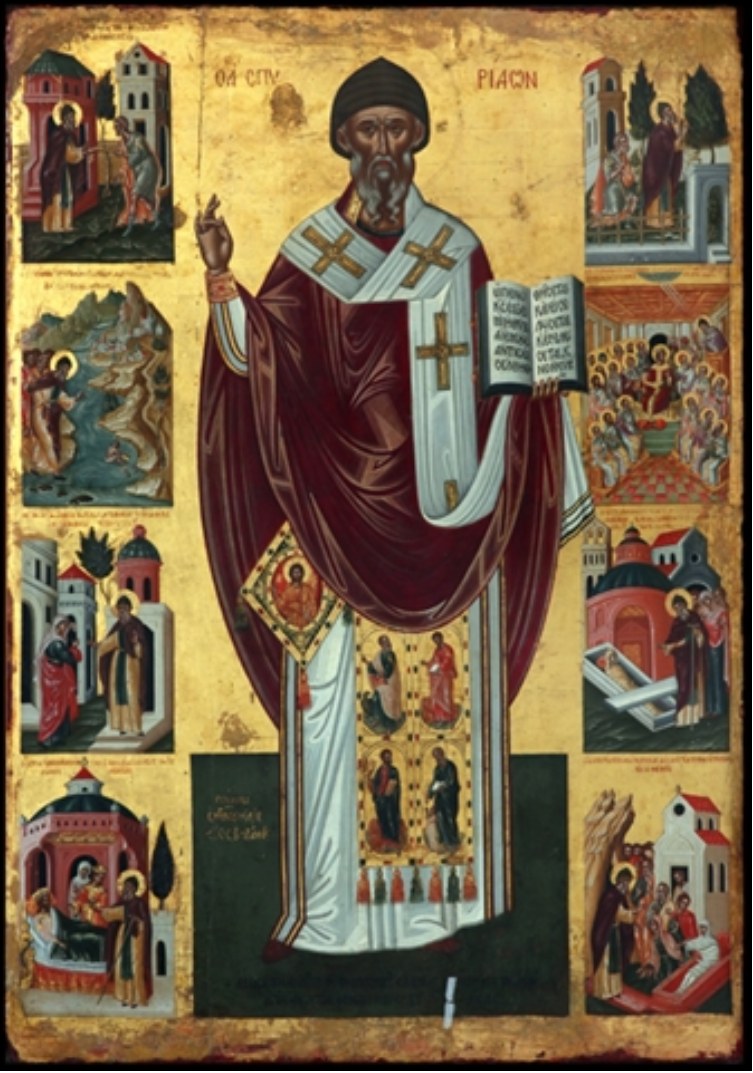
Spyridon is one of the most instantly recognisable of all the hierarchs, and for a single reason: alone among bishop-saints, who are shown bareheaded, he wears a distinctive plaited or woven cap, shaped like a shepherd's hat or a beehive — a memory of his years in the fields, kept in the iconography as the sign of his origins and his humility. He is otherwise vested as a bishop, in phelonion or sakkos and omophorion, blessing with his right hand and holding the Gospel book. Vita icons surround the central figure with scenes of his miracles — the Council of Nicaea and the tile, the raising of the dead, the healing of the emperor, the questioning at the grave. The stored image is the celebrated vita icon of the Cretan master Emmanuel Tzanes (1636), "Saint Spyridon with Scenes from his Life," showing the saint in the woven hat with eight surrounding scenes.
Disputed questions
- The tile miracle. Spyridon's attendance at Nicaea in 325 is historically attested (Socrates and Sozomen both name him among the fathers), but the dramatic demonstration of the Trinity with a brick or tile is not found in the earliest notices and belongs to the later hagiographic tradition; the same demonstration is elsewhere attributed to other fathers. It is recorded here as the Church has received it, without prejudice to its origin.
- Dates. The year of birth (c. 270) and of repose (348) are the conventional figures of the tradition; the sources give only the reigns (Constantine, and the Council of 325) as fixed points.