
Stephen the New
Our Venerable Father Stephen the New, Monastic Martyr and Confessor, of Mount Saint Auxentius
Venerable Martyr · Martyr · b. c. 715 — d. 764
Commemorated 28 November — Martyrdom at Constantinople
Stephen the New (c. 715–764) was the foremost martyr of the second period of iconoclasm and the great monastic witness against the emperor Constantine V Copronymus. An ascetic and abbot of Mount Saint Auxentius near Chalcedon, he became the acknowledged leader of the defenders of the holy icons after the iconoclast Council of Hieria (754), refusing every bribe and threat to make him subscribe to it. Imprisoned, exiled, and at last handed to a mob, he was dragged through the streets of Constantinople and beaten to death on 28 November 764. Because his confession joined the ascetic and the martyric crowns, the Church styles him "monastic-martyr and confessor," and his Life became one of the principal documents of the whole iconoclast controversy.
.jpg)
Origins and early life
Stephen was born about 715 at Constantinople, the longed-for son of pious parents who already had two daughters. The tradition, following his early biographer, relates that his mother carried the newborn to the great church of the Theotokos at Blachernae and there dedicated him to God, as Hannah had dedicated Samuel — a comparison the hymns of his feast take up directly.
His boyhood coincided with the outbreak of the imperial war on the holy images. Under Leo III the Isaurian (717–741), whose edicts against the icons began about 726–730, Orthodox devotion survived chiefly in the monasteries and in private faith rather than in the capital's official Church. His parents, grieving at the prevailing impiety, withdrew from Constantinople into Bithynia and there gave their sixteen-year-old son into the keeping of a solitary named John, an ascetic of Mount Saint Auxentius, the mountain above Chalcedon on the Asian shore of the Bosphorus. Stephen remained with the elder more than fifteen years, wholly given over to his direction and learning from him the whole discipline of the monastic life. During these years he received word that his father had died and that his mother and sisters had themselves received the monastic tonsure.
Ascetic struggle
When John in turn reposed, Stephen buried him and continued alone in the elder's cave. As so often, solitude drew disciples: monks gathered to learn from him, a community formed, and Stephen was made its abbot. At about forty-two years of age he surrendered even this, leaving the monastery he had founded to seek a stricter seclusion on a higher summit of the mountain; but here too a brotherhood assembled around him seeking his guidance, so that he governed while longing for the desert. His fame as an ascetic and wonderworker spread far beyond Bithynia, and his monastery became known in the capital — a reputation that was to prove fatal, because it placed the most respected monastic voice of the age unmistakably on the side of the icons.
The iconoclast council and the confession
Leo III was succeeded by his son Constantine V (741–775) — nicknamed by his enemies Kopronymos, "the dung-named" — a harder and more zealous persecutor than his father. In 754 he convened at Hieria, across the water from the capital, the iconoclast council that would style itself the Seventh Ecumenical Council: it gathered some 338 bishops, but was presided over by no patriarch save Constantine of Constantinople, whom the emperor had raised uncanonically to the throne, none of the other four patriarchates being represented. The council declared the icons idols, defined their veneration as heresy, and anathematised those who kept it.
The monks were the natural leaders of resistance, and Stephen the most eminent of them. The emperor and his patriarch understood that so long as this renowned abbot refused the council's decrees, the confession of the icons had a living head. They first sought to win him — by flattery, by gifts, by an appeal to subscribe — and, failing, turned to threats and then to slander. He was accused of an unchaste relation with a nun named Anna; but she denied the charge under torture and died of the beatings without incriminating him, so that the calumny collapsed. The emperor then ordered him imprisoned and his monastery destroyed. Iconoclast bishops sent to reason with him in prison found their arguments turned back on them, and Stephen unmoved.
Exile, the pillar, and the trial
He was next exiled to an island in the Sea of Marmara (the tradition points to Proconnesus). There again disciples found him out; he settled first in a cave and then, in the manner of the older Syrian ascetics, took up his stand upon a pillar, so that the news of "Stephen the Stylite" and of the healings worked through his prayers spread through the empire and strengthened the Orthodox.
Recalled, imprisoned on the island of Pharos, and at last brought to trial before the emperor and his court, Stephen gave the controversy its most famous image. To the iconoclast argument that to venerate the icon was to dishonour Christ, he answered by producing a gold coin bearing the emperor's likeness. He asked the judges what a man would deserve who threw the coin down and trampled the imperial image underfoot; they replied that such a man would be punished for insulting the emperor. Then, said Stephen, how much greater the punishment of those who dishonour the image of the King of Heaven and His saints — and with that he spat upon the coin, cast it down, and trampled the emperor's face beneath his own feet. The gesture, an argument turned into an act, is remembered as the classic reductio of the iconoclast position: honour or dishonour shown to an image passes to its prototype.
Martyrdom
Stephen was returned to prison, where already some three hundred and forty-two confessors of the icons were held, monks and others condemned for the same cause. There he passed his last eleven months turning the prison into a monastery, keeping the round of prayer and psalmody according to the typikon while crowds came to the gates asking his intercession. When the emperor learned that even in chains Stephen had gathered a praying community that venerated icons, he sent two of his own servants — twin brothers — to beat the confessor to death; but at the sight of his face they fell down and begged his prayers, and returned with a false report that the deed was done. Discovering the truth, Constantine resorted to a last device: telling a company of soldiers that the monk was plotting against his throne, he sent them to the prison. Stephen came out to meet them. They seized him and dragged him by the feet through the streets of the city until he was dead, then flung his mangled body into the pit where the bodies of criminals were thrown. His death is placed on 28 November 764.
The hagiographer records that on the following morning a fiery cloud was seen over Mount Auxentius and a heavy darkness with a killing hail fell upon the capital — signs read by the faithful as the vindication of the martyr and a judgement upon his persecutors.
The companions
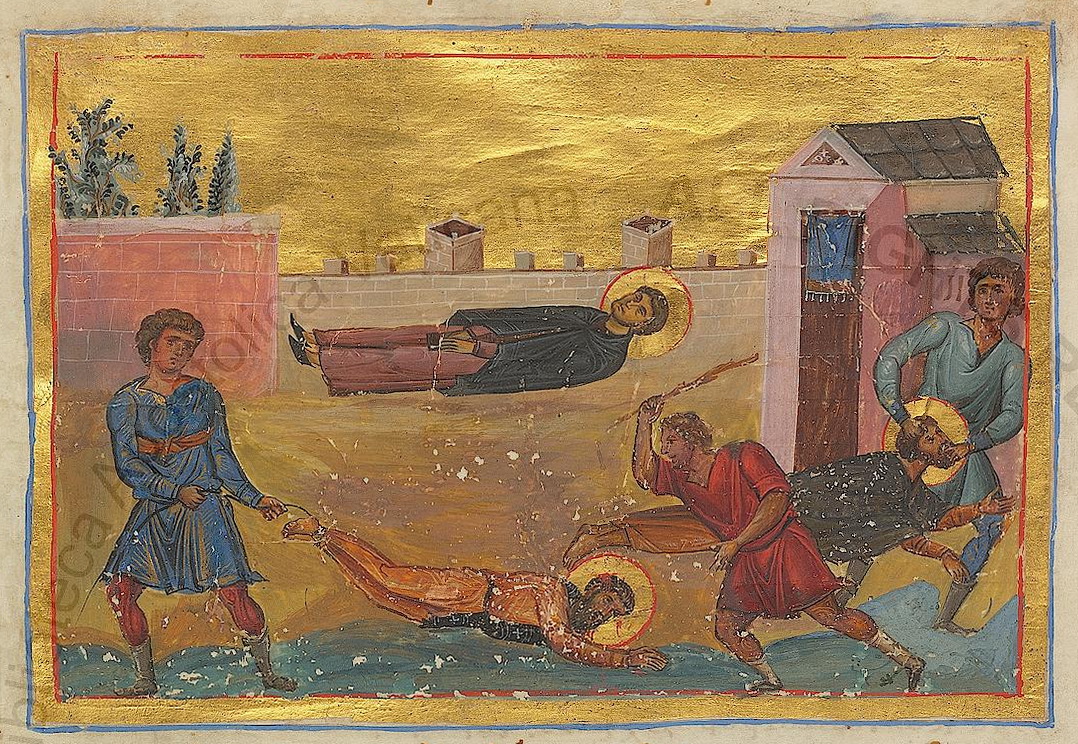
Stephen did not suffer alone, and the day's commemoration gathers those who died with and after him for the same confession. The nun Anna, tortured to make her slander him, died under the lash and is counted among the martyrs of the day. The company of confessors imprisoned with him — the calendars name Basil, two named Gregory, John, and others — were put to death after him for the veneration of the icons; and the Greek synaxarion of the day singles out two by name and manner of death: Andrew, dragged along the ground like his teacher, and Peter, beaten to death, both "for the honouring of the holy images." The stored icon of this feast, a miniature of the Menologion of Basil II, shows Stephen dragged upon the ground with Peter and Andrew suffering beside him. These are venerated together with him and have no separate feast; their account belongs to his.
Veneration and later cultus
Stephen's death made him at once the emblem of the icons' cause, and the restoration of the images — first briefly under the empress Irene and the Seventh Ecumenical Council of 787, then definitively in 843 — sealed his memory as that of the pre-eminent martyr of the whole struggle. His Life, composed about 809 by the deacon Stephen of Constantinople (Stephen the Deacon), is not only a hagiography but one of the fullest narrative sources for the reign of Constantine V and for monastic life in the mid-eighth century; historians read it critically for its polemical shaping even as they mine it for detail. His relics were venerated at Constantinople, and churches and monasteries were dedicated to him in the Byzantine world and beyond.
Feast and commemoration
Stephen is commemorated on 28 November (church date; Old Calendar civil December 11), the day of his martyrdom, universally in the Byzantine rite and within the Nativity Fast. His service in the Menaion is a full one, with proper stichera by the Studite, two canons (the second for the martyr Irenarchus, who shares the day), and the kontakion given below; the day also gathers his fellow-confessors Andrew, Peter, Anna, and the rest, and the martyr Irenarchus of Sebaste with the seven women.
Hymns
Troparion — Tone 4
Having trained yourself beforehand in asceticism on the mountain, with the whole armour of the Cross you laid low the invisible battle-lines of the enemy, O all-blessed one; and again you stripped for the contest manfully, slaying Copronymus with the sword of faith. For both crowns you were crowned by God, O monastic-martyr Stephen of everlasting memory.
Original translation from the Greek
Kontakion — Tone 4
Today the Church keeps a joyful feast in your memory, and faithfully extolling you cries aloud: O divine Stephen, boast of the venerable.
Original translation from the Greek
Iconography
Stephen the New is shown as a monastic — bearded, in the tunic and mantle of the schema, often holding a small icon of Christ or of the Theotokos as the badge of his confession, the sign that he died for the images. Two scenes recur: his standing portrait with the icon in hand, and the narrative of his martyrdom, in which he is dragged along the ground by the feet. The stored image is the miniature for his feast in the Menologion of Basil II (Constantinople, c. 985): Stephen lies dragged upon the earth, his companions Peter and Andrew are beaten and pulled down beside him, and the martyrdom unfolds before the city wall. (The Vatican scan carries a faint diagonal watermark.)
Disputed questions
- Year of death. The sources and calendars vary between 764, 765, and 767; 764 is followed here, with Wikidata and much scholarship, and the day (28 November) is firm.
- Year of birth and age. Birth is given as 713 or 715, making him about forty-nine to fifty-two at his death; c. 715 (with the OCA and the Life) is used here.
- "Confessor" and "martyr." He is styled both Homologetes (Confessor, for his witness under persecution) and Hosiomartyr (monastic-martyr, for his violent death); the calendars lead with the monastic-martyr title, and this entry classifies him accordingly while retaining the Confessor style he bears in the service and synaxarion.
- The number of the council's bishops. The iconoclast council of 754 is given 338 bishops in most accounts (some sources round to 348 or 358); the essential and undisputed point is that no patriarch but the emperor's own attended.
- Not to be confused with two other saints named Stephen: Stephen the Protomartyr and Archdeacon (the first martyr, commemorated December 27 and September 15), and Stephen the Hymnographer of the Lavra of Saint Sabbas (October 28). Stephen the New is the eighth-century iconophile abbot of Mount Auxentius; the epithet "the New" (or "the Younger") distinguishes him from the Protomartyr.