
Symeon of Trebizond
The Holy New Martyr Symeon of Trebizond, the Goldsmith, who suffered at Constantinople
New Martyr · b. at Trebizond, early 17th century — d. 14 August 1653, at Constantinople
Commemorated 14 August — Hanged at Constantinople, 1653, for refusing to deny Christ
Symeon, a goldsmith of Trebizond working in Constantinople, was hanged under a plane tree in the imperial city on 14 August 1653, refusing to save his life by accepting Islam. He had been caught up in a street affray between Christians and their neighbours, accused of stabbing a man who afterwards died of the wound, and offered by the judge the standard Ottoman escape from a capital sentence — apostasy. His recorded answer, "Though you give me ten thousand deaths, I will not be parted from the faith and the love of Jesus Christ, my Lord and my God," is the reason the Church numbers him not among the executed but among the new martyrs. His passion was written down by the Constantinopolitan scholar John Karyophylles, which makes him one of the better documented of the mid-seventeenth-century martyrs.

Trebizond and the goldsmiths' quarter
Symeon was a Pontic Greek, born at Trebizond on the Black Sea — the last Greek capital to fall to the Ottomans (1461) and, two centuries later, still a substantially Christian city whose people supplied the imperial capital with craftsmen. He himself went to Constantinople and there practised the trade of goldsmith (χρυσοχόος), one of the guild trades in which the Greeks of the city remained pre-eminent under Ottoman rule, working in the covered market alongside Armenian and Jewish craftsmen in the same line.
The goldsmiths' quarter was a place of constant, close, and often abrasive contact between the communities of the city, each subject to its own law and each liable in a criminal matter to be judged by a Muslim magistrate. It is out of exactly such contact that Symeon's passion arose.
The affray and the accusation
The account, as the Greek synaxarion transmits it from Karyophylles, is precise about the sequence and open about its ambiguity. Symeon found himself in a brawl between Christians and a group the Greek text calls τουρκοεβραῖοι — a term of Ottoman communal usage, denoting Jews under Turkish rule (and, in seventeenth-century Constantinople, sometimes converts from Judaism to Islam). One of that party was stabbed. Symeon was accused of the stabbing, an accusation the account calls a slander (συκοφαντήθηκε), and was arrested and imprisoned.
He lay in prison forty days. When the wounded man's condition improved, the court dealt with the matter as a civil injury: Symeon was released on payment of 280 grosia to the injured man for his treatment — a heavy but survivable fine, and the ordinary outcome of such a case.
Ten days after his release, the wounded man died of his injuries. The case was reopened as a homicide, and Symeon was arrested a second time.
"Though you give me ten thousand deaths"
Under Ottoman law a Christian condemned for the killing of a non-Christian faced death; and under the same law there was one exit, universally understood and frequently offered by the courts. The judge pressed Symeon to become a Muslim in order to escape the capital sentence.
This is the hinge on which every one of the neomartyria turns, and the reason the Church honours men who were, in the eyes of the state, ordinary criminal defendants. The moment the alternative to death is apostasy, the sentence ceases to be a punishment for an alleged act and becomes a trial of faith. Symeon answered — the words are preserved — "Though you give me ten thousand deaths, I will not be parted from the faith and the love of Jesus Christ, my Lord and my God."
Sentence was carried out on 14 August 1653. He was hanged from a plane tree in Constantinople — the great planes of the city's squares served as gallows in this period, and more than one new martyr died on them. He was still a young man; the icon tradition paints him beardless.
The written passion
The martyrion of Symeon was composed by John Karyophylles (Ἰωάννης Καρυοφύλλης, c. 1600–1693), the Great Logothete of the Great Church, teacher of the Patriarchal Academy and one of the leading Greek scholars of his generation — the same man whose theological positions on the eucharist were condemned at the end of his life. That so eminent a figure took the trouble to write up the death of a goldsmith is a measure of how the Phanariot church of the mid-seventeenth century understood the new martyrs: as the living proof, against the steady drift of conversions, that the faith still produced confessors.
Feast and commemoration
Symeon is commemorated on August 14 (church date; New Calendar civil August 14, Old Calendar civil August 27), the last day of the Dormition fast and the Forefeast of the Dormition, and is kept chiefly in Greek usage and under the Ecumenical Patriarchate, with a particular veneration among the Pontic Greeks and in the diaspora communities of Trebizond origin. Like most of the new martyrs of the Turkish period, he is also commemorated collectively on the Sunday of All Saints and in the synaxis of the new martyrs. The Slavic calendars do not carry him for this day.
Hymns
Apolytikion — Tone 4
A new champion of the faith hast thou been shown, O Symeon, contending lawfully in the latter days; for having despised the deceit that was offered thee in place of death, thou didst confess Christ before the judge and didst ascend the tree rejoicing: wherefore entreat him, O martyr, that our souls may be saved.
Iconography
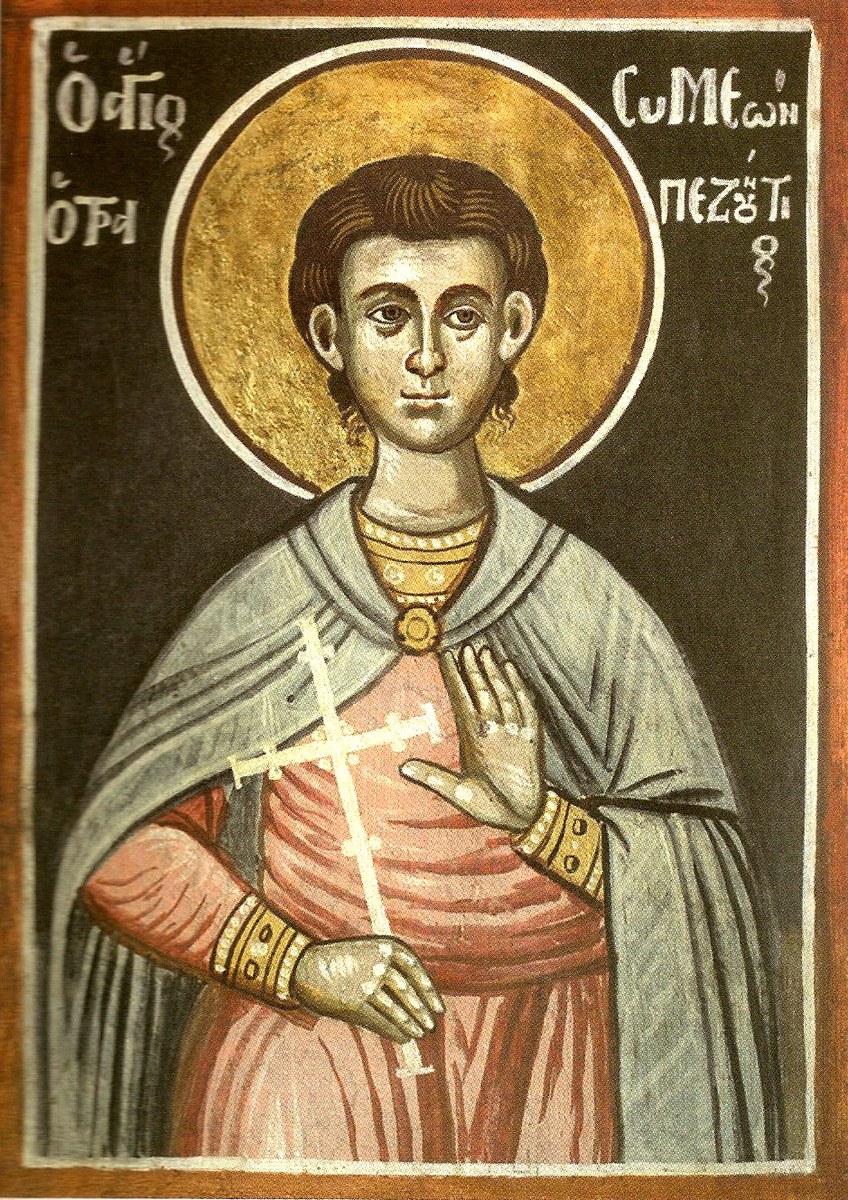
Symeon is painted as a young layman: beardless or with the first down of a beard, the hair dark and short, in the dress of a prosperous Constantinopolitan craftsman rather than in any monastic or military habit, and holding the martyr's cross. Where a narrative scene is given, it shows the plane tree and the noose. As a goldsmith he is occasionally shown with the tools or the wares of his trade, and he is invoked by the guild.
The stored image is a post-Byzantine Greek panel of the seventeenth to nineteenth century, inscribed at the left Ο ΑΓΙΟ[Σ] and at the right ϹΥΜΕωΝ / [ΤΡΑ]ΠΕΖΟΥΝΤΙΟϹ — "Saint Symeon of Trebizond." The martyr is shown half-length against a dark ground, a broad gold nimbus behind him, in a rose-red tunic with a gold collar and clasp and a grey-blue mantle; his right hand is raised to his breast and his left holds the white cross of the martyrs. The inscription was read on the image itself before it was stored.
Disputed questions
- The stabbing. The synaxarion states plainly that the charge was a calumny, and it is recorded here as the source gives it; no independent testimony survives on either side. The Church's veneration does not rest on the question, since the martyrdom lies in the refusal of apostasy offered as a pardon, not in the innocence or guilt of the original charge.
- The terminology. The Greek notice's word τουρκοεβραῖοι reflects seventeenth-century Ottoman communal categories rather than any modern one, and is reported here for accuracy of the source. Nothing in the martyr's own recorded words touches the other community; his confession is addressed to the judge and concerns Christ alone.