
Tabitha
The Holy and Righteous Tabitha, raised from the dead by the Apostle Peter
Righteous · d. 1st century
Commemorated 25 October — Commemoration of the disciple raised by the Apostle Peter
Tabitha — called in Greek Dorcas, both names meaning "gazelle" — was a woman disciple of the earliest Church at Joppa on the coast of Judea, remembered in the Acts of the Apostles as one "full of good works and almsdeeds" who made garments for the widows of the community. When she fell sick and died, the disciples sent for the Apostle Peter, then at nearby Lydda; coming up to the room where she was laid out and the widows wept over the clothes she had made, Peter put them all out, knelt in prayer, and said, "Tabitha, arise." She opened her eyes and sat up, and the miracle, becoming known through all Joppa, brought many to faith. She is venerated among the righteous and commemorated on October 25.

The disciple of Joppa
Tabitha belonged to the Christian community of Joppa (the modern Jaffa), the ancient port on the Mediterranean coast of Judea, in the first years after Pentecost. The Acts of the Apostles introduces her with a word used of no other woman in the New Testament — mathetria, the feminine of "disciple" — and sums up her life in a phrase the Church has never let go: she "was full of good works and almsdeeds which she did" (Acts 9:36). The tradition understands her as a widow of means who gave herself to charity, and above all to clothing the poor: when she died, the widows of Joppa stood weeping and showing "the coats and garments which Dorcas made, while she was with them" (Acts 9:39). Her double name is given by Luke himself — Tabitha in the Aramaic of the Jewish Christians of Joppa, Dorcas in the Greek of the wider world — and both render the same image of the gazelle, a figure of grace and gentleness.
Death and raising
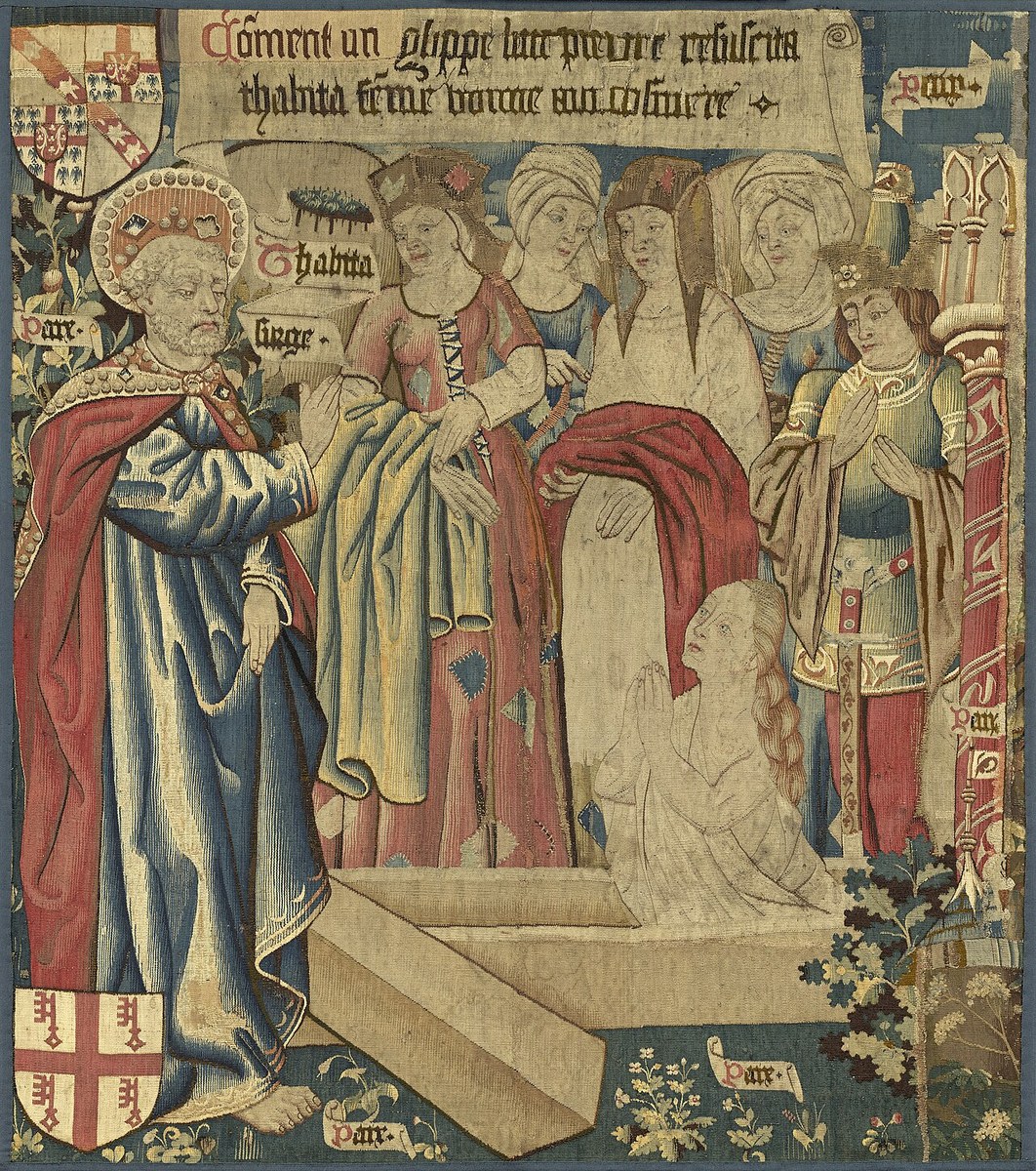
Tabitha fell ill and died, and the community washed her body and laid it in an upper room. Hearing that Peter was in Lydda, some ten miles inland — where he had just healed the paralytic Aeneas — the disciples of Joppa sent two men to urge him to come without delay. Peter came, and going up to the upper chamber found it filled with mourning widows displaying the clothes Tabitha had made for them. He sent them all out of the room, knelt down and prayed, then turned to the body and said, "Tabitha, arise." She opened her eyes, and seeing Peter, sat up; he gave her his hand and lifted her to her feet, then called in the saints and widows and presented her alive (Acts 9:40–41). The raising — the first restoration to life worked by an apostle in the Acts, an echo of the Lord's own raising of the daughter of Jairus, whom he had bidden "arise" with almost the same word — became known throughout Joppa, "and many believed in the Lord" (Acts 9:42). Peter remained in the city many days, lodging with Simon the tanner; it was there, on the housetop, that he received the vision of the sheet let down from heaven that opened the Gospel to the Gentiles. Of the rest of Tabitha's life the Scripture says nothing; the Church honours her as a righteous almsgiver whom God restored to her works of mercy.
Veneration and the site at Jaffa
Tabitha's memory has always been bound to Joppa, and her traditional tomb is shown there to this day. On the southeastern edge of Jaffa the Russian ecclesiastical mission acquired the site in the later nineteenth century and built the church of the Apostle Peter and the Righteous Tabitha, dedicated in 1888, over a rock-cut tomb and remains of a Byzantine-era chapel and mosaics identified by pilgrim tradition with her burial. The garden compound has become a place of pilgrimage, keeping alive in the land itself the memory of the gazelle of Joppa.
Feast and commemoration
October 25 (church date; Old Calendar civil November 7), together with the martyrs Marcian and Martyrius. Tabitha is venerated across the Byzantine rite among the righteous of the apostolic age; the Slavic and Greek calendars keep her on this day.
Iconography
Tabitha is depicted in the scene of her raising: she rises or sits up from her bier or bed as the Apostle Peter, standing over her, extends his hand and blesses, while the widows of Joppa look on, sometimes holding the garments she had sewn for them. She herself is shown as a matron in the veil and long robe of a widow. There is no ancient Byzantine panel-icon of her in wide circulation; the tradition transmits her chiefly through the narrative image of the miracle. The stored image is a fifteenth-century Netherlandish depiction of the raising of Tabitha, showing Peter raising her before the assembled widows.