
Ten Martyrs of Crete
The Holy Ten Martyrs of Crete
Martyr · d. c. 250
Commemorated 23 December — Martyrdom at Gortyna under Decius
The Ten Martyrs of Crete — Theodulus, Saturninus, Euporus, Gelasius, Eunician, Zoticus, Pompeius, Agathopus, Basilides and Evaristus — were Cretans of several towns who confessed Christ together at Gortyna, the Roman capital of the island, and were beheaded there around the year 250 in the persecution of the emperor Decius. Interrogated and tortured over some thirty days by a governor of Crete who also bore the name Decius, they held firm and died as one company. They are the patron-martyrs of the whole island — its foundational Christian witnesses, whose memory is preserved in the village near Gortyna still called Agioi Deka, "the Holy Ten" — and their feast on December 23 falls within the Forefeast of the Nativity, so that the hymns of the day join their contest to the coming of Christ.

Origins and early life
The ten belonged to Crete, an island evangelised in apostolic times: the Apostle Paul left Titus there to ordain presbyters "in every city" (Titus 1:5), and the Church of Crete counted Titus its first bishop. By the middle of the third century Christianity was well rooted among the Cretans, though the island remained overwhelmingly pagan, with Gortyna — its Roman administrative centre in the fertile Messara plain — a stronghold of the old cults. The sources name the ten as men drawn from different parts of the island: Theodulus, Saturninus, Euporus, Gelasius and Eunician are associated with Gortyna itself, Zoticus with Knossos, Pompeius (also given as Pompius or Pompey) with Lebena on the south coast, Agathopus with the port of Panormos, Basilides with Cydonia (modern Chania), and Evaristus with Heraklion. They were, the synaxaria say, of good repute, and united not by kinship but by a common confession.
Martyrdom
Their sufferings fell in the general persecution decreed by the emperor Decius (reigned 249–251), the first empire-wide assault on the Church, which required every subject to sacrifice to the gods and obtain a certificate of having done so. The persecution on Crete was pressed by a governor whom the tradition also names Decius — a coincidence of name that the hagiographers underline — who took particular zeal against the Christians of Gortyna. The ten were arrested in their several towns and brought together before him.
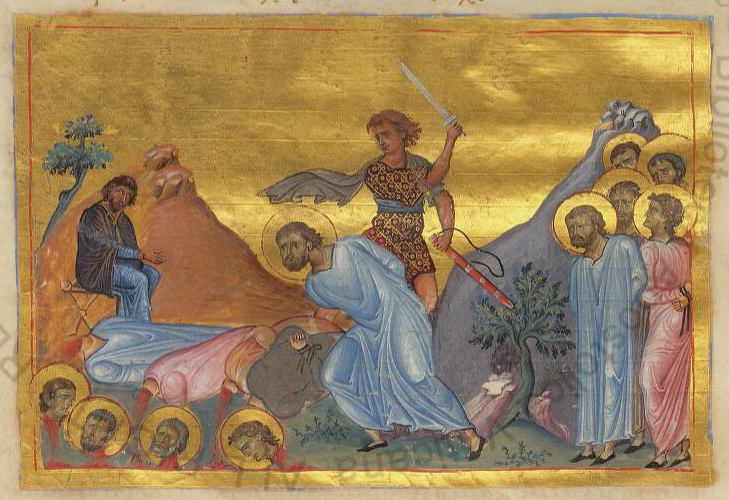
Commanded to sacrifice, they refused with one voice. The account describes a protracted ordeal: over roughly thirty days they were paraded, mocked, scourged, stoned, dragged over rough ground, and pressed to worship Zeus, Apollo and the other gods of the island, the governor alternating threats with promises of honour. The ten answered his arguments and endured the tortures, confessing Christ and deriding the idols as lifeless. When it became plain that neither pain nor persuasion would move them, sentence of death was passed, and the ten were led out together and beheaded — the Byzantine verse for the day summing it in a line: "on the twenty-third, ten men were cut down in Crete." The martyrdom is dated to about 250. Christians of Gortyna took up the bodies and buried them with honour.
Relics and veneration
The tomb of the ten at Gortyna became the centre of their cult, and their fame spread quickly through the Greek world; portions of their relics were later distributed, and their names entered the Synaxarion of Constantinople and the Menaion, giving them a place in the universal calendar. On Crete itself their memory never lapsed: the village that grew up near the ruins of Gortyna is named Agioi Deka ("the Holy Ten") after them, and its church — with an early Christian crypt and columns traditionally shown as the block on which the martyrs were beheaded — remains their principal shrine and a place of island pilgrimage. They are venerated as the protomartyrs and patrons of Crete, the island's own company of witnesses set beside its apostolic founder Titus.
Gelasius of the ten is not to be confused with Gelasius the Martyr commemorated on June 6 — a distinct martyr of one of the general persecutions, of unknown date and province, whose notice remembers him for giving away all he had, going among the imprisoned confessors in a long white robe and kissing their wounds, and being scourged and beheaded alone. The two share only the name.
Feast and commemoration
December 23 (church date; Old Calendar civil January 5), kept universally in the Byzantine rite. The date sets the feast in the last days of the Forefeast of the Nativity, and the Menaion deliberately reads the martyrs in the light of the approaching feast: their canon and kontakion for the day are composed as a forefeast of the martyrs' own, the ten made heralds of the One about to be born in the cave of Bethlehem. On Crete the day is a major local celebration, especially at Agioi Deka; the Church of Crete keeps the ten among its chief patrons.
Hymns
Troparion — Tone 3
Let us honour Crete, rich in wonders, that put forth precious flowers, the pearls of Christ — martyrs grown together into one, ten in number, O blessed ones — who put to shame the whole idolatrous nation, and therefore received their crowns, O valiant of soul.
Original translation from the Greek
Kontakion — Tone 4
The morning star has shone forth — the honoured contest of the martyrs — foreshowing to us the One born in the cave, whom the Virgin bore without seed.
Original translation from the Greek
Appointed readings
Epistle — Ephesians 6:10–17 (proper to the martyrs)
10Finally, my brethren, be strong in the Lord, and in the power of his might. 11Put on the whole armour of God, that ye may be able to stand against the wiles of the devil. 12For we wrestle not against flesh and blood, but against principalities, against powers, against the rulers of the darkness of this world, against spiritual wickedness in high places. 13Wherefore take unto you the whole armour of God, that ye may be able to withstand in the evil day, and having done all, to stand. 14Stand therefore, having your loins girt about with truth, and having on the breastplate of righteousness; 15And your feet shod with the preparation of the gospel of peace; 16Above all, taking the shield of faith, wherewith ye shall be able to quench all the fiery darts of the wicked. 17And take the helmet of salvation, and the sword of the Spirit, which is the word of God:
Iconography
The ten are shown as a company — a row or cluster of youthful and mature men in the tunics and mantles of laymen, each bearing the martyr's cross, sometimes gathered before the executioner or beneath a single sword. The stored image is the miniature of the Menologion of Basil II (Constantinople, c. 985), which depicts the ten standing together at the moment of their beheading, an angel or the hand of God above, and their names inscribed. In post-Byzantine Cretan-school panels — the island honouring its own patrons — the ten are grouped in two rows of five, holding crosses, above or beside a view of Gortyna.