
Theodosia of Constantinople
The Holy Venerable Virgin-Martyr Theodosia the Nun of Constantinople
Venerable Martyr · Virgin · d. 729 (or 726/730), at Constantinople
Commemorated 29 May — Martyrdom at the Forum of the Ox for the icon of Christ of the Chalke Gate
Theodosia was a nun of the monastery of the Martyr Anastasia at Constantinople who, when soldiers of the emperor Leo III the Isaurian came to take down the venerated image of Christ that hung above the great bronze Chalke Gate of the imperial palace, ran with other women of the city, shook the ladder until the officer on it fell to his death, and was seized, beaten through a week of imprisonment, dragged to the Forum of the Ox and killed by a ram's horn driven into her throat. She is honoured as the first martyr of the iconoclast persecution — a monastic woman who met the first act of official iconoclasm with her own hands — and her shrine at the church of St Euphemia en to Petrio, afterwards renamed for her, became one of the great healing-shrines of Byzantine Constantinople. She is not Theodosia of Tyre, the maiden martyred in Palestine in 307, with whom the calendars constantly confuse her.
.jpg)
Origins and monastic life
The tradition presents Theodosia as a native of Constantinople, born late in her parents' married life in answer to their persistent prayer for a child — the pattern the synaxaria use for saints marked out from the womb. Her parents died while she was still young, and she was brought up in the women's monastery of the Holy Martyr Anastasia in the capital, where in due course she received the tonsure. Coming into her inheritance, she gave the greater part of it to the poor and spent the remainder on icons wrought in gold and silver — of the Saviour, of the Theotokos, and of St Anastasia, the martyr of her own house. The detail is neither ornamental nor accidental: the woman who died for an image of Christ is remembered first as one who had spent her whole patrimony on images, and the notice thereby makes her martyrdom the natural end of her monastic life rather than an accident of the street.
The icon of Christ over the Chalke Gate
Over the Chalke — the "Bronze" vestibule that formed the ceremonial entrance to the Great Palace, at the very hinge between the palace, the Hippodrome and the Augustaion — there hung a figure of Christ Chalkites, an image that the tradition says had stood in that place for more than four hundred years. Its position made it the most publicly visible sacred image in the empire, the icon under which every embassy, procession and triumph passed. When the emperor Leo III turned against the veneration of images, it was this icon he moved against first, and precisely because taking it down was a proclamation: the whole city would see the empire's most conspicuous icon replaced.
An officer — the sources call him a spatharios or spatharokandidatos — was sent with a ladder to cut the image down. A crowd of women gathered as he climbed, and among them Theodosia. They begged him to desist; when he set his axe to the image, Theodosia took hold of the ladder and shook it until he fell from his height and was killed. The crowd, now a riot, tore the man to pieces and carried the tumult through the streets; and the removal of the Chalke icon, thus resisted, became both the first act and the first bloodshed of the iconoclast century.
Martyrdom
Theodosia was arrested. She was held in prison, and for a week she was beaten daily — by one account a hundred stripes a day. At the end of it she was led out and paraded through the city, still under the lash, to the Forum of the Ox (τὸ Βοῦς, the Boarion), the place of public execution in the western quarters. There one of the soldiers took a ram's horn and drove it into her throat, and she died. The tradition remembers her as ὁσιομάρτυς — a venerable-martyr, a monastic who died a martyr's death — and as the protomartyr of the icons.
The women who suffered with her are not forgotten. Some notices speak of a company of nine who were beheaded or drowned with her; the Byzantine synaxaria, however, keep Theodosia's name alone, and it is her alone whose cultus survived.
Relics, shrine and cultus
When the veneration of the icons was restored, Theodosia's body was translated to the church of St Euphemia en to Petrio, on the slope above the Golden Horn in the north-western quarter of the city. Her tomb there became a shrine of the first rank. The sick were brought to it, and the Constantinopolitan sources record crowds so dense on her feast that the approach had to be managed; a famous cure of a deaf-and-dumb man in 1306 is reported among many. In time the church itself came to be known not by Euphemia's name but by Theodosia's — Hagia Theodosia — and the sea gate beside it took her name too, the Ayakapı ("Saint's Gate") of Ottoman and modern Istanbul. The building is generally, though not universally, identified with the Gül Camii ("Rose Mosque") in the Ayakapı quarter, and the Turkish name is popularly explained by the roses with which her shrine was heaped on her feast.
That feast fell on 29 May. It was therefore on St Theodosia's day, and at her shrine, that the last hours of Byzantine Constantinople were spent: the tradition of the city holds that the faithful were keeping her vigil, and carrying flowers to her tomb, when the walls were breached on 29 May 1453. It is a coincidence of the calendar rather than a fact of her Life, but the Greek memory has never separated the two, and her name is spoken with the fall of the City.
Feast and commemoration
May 29 (church date; New Calendar civil May 29, Old Calendar civil June 11). Kept universally: in the Greek synaxaria as ἡ ὁσιομάρτυς Θεοδοσία ἡ μοναχή, in Antiochian and other New-Calendar usage on May 29, and in the Russian books on Old-Calendar May 29 (civil June 11). The Roman martyrology commemorates her on July 18.
Because Orthodox Pascha falls between April 4 and May 8, this day always stands within the Pentecostarion, and in a given year the movable commemoration falling on it takes precedence over the fixed. In Constantinople her feast was a public one, with the crowds and the roses noted above; and it is the day of the fall of the City in 1453, so that in Greek usage her memory and that mourning are inseparable.
Hymns
Troparion — Tone 4 (common of a woman-martyr)
Thy lamb, O Jesus, crieth with a loud voice: Thee, O my Bridegroom, do I love, and seeking Thee I pass through many sufferings; I am crucified and buried with Thee in Thy baptism, and I suffer for Thy sake that I may reign with Thee; I die for Thee that I may live in Thee. Accept me as a spotless sacrifice offered in love. By her prayers, O merciful One, save our souls.
Original translation from the Greek
Kontakion — Tone 2
Thou didst spend thy patrimony upon the holy images, and for an image thou didst give thy blood; for when the destroyer set his hand to the Saviour's likeness above the gate, thou didst cast him down, O bride of Christ, and didst receive the ram's horn as a crown. Wherefore, O venerable martyr Theodosia, pray that our souls may be kept in the true faith.
Original translation from the Greek
Iconography
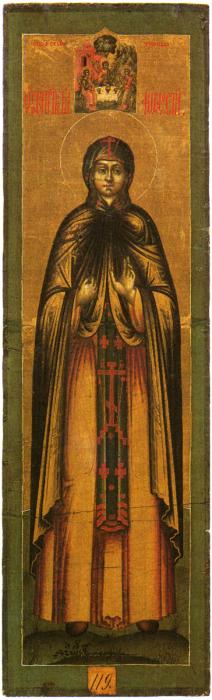
Theodosia is painted as a nun, and that is the whole key to telling her from her Tyrian namesake: she wears the dark monastic mantion over the rasson, with the head veiled, and very often the great-schema analavos — the embroidered band bearing the cross of Golgotha with the lance and reed, the skull and the instruments of the Passion — laid over the breast. Her hands are commonly raised before her in prayer, or she holds a cross, or — most tellingly — a small icon of Christ, the image of the Chalke Gate for which she died. Narrative scenes of her passion show the gate with the figure of Christ above it, the ladder, the soldier falling, and the women below; the martyrdom itself is shown at the Forum of the Ox, the ram's horn in the soldier's hand. Russian painting knows her well, both singly and in the May menologion registers.
The stored image is a Muscovite icon of 1690 by Kirill Ulanov, a мерная икона or "measure icon" — a panel painted to the length of a newborn child and given as its name-saint's image, in this case for the Tsarevna Feodosia Ivanovna, daughter of Ivan V — from the Ascension Convent in the Moscow Kremlin, now in the State Tretyakov Gallery. It shows her full-length on a gold ground in the black mantle with the schema-cross in red and green upon it and a red under-robe, hands raised in prayer, with the Hospitality of Abraham (the Old Testament Trinity) in the upper field and the red inscription naming her venerable-martyr (прпⷣмчнца) Theodosia — the monastic title that distinguishes her from Theodosia of Tyre. Its tall narrow format is a consequence of its purpose. The photograph on Commons is a faithful flat reproduction of a 1690 panel and is marked public domain.
Disputed questions
- Not to be confused with Theodosia of Tyre (†307, feast April 3) — the young laywoman of Tyre, not yet nineteen, tortured and drowned at Caesarea in Palestine under the governor Urbanus, whose martyrdom Eusebius witnessed. The two are a different age, a different country, a different state of life and a different manner of death: Theodosia of Tyre is a virgin-martyr of the last pagan persecution; Theodosia of Constantinople is a nun of the iconoclast crisis four centuries later. The confusion is nevertheless entrenched, and for a specific reason: several calendars — the OCA day-page among them — carry both Theodosias on May 29, the Tyrian saint being kept on that day as well as on her own April 3, so that the two names stand side by side in one day's list. Some abridged notices go further and merge the two into a single composite saint of Constantinople martyred under Diocletian, which is a confusion of two entries and not a variant tradition. Iconography is where the error does real damage: the nun in the mantle and the great-schema analavos is Theodosia of Constantinople, and the young woman in the martyr's tunic with the sea behind her is Theodosia of Tyre.
- The year. The Chalke icon's removal is dated by historians to 726 (following the chronology of Theophanes the Confessor, who links it to the volcanic eruption at Thera and Leo's reading of it as a divine judgement on images) or to 730, the year of the formal iconoclast edict and of the deposition of the Patriarch Germanus. The hagiographic tradition of Theodosia commonly gives 729, and some notices date her death to 19 January of that year while keeping her feast on 29 May — a discrepancy the sources do not explain, and which may preserve the memory of a translation on the later date. The OCA notice, which attributes the order for the icon's removal to "the patriarch," is following a chronology in which the deed belongs to 730 and therefore to the iconoclast patriarch Anastasius rather than to the orthodox Germanus. This repository records the variants and does not adjudicate between them.
- Whether the episode happened. Modern Byzantine scholarship — most influentially Marie-France Auzépy's study of the Chalke icon (1990) — has argued that the whole incident of the icon, the ladder and the women is a construction of the post-iconoclast period: the earliest witnesses to Leo's iconoclasm say nothing of it, the developed story appears only in ninth-century and later sources, and it serves the polemical need of the victorious iconodules for a foundation-martyrdom. Others hold that a genuine riot at the Chalke lies beneath the later elaboration. The Church's veneration of Theodosia does not stand or fall with the outcome: her cultus in Constantinople is very early and very solid — a church, a city gate, a great pilgrimage and a fixed feast — and what is contested is the literary form of the narrative, not the existence of the saint.
- Her monastery. The house of St Anastasia in which she was raised is not securely located, and the Anastasia in question — the Roman virgin-martyr, the Widow, or Anastasia Pharmakolytria — is not specified by the notices.