
Theophano the Empress
The Holy and Right-believing Empress Theophano the Wonderworker
Righteous · Queen · Wonderworker · b. c. 866, Constantinople — d. c. 893/897
Commemorated 16 December
Theophano (c. 866 – c. 893/897) was the first wife of the Byzantine emperor Leo VI the Wise and one of the most beloved of the imperial saints of Constantinople — venerated not for her rank but for the piety, humility and charity by which she sanctified life in the palace. Chosen from the noble Martinakios family to marry the heir to the throne, she shared his three years' imprisonment under his father Basil I and, once freed, gave herself to prayer, fasting and unwearied mercy: building and restoring churches, feeding the poor, and visiting the afflicted in plain dress. Reputed a wonderworker in her own lifetime, she died young, and her incorrupt relics rest to this day in the Patriarchal Church of St George at the Phanar in Constantinople. She is commemorated on December 16.

Origins and early life
Theophano was born in Constantinople about the year 866, of the distinguished family of the Martinakioi — her father was Constantine Martinakios and her mother Anna, who, the tradition says, had long been childless and received their daughter as a gift of prayer, and raised her with care in the fear of God. She grew up gentle, devout and generous, formed in the Scriptures and the services of the Church.
When Theophano came of marriageable age, the emperor Basil I the Macedonian sought a bride for his second son and heir, Leo — the future Leo VI, called "the Wise" for his learning. By the custom of the Byzantine court a bride-show gathered the noble maidens of the empire, and from among them Theophano was chosen. The marriage, about 882/883, joined her to a husband with whom, the chroniclers say, she lived twelve years in fidelity, though it was never an easy union: Leo's heart was set elsewhere (on Zoe Zaoutzaina, whom he would later marry), and Theophano bore her position with patience.
Trial and imprisonment
The early years of the marriage fell under a heavy cloud. Leo was denounced to his father — falsely, on the tradition's account — as plotting against the emperor's life; a courtier was said to have shown Basil a dagger hidden in the young man's boot, planted there as evidence. Basil, believing the charge, cast his son into prison, and Theophano into confinement with him, where the two remained shut up for some three years, in danger and disgrace. Only after the intercession of the court and, the sources say, a portent read as heaven's vindication was Leo released and restored to the succession; on Basil's death in 886 he came to the throne as Leo VI. Through the whole ordeal Theophano is remembered as bearing her sufferings without complaint, in prayer and trust in God — the "patience and humility" her hymns single out for praise.
A holy life in the palace
Set free and raised to the rank of empress ("Augusta"), Theophano did not use her station for herself. Though surrounded by the wealth and ceremony of the imperial court, she renounced its luxury inwardly: she kept to simple, even mean clothing so as not to be recognised, wore a hair-shirt beneath the purple (as her kontakion sings, "covering the royal robe with sackcloth of hair"), and gave herself to secret ascetic labours of vigil and fasting. Her wealth she poured out on others — building new churches and monasteries and restoring those fallen into disrepair, ransoming captives, relieving the poor, and caring, as the chroniclers put it, like a true mother for the widows and orphans of the City. Attended by two trusted servants she would go herself to the houses of the poor and the persecuted to bring them help. So conspicuous were her charity and her holiness that she was reckoned a saint and a wonderworker even while she lived: it is recorded that where physicians despaired of the sick, her prayer restored them to health.
Repose and relics
Theophano died young — the Greek and Slavic tradition places her repose about the years 893–894, while modern scholarship, following the death-notice of the sources, more often gives 10 November 897. Leo, who came to honour his first wife as a saint, began even before her death to raise a church intending to dedicate it to her; but she forbade the dedication in her own name, and it was consecrated instead to All the Saints. From this, the tradition holds, came the emperor's decree that the Sunday after Pentecost be kept as the feast of All Saints — Leo reasoning that his wife, if she were indeed among the righteous, would be honoured whenever that feast was celebrated. Her body was found incorrupt, and her relics have been preserved through the centuries; they rest today in the Patriarchal Church of St George at the Phanar in Constantinople, with a portion at the Monastery of Dionysiou on Mount Athos.
Feast and commemoration
Theophano is commemorated on December 16 (church date; Old Calendar civil December 29), the same day as the Prophet Haggai and the Martyr Marinus of Rome, in the weeks of the Nativity Fast. Her cultus is centred on Constantinople, where her relics lie at the Phanar, but her memory is kept universally on this day in the Greek, Slavic, Antiochian and OCA calendars; the Slavic books style her "the blessed empress," the Greek "the wonderworker."
Hymns
Troparion — Tone 8
Hymning thee, the empress made manifest of God, and praising thy life like a nun's, blessing thy patience and humility of wisdom, with love we cry to thee without ceasing: Remember us also, O blessed Theophano, in thine unsleeping prayers to Christ.
Original translation from the Slavonic
Kontakion — Tone 2
Crowned on earth with a royal crown, O blessed Theophano, thou didst long for the crown of heaven; therefore thou didst chasten thy flesh with vigil and fasting, covering the royal purple with sackcloth of hair, and offering warm prayers to God at every hour, doing thy struggles in secret. Wherefore Christ our God, the Giver of the prize, made thee manifestly glorious; and now we all cry to thee: Rejoice, O blessed empress, for thou hast been counted worthy of the Kingdom of heaven.
Original translation from the Slavonic
Iconography
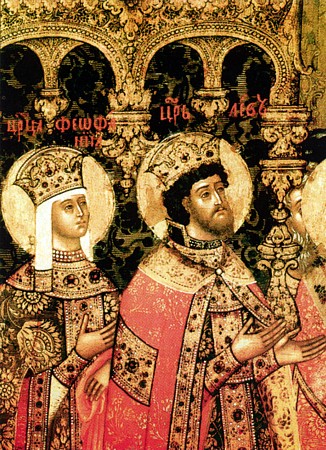
Theophano is depicted as a Byzantine empress: crowned, in the jewelled loros and imperial mantle, often holding a cross or a scroll — the marks of her rank worn by a saint who counted them nothing. She is frequently shown together with her husband Leo VI, the pair crowned and haloed side by side, as in the stored image, an eighteenth-century icon in which each is named in the inscription ("Empress Theophano," "Emperor Leo"). Her likeness is kept especially at the Phanar, where her relics repose, and at Dionysiou on Athos.
Disputed questions
- Date of repose. The received Byzantine and Russian usage gives c. 893–894; the critical sources and modern chronology give 10 November 897. The divergence is recorded, not resolved.
- Not to be confused with the other imperial Theophano of the same century — the wife of Romanos II and afterwards of Nikephoros II Phokas, mother of Basil II — a powerful and much-blackened figure of the palace who is not a saint; nor with Theophano (Theophanu), the Byzantine princess who became Holy Roman Empress as wife of Otto II. Our saint is Theophano of the Martinakios family, first wife of Leo VI.