
Theophilus the Confessor
Our Venerable Father Theophilus the Confessor
Venerable · Confessor · d. 716 (as transmitted; see Disputed questions)
Commemorated 2 October — Repose in peace; the Greek synaxaria keep him this day, the Slavic books on October 10
Theophilus the Confessor (†716, as the calendars transmit the date) was a monastic of Mount Selention who suffered for the holy icons at the outbreak of iconoclasm. A monk from the age of sixteen and later founder of a monastery near his home country, he openly resisted the iconoclast policy of the emperor Leo the Isaurian: he was beaten, led bound through the city, and given over to an official named Hypatius to be broken — whom Theophilus instead converted to the veneration of the icons, defending them from the brazen serpent of Moses, the cherubim of the Ark, and the Image of Edessa. Released, he returned to his monastery and reposed in peace soon after. The Greek synaxaria commemorate him on October 2, the Slavic books on October 10, and his transmitted dates contain a chronological knot recorded honestly below.
.jpg)
Origins and early life
The tradition places Theophilus's origins in the borderlands the later sources call Bulgaria — the region of Tiberiopolis (Strumica), though some recensions say "the country round Tiberias" — in the latter seventh century. At thirteen he left his parents' house secretly for the monastery on Mount Selention, where he was formed under an elder named Stephen, and after three years' testing received the monastic tonsure.
When his parents at last discovered where their son had gone, they came to the monastery — not to reclaim him, but to ask the igumen that Theophilus and some of the brethren be sent to found a new monastery nearer their home. The igumen set the whole community to fast and pray for a sign; on the third day, the tradition relates, a voice in the church gave the blessing, adding that Theophilus would become renowned for his ascetic struggles. He founded the new house and governed it, growing in the virtues and in reputation.
Confession under the iconoclasts
When the emperor Leo the Isaurian (717–741) moved against the holy icons, Theophilus resisted the innovation openly. By imperial order he was beaten and led through the city bound like a criminal, and then handed over to an official named Hypatius, charged with compelling the confessor to renounce the icons. The contest went the other way: Theophilus set before his keeper the classical defence of the images — the brazen serpent which Moses lifted up at God's command (Numbers 21:9), the cherubim of gold overshadowing the Ark of the Covenant, and the Icon of the Saviour Not-Made-by-Hands sent to Abgar, prince of Edessa — and Hypatius was persuaded. Won over, he obtained from the emperor the confessor's release.
Repose
Theophilus returned to his monastery and lived only a short time longer, reposing in peace. The transmitted year, 716, sits impossibly before the persecution it should follow (see below). The synaxarion's distich for October 2 plays on his name — Theophilos, "friend of God": "Precious in My sight is thy death," saith God to thee His friend Theophilus.
Feast and commemoration
October 2 in the Greek synaxaria (church date; Old Calendar civil October 15), where his memory follows that of Cyprian and Justina; October 10 in the Slavic tradition. He has no proper service: in the Menaion for October 2 he appears in the synaxarion notice with his distich, and the commons of a venerable are used where a fuller commemoration is required.
Hymns
Troparion — Tone 8
In thee, O father, that which was made according to the image of God was preserved exactly; for taking up the cross, thou didst follow Christ, and by thy deeds thou hast taught us to disdain the flesh, for it passeth away, but to care for the soul, which is a thing immortal: wherefore thy spirit, O venerable Theophilus, rejoiceth with the angels.
Original translation from the Greek
Iconography
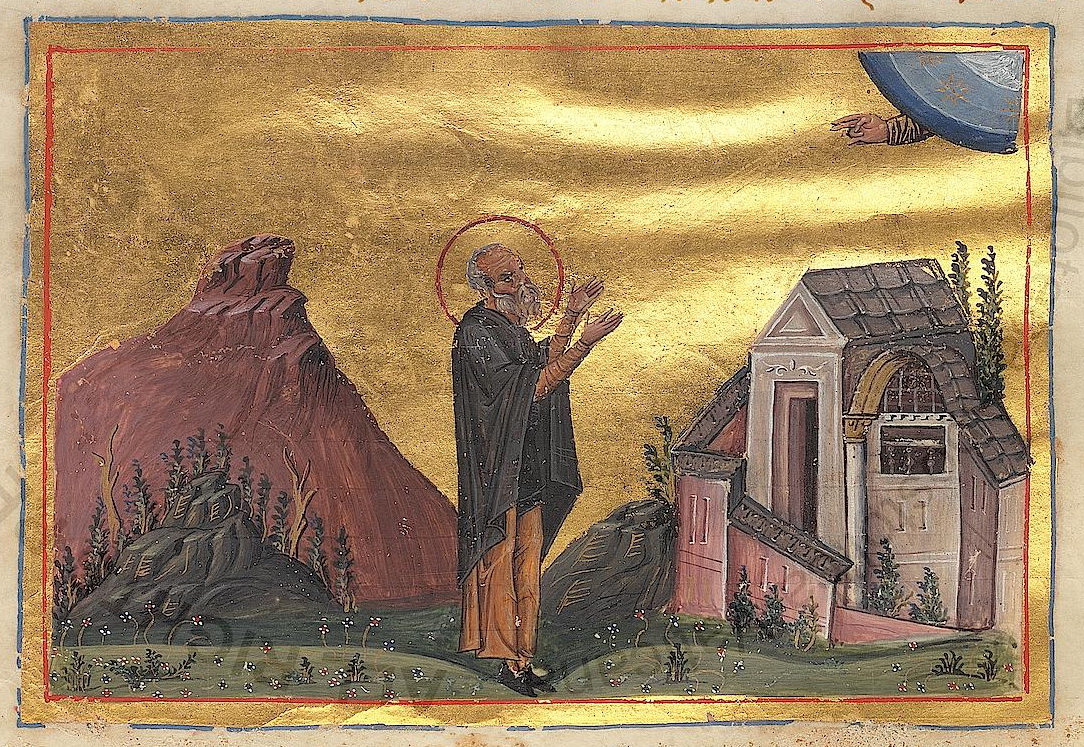
Theophilus is painted as a venerable: an aged monk in the black mantle, grey-bearded, his hands raised in prayer. The stored image is the miniature of the Menologion of Basil II (Constantinople, c. 985; Vatican Library), which shows the confessor standing in prayer between a mountain — his Selention — and a monastery church, the blessing hand of the Lord reaching toward him from heaven.
Disputed questions
- The chronology. The calendars that give a year of death give 716; but Leo the Isaurian came to the throne in 717 and published his iconoclast measures only from the mid-720s. Both data cannot stand: either the death-date is a copyist's or compiler's error (a repose later in the eighth century would fit the story), or the association with Leo's persecution has been attached secondarily to an ascetic who died before it. The sources as they stand do not allow a resolution; this entry transmits both the traditional date and the contradiction.
- One Theophilus, two days. The Greek synaxaria (Synaxarion of Constantinople, the Great Synaxaristes) commemorate Theophilus the Confessor on October 2, in the train of Cyprian and Justina; the Slavic and Russian books, followed by the OCA, keep "Theophilus the Confessor of Bulgaria" on October 10. The notices tell the same story and are taken here as one saint kept on two days by different traditions; this file is keyed to October 2 with the Greek books, and the October 10 listing should cross-reference it when that day is authored.
- "Of Bulgaria." The epithet of the Slavic calendars is anachronistic for the saint's own lifetime (the region of Tiberiopolis/Strumica lay within the Bulgarian lands only later) and does not appear in the Greek notices; it is kept here among the alternate names.
- Not to be confused with Theophilus, bishop of Antioch, the second-century apologist; with Theophilus the New Martyr of Cyprus (January 30); or with other confessors of the iconoclast eras bearing the name.