
Thomas the Apostle
The Holy and Glorious Apostle Thomas
Apostle · d. c. 72 (traditional, at Mylapore in India)
Commemorated 30 June — Synaxis of the Twelve Apostles, 6 October — Commemoration of the Apostle, Pascha offset 7
Thomas the Apostle, called Didymus, "the Twin," is the apostle of the great doubt and the greater confession: absent when the risen Lord first appeared to the Twelve, he refused to believe without touching the wounds, and eight days later, invited to do so, uttered the highest confession of Christ in all the Gospels — "My Lord and my God." The tradition of the Church sends him east after Pentecost, to Parthia and India, where he preached, founded churches, and was slain with spears at Mylapore about the year 72; the Christians of the Malabar coast bear his name — "St Thomas Christians" — to this day. His chief feast is October 6, he is commemorated with his brethren on June 30, and the whole Church relives his doubt and confession each year on Thomas Sunday, the first Sunday after Pascha.
.jpg)
Origins and early life
The name Thomas is not Greek but Aramaic — tāʾmā, "twin" — and the fourth Gospel three times glosses it for its Greek readers: "Thomas, called Didymus" (John 11:16, 20:24, 21:2), Didymos being simply the Greek for the same thing. Whose twin he was, no canonical text says, and the sober tradition of the Church leaves the question open. Like most of the Twelve he was a Galilean; the later Russian lives, followed by the OCA synaxarion, name his birthplace as Pansada (Paneada), a Galilean town, and make him a fisherman — details not found in the earlier sources but consistent with his appearance among the fishermen of John 21. Hearing the preaching of Christ, he left everything and followed him, and was numbered among the Twelve (Matthew 10:3; Mark 3:18; Luke 6:15), where the synoptic lists pair him with Matthew, and Acts 1:13 with Philip.
The Syriac-speaking East knew him under a fuller name, "Judas Thomas" — Judas the Twin — as though "Thomas" were not a name at all but the epithet that distinguished this Judas from Iscariot and from Judas the brother of James; the old Syriac version of John 14:22 actually reads "Judas Thomas, not Iscariot," and the Edessene Doctrine of Addai and the apocrypha of the Thomas cycle use the double name throughout. The usage is ancient and probably preserves a genuine memory, though the further step taken by the apocryphal Acts of Thomas — which makes him the twin of the Lord himself — is a flourish the Church has always rejected.
The Gospel record
The synoptics give Thomas nothing but his place in the lists; it is John's Gospel that draws his portrait, in three scenes so consistent in character that they read like studies of one temperament: a devoted, literal, melancholy mind that must see the worst — or see the thing itself — before it can rest.
The first is at the raising of Lazarus. When the Lord, who had withdrawn beyond Jordan from those who sought to stone him, announced that he was returning to Judea, the disciples protested the danger; it was Thomas who ended the argument: "Let us also go, that we may die with him" (John 11:16). The saying is at once pessimism and perfect loyalty — he expects death and goes anyway — and the Fathers loved it as the measure of the man: no illusions, and no desertion.
The second is at the mystical Supper, in the Farewell Discourse. To the Lord's "whither I go ye know, and the way ye know," Thomas objected with characteristic bluntness: "Lord, we know not whither thou goest; and how can we know the way?" (John 14:5). The question of the literalist drew from Christ one of the supreme sayings of the Gospel: "I am the way, the truth, and the life: no man cometh unto the Father, but by me." As with his doubt after Pascha, the Church has always noted that Thomas's slowness became the occasion of revelation for everyone else.
The third scene is the one from which he is named in every language. On the evening of the Resurrection, when the risen Lord came through the shut doors and stood among the disciples, "Thomas, one of the twelve, called Didymus, was not with them when Jesus came" (John 20:24). To the others' "We have seen the Lord" he answered with the demand that has made him the patron of every honest doubter since: "Except I shall see in his hands the print of the nails, and put my finger into the print of the nails, and thrust my hand into his side, I will not believe." Eight days later — the Church hears in that "eighth day" the first Sunday after the Sunday of Pascha, and keeps it so — the doors again being shut, the Lord stood in the midst and addressed him directly, taking up his own words: "Reach hither thy finger, and behold my hands; and reach hither thy hand, and thrust it into my side: and be not faithless, but believing." And Thomas answered, "My Lord and my God" (John 20:26–28).
The confession is the summit of the fourth Gospel and of its theology. The Gospel that opens "In the beginning was the Word, and the Word was God" closes with a man addressing the crucified and risen Jesus, flesh and wounds before him, as "my God" — the only direct, unqualified confession of Christ's divinity spoken by anyone in the four Gospels, and the deliberate answering bracket to the prologue. It is no accident that the evangelist places immediately after it both the Lord's beatitude on all subsequent believers — "because thou hast seen me, thou hast believed: blessed are they that have not seen, and yet have believed" — and the Gospel's own statement of purpose: "these are written, that ye might believe that Jesus is the Christ, the Son of God" (John 20:29–31). Thomas's journey from refusal to worship is the journey the Gospel was written to produce in its reader. Whether he in fact touched the wounds the text does not say — only the invitation and the confession are recorded — but the tradition, the hymns, and the icon of the feast (the Psēlaphēsis, "the Touching") understand that he did, and John Chrysostom, whom the synaxaria follow, drew the abiding moral: the disciple who was weakest in faith became, by the grace of God, the most tireless of them all, running through nearly the whole earth and never fearing to preach the Word to savage nations.
Thomas appears once more, among the seven who fished all night on the Sea of Tiberias and to whom the Lord appeared at dawn (John 21:2), and then in the upper room with the Eleven awaiting Pentecost (Acts 1:13), where the Scriptural record of him ends.
The mission to the East and India
When the apostles divided the world by lot, the tradition — as old as Origen, whom Eusebius quotes — assigned Parthia to Thomas; the Syriac tradition, embodied in the Acts of Thomas, says India, and the two are less contradictory than they sound, since the route to north-west India lay through the Parthian world and the dynasty then ruling the Indus lands was itself Parthian. Eusebius adds a further Edessene memory: it was "Judas, who is also Thomas" who sent Thaddeus, one of the Seventy, to king Abgar of Edessa — the beginning of the church in the city that would later hold the apostle's bones.
The Acts of Thomas, composed in Syriac at or near Edessa early in the third century, tells the mission-story that all later accounts embroider. Thomas, whose lot was India, shrank from it — "how can I, a Hebrew, preach among the Indians?" — until the Lord himself, in the boldest scene of the book, sold him as a slave to Habban (Abbanes), the merchant of the Indian king Gundaphorus, who was seeking a carpenter. Brought to the king, Thomas was commissioned to build him a palace, and spent the money on the poor; threatened with death, he was saved when the king's dead brother Gad, restored to life, testified that he had seen in heaven the palace Thomas's alms had built there. Gundaphorus and Gad believed and were baptized. The book then carries the apostle through a cycle of wonders and conversions to another kingdom, that of king Mazdai (Misdaeus in the Greek), where the conversion to continence and Christ of the noblewomen Mygdonia and Tertia and of the king's son Vizan brought down the royal wrath, and the apostle was led up a hill outside the city and dispatched by four soldiers with spears.
For centuries king "Gundaphorus" was cited as proof of the book's worthlessness — no such Indian king was known to any historian. The nineteenth century reversed the verdict: coins turned up in the Punjab and Afghanistan in great numbers bearing the name Gondophares (Guduvhara), founder of the Indo-Parthian kingdom that ruled Taxila and the Indus country, and the Takht-i-Bahi inscription fixed his reign in the first half of the first century — precisely the right man, in the right place, at the right time for an apostolic visitor, and a name that no late romancer could have invented after the dynasty had vanished from memory. The vindication of the name does not prove the mission; it does prove that the Thomas tradition, whatever its legendary dress, reaches back to authentic first-century knowledge of north-west India.
The Christians of South India tell the story differently, and of themselves. Their tradition — continuous, unwritten for centuries, sung in their old Syriac-rite communities long before the Portuguese reached them in 1498 — holds that Thomas landed at Muziris (Cranganore, modern Kodungallur) on the Malabar coast in AD 52, preached to the Jewish trade colonies and the high families of the coast, founded seven churches, and ordained ministers for them; that he then crossed to the east coast, to the country round Mylapore; and that they themselves, the Mar Thoma Nasrani — the "St Thomas Christians" of Kerala — are the heirs of that preaching. Nothing in the first-century record makes this impossible: the monsoon sea-route from Egypt to Muziris was a highway of Roman commerce in exactly that generation, better travelled than many roads the other apostles took. The historian can say no more than that the tradition is ancient, geographically credible, and unverifiable; the fourth-century Fathers — Ephrem the Syrian, Gregory the Theologian, Ambrose, Jerome — already speak of Thomas and India as of a thing everyone knew.
Martyrdom at Mylapore
The traditions agree on the manner of the apostle's end — the spear — and the Indian tradition supplies the place: a hill outside Mylapore, near modern Chennai (Madras), still called St Thomas Mount, with a second site, Little Mount, shown as his refuge. Pierced by the spears of the king's soldiers — the Acts say four soldiers, the Russian synaxarion tradition five spears, the hymns of the Church simply "the spear" answering the spear he had sought in his Master's side — he was buried with honour at Mylapore, and the Indian church keeps AD 72 as the traditional year. The Greek stichos of the feast catches what every Orthodox account of his death has seen in it: "He who once sought to put his hand into Thy side, O Word, is pierced in the side for Thy sake." The doubter who demanded to touch the wounds of Christ was granted, in the end, the same wounds.
Relics and translations
The Acts of Thomas itself already knows that the bones did not stay in India: one of the brethren, it says, secretly carried them away "to the West," to Mesopotamia. By the middle of the fourth century they were at Edessa, enshrined in the martyrium that made the city, with its Abgar legend and its school, the capital of Syriac Christendom: Ephrem the Syrian (d. 373) sings in the Carmina Nisibena of the merchant who brought the bones and of the devil's complaint that the apostle slain in India now drove him out of Edessa; the pilgrim Egeria, about 384, prayed at the martyrium and was given the Acts to read on the spot; John Chrysostom counts the tomb of Thomas at Edessa among the only four apostles' tombs then known on earth (with Peter, Paul, and John). The relics survived the city's disasters until the age of the Crusades; after the fall of the county of Edessa the tradition follows them to the island of Chios in the Aegean, and from Chios, on September 6, 1258, the Ortonese captain Leone degli Acciaiuoli, returning from a Genoese-Venetian war raid, carried the bones and the ancient tombstone to Ortona on the Abruzzo coast of Italy, where they rest today in the basilica of San Tommaso Apostolo — a translation the Ortonese keep with their own feasts, and which the Orthodox East records without ever having formally celebrated.
Mylapore, for its part, never surrendered the honour of the empty tomb: the Portuguese built over it, and the present San Thome basilica in Chennai stands upon the traditional grave, to which a portion of relics has in modern times been restored; the Malabar churches keep relic traditions of their own at Kodungallur. The OCA synaxarion adds that portions of the apostle's relics are found in India, in Hungary, and on Mount Athos; a skull of the apostle is claimed both at Ortona and by the monastery of St John the Theologian on Patmos. As with most apostles, the plurality of claims is itself the record of the breadth of his cultus, and this entry records the claims without adjudicating them.
Veneration and later cultus
Two great streams carried the apostle's memory. The first is Edessene and Syriac: Edessa's martyrium made Thomas the apostle-patron of the whole Syriac world, East and West; the Church of the East carried his name along the trade routes into Persia, Central Asia, and China, and its daughter churches in India — the one apostolic Christianity of the subcontinent — call themselves by no other name than his. The "St Thomas Christians" survived isolation, the Portuguese, and schism, and their modern descendants (Syro-Malabar, Malankara, Mar Thoma, and the rest), whatever their present communion, are united in the claim their name asserts. The Syriac churches keep his great day, the Dukhrana (commemoration), on July 3, the date of the translation to Edessa — the date the Roman church also adopted for him in 1969, having kept him on December 21 for the previous millennium.
The second stream is Byzantine and liturgical: the annual reliving of the doubt and confession on Thomas Sunday, the first Sunday after Pascha (see Feast and commemoration below), which planted the apostle's story in the paschal experience of every Orthodox generation; and the fixed feast of October 6 with its proper service. In the Russian tradition the name of the apostle is further attached to the Arabian (Arapet) icon of the Mother of God (September 6), which tradition associates with his preaching in the East — an association the OCA synaxarion records.
A tender Byzantine tradition joins Thomas to the Dormition of the Theotokos: as once before, he was absent — detained, the story says, in India — and arrived on the third day, weeping to have missed her burial; and when the tomb at Gethsemane was opened for his sake, it was found empty of her body. Thus the doubter's late arrival became, a second time, the occasion of proof, and the Church's knowledge that the Mother of God was translated bodily rests, in the telling of the synaxaria, on Thomas's tears. The Athonite tradition of the Holy Girdle at Vatopedi adds that the Theotokos, being taken up, let fall her girdle to Thomas as testimony. These traditions are late and devotional, transmitted by the synaxaria and the festal homilies rather than by early sources, and are recorded here as such.
Miracles and traditions
The Acts of Thomas surrounds the mission with a cycle of wonders — the heavenly palace of Gundaphorus, the speaking colt, the serpent slain, the young man raised — which belong to the romance and are recorded as legend; but the palace built in heaven by alms became one of the most fruitful images in Christian moral teaching, East and West, and the hymns of October 6 draw on the cycle freely, singing the apostle as the enlightener of "the Indians darkened in soul." The Indian church's own traditions — the seven churches of Malabar, the brahmin conversions, the carved "Persian crosses" of Mylapore and the hills — form a parallel cycle, the living folklore of an apostolate. Later Byzantine piety knew him chiefly through Thomas Sunday, and the paradox the Fathers never tired of turning: that the Church owes more certainty to Thomas's doubt than to the ready faith of the others — "the unbelief of Thomas," as the hymns put it, "gave birth to sure faith."
Hymnographic and literary legacy
No canonical writing bears Thomas's name, but a whole apocryphal literature does — the fruit of the Syriac "Judas Thomas" tradition and, in part, of circles the Church condemned: the Gospel of Thomas (the Coptic collection of one hundred and fourteen sayings found at Nag Hammadi, a second-century compilation with gnosticizing colour, not the work of the apostle), the Book of Thomas the Contender, the Infancy Gospel of Thomas, the Apocalypse of Thomas, and the Acts of Thomas already described — this last the only one the Church's tradition has used, cautiously, as the vehicle of the India story. The attachment of so much literature to his name is itself evidence of the weight of his memory in the East.
In the Church's own books his legacy is the hymnography of the "good unbelief." The canon of October 6 is the work of Theophanes the Branded (Graptos), in Tone 4, with the acrostic "I shall marvel at Thomas who is full of marvels"; the stichera of the feast turn the paradox over and over — "by thy faithful unbelief thou didst confirm the faithful"; "Thomas the wonderful opened the fountain of doctrines, for, feeling Thy side, he was initiated into the twofold energy of the two natures, and cried: Thou art my God and Master, Thou the Lord of glory, who for me becamest flesh" — a whole dyophysite Christology drawn from one probing hand. The services of Thomas Sunday, in the Pentecostarion, carry the same theology onto the greater stage of Pascha, and gave the tradition its most famous exclamation: "O good unbelief of Thomas, which hath led the hearts of the faithful to knowledge!"
Feast and commemoration
The fixed feast of the apostle is October 6 (church date; Old Calendar civil October 19), kept universally — the Antiochian, Greek, Slavic, and OCA calendars agree — with a full proper service in the Menaion (six stichera at "Lord, I have cried," a doxastikon by Anatolius, the canon of Theophanes). On June 30 he is commemorated with his brethren in the Synaxis of the Holy, Glorious and All-praised Twelve Apostles. On the Russian calendar for this day the apostle shares October 6 with commemorations of later Russian saints (see the calendar file for the day); in 1977 the OCA's glorification of Innocent of Moscow was appointed to this feast, so that on the OCA calendar the apostle now shares his day with that glorification, whose propers take liturgical precedence in OCA parish use.
The apostle's greatest liturgical presence, however, is movable: Thomas Sunday (Ἀντίπασχα, Antipascha, "opposite Pascha"; also called New Sunday), the first Sunday after Pascha — in the terms of this collection's movable-feast vocabulary, 7 days after Pascha, the eighth day of Pascha. The Pentecostarion appoints the whole day to the Gospel's "after eight days" (John 20:19–31): the doubt, the invitation, and the confession "My Lord and my God" are relived annually at the head of the paschal season, so that every Orthodox believer renews Pascha through Thomas's hands. The day closes Bright Week and begins the ordinary reckoning of the weeks after Pascha ("the second Sunday," of the Myrrhbearers, follows it); in Russian folk usage its season is Krasnaya Gorka, the traditional time of weddings. The rule file for this commemoration lives at 7 days after Pascha.
Beyond the Byzantine rite: the Syriac churches (and with them the St Thomas Christians of India) keep the apostle's Dukhrana on July 3, the date of the translation of his relics to Edessa; the Roman church kept him on December 21 from antiquity until 1969, when it moved his feast to the same July 3; July 3 is also a public holiday of the church calendar in Kerala. These are recorded as the usage of other traditions; the Orthodox fixed feast is October 6 everywhere.
Hymns
Troparion — Tone 2
Thou wast a disciple of Christ and a member of the divine apostolic company; having through thine unbelief given proof of Christ's Resurrection, and verified His most pure Passion by thy touch, O all-praised Thomas, entreat now also for us peace and great mercy.
Original translation from the Slavonic
Apolytikion — Tone 3 (Greek use)
O holy Apostle Thomas, intercede with the merciful God, that He grant unto our souls the forgiveness of offences.
Kontakion — Tone 4
Filled full of divine grace, the Apostle of Christ and His true servant cried out in repentance: Thou art my God and Lord.
Original translation from the Greek
Magnification
We magnify thee, O Thomas, Apostle of Christ, and we honour the pains and labours whereby thou didst labour in the good tidings of Christ.
Original translation from the Slavonic
Stichera
By thy faithful unbelief thou didst confirm the faithful, beginning to speak as God of Him who is God and Lord of all creation, who for our sake on earth put on flesh, and endured the Cross and death, and the piercing of the nails, and the opening of His side by the lance, whence we draw life. Thomas the wonderful opened the fountain of doctrines to the godly minded, O Master; for feeling Thy side he was fittingly initiated into the twofold energy of the two natures, and cried: Thou art my God and Master, Thou the Lord of glory, who for my sake becamest flesh.
Appointed readings
Epistle — 1 Corinthians 4:9–16
9For I think that God hath set forth us the apostles last, as it were appointed to death: for we are made a spectacle unto the world, and to angels, and to men. 10We are fools for Christ’s sake, but ye are wise in Christ; we are weak, but ye are strong; ye are honourable, but we are despised. 11Even unto this present hour we both hunger, and thirst, and are naked, and are buffeted, and have no certain dwellingplace; 12And labour, working with our own hands: being reviled, we bless; being persecuted, we suffer it: 13Being defamed, we intreat: we are made as the filth of the world, and are the offscouring of all things unto this day. 14I write not these things to shame you, but as my beloved sons I warn you. 15For though ye have ten thousand instructers in Christ, yet have ye not many fathers: for in Christ Jesus I have begotten you through the gospel. 16Wherefore I beseech you, be ye followers of me.
Gospel — John 20:19–31
19Then the same day at evening, being the first day of the week, when the doors were shut where the disciples were assembled for fear of the Jews, came Jesus and stood in the midst, and saith unto them, Peace be unto you. 20And when he had so said, he shewed unto them his hands and his side. Then were the disciples glad, when they saw the Lord. 21Then said Jesus to them again, Peace be unto you: as my Father hath sent me, even so send I you. 22And when he had said this, he breathed on them, and saith unto them, Receive ye the Holy Ghost: 23Whose soever sins ye remit, they are remitted unto them; and whose soever sins ye retain, they are retained. 24But Thomas, one of the twelve, called Didymus, was not with them when Jesus came. 25The other disciples therefore said unto him, We have seen the Lord. But he said unto them, Except I shall see in his hands the print of the nails, and put my finger into the print of the nails, and thrust my hand into his side, I will not believe. 26And after eight days again his disciples were within, and Thomas with them: then came Jesus, the doors being shut, and stood in the midst, and said, Peace be unto you. 27Then saith he to Thomas, Reach hither thy finger, and behold my hands; and reach hither thy hand, and thrust it into my side: and be not faithless, but believing. 28And Thomas answered and said unto him, My Lord and my God. 29Jesus saith unto him, Thomas, because thou hast seen me, thou hast believed: blessed are they that have not seen, and yet have believed. 30And many other signs truly did Jesus in the presence of his disciples, which are not written in this book: 31But these are written, that ye might believe that Jesus is the Christ, the Son of God; and that believing ye might have life through his name.
Iconography
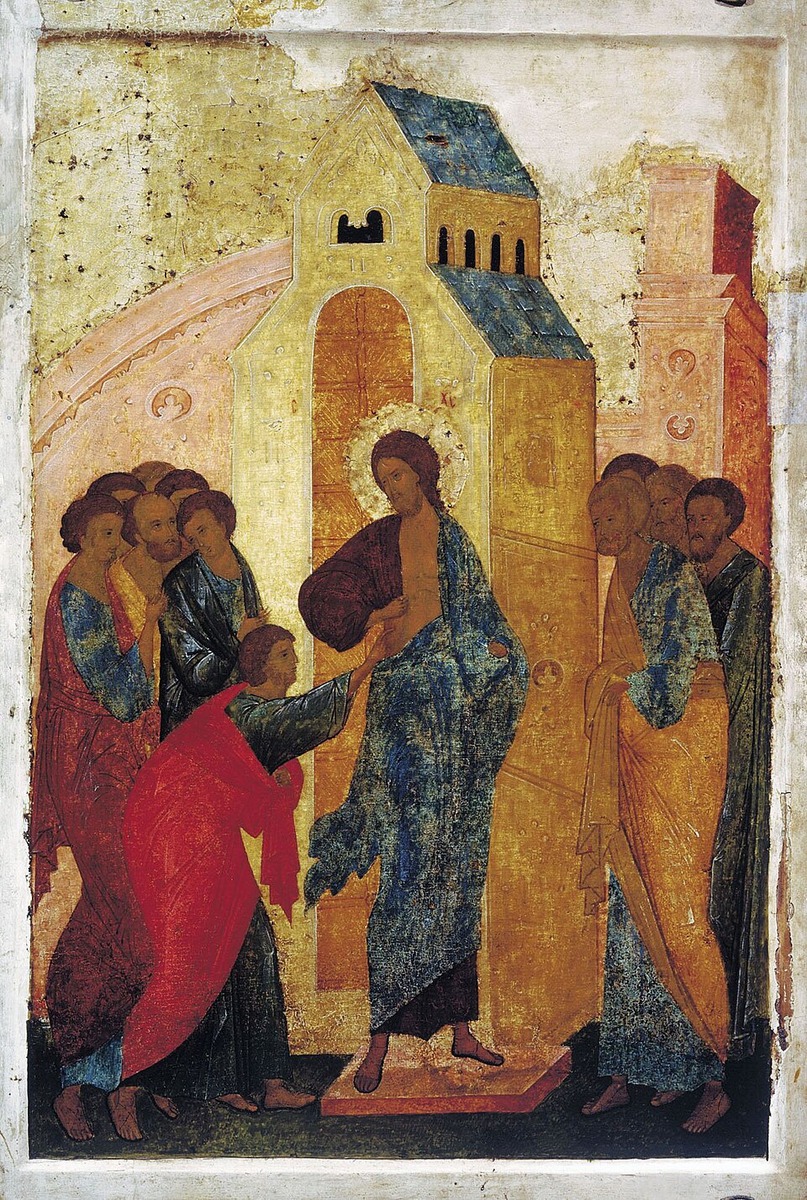
Thomas is depicted in two principal ways. As a person, he is among the youngest of the Twelve: beardless, with short curling hair, in tunic and himation, holding a closed scroll — so he appears in apostle-tiers, Pentecost and Ascension icons, and calendar miniatures such as the Menologion of Basil II. As an event, he is the subject of one of the fixed festal images of the Byzantine tradition: "The Touching of Thomas" (Ἡ Ψηλάφησις τοῦ Θωμᾶ; in Slavonic Уверение Фомы, "the Assurance of Thomas"; in Western usage "the Incredulity"), the icon of Thomas Sunday. Christ stands before the shut doors, His right arm raised to bare the wound in His side; Thomas leans in from the left, his hand extended to the wound; the other disciples flank the scene in two astonished groups. The type is ancient — it is already among the sixth-century mosaics of Sant'Apollinare Nuovo at Ravenna and the eleventh-century mosaics of Hosios Loukas — and the OCA synaxarion pointedly notes that the English label "Doubting Thomas" mistranslates the tradition: the inscriptions name not the doubt but its cure. In the churches of India his emblem is the "Persian cross" or Mar Thoma cross, the carved crosses of Mylapore and the Malabar hills.
The stored primary icon is the festal-tier icon of the Assurance of Thomas painted in 1500 by Dionisy and his workshop for the Trinity church of the Pavlov-Obnorsky monastery, now in the Russian Museum — a summit of the Moscow school's treatment of the type. The stored variant is the apostle's calendar portrait from the Menologion of Basil II (Constantinople, c. 985, Vatican Library (source, public domain, pd-old-work)).
Disputed questions
- Parthia or India? The oldest Greek tradition (Origen, followed by Eusebius) assigns Thomas Parthia; the Syriac tradition and all later Greek and Latin writers, India. The two are compatible — the Indo-Parthian kingdom of Gondophares straddled both — and "India" in ancient usage was elastic, sometimes covering Arabia and East Africa; but the traditions are of independent origin, and scholarship ranges from treating the India mission as pure romance to accepting a genuine first-century Malabar apostolate as historically plausible (the trade route being open and heavily used). The numismatic recovery of Gondophares establishes the authenticity of the tradition's first-century Indian setting, not the fact of the journey. This entry follows the Church's calendars, which commemorate the India mission and martyrdom, while recording the state of the question.
- The character of the Acts of Thomas. The book is a third-century Syriac romance with marked encratite tendencies (it treats marriage itself as to be renounced) and passages of gnosticizing colour (the "Hymn of the Pearl"); it also calls Thomas the twin brother of the Lord. The Church has never received the book; the synaxaria use its narrative skeleton — Gundaphorus, the palace, Mazdai, the spears — stripped of its heterodoxy, and this entry does the same, identifying the source throughout.
- Whose twin? The canonical texts never say. The Syriac apocrypha's answer (twin of Jesus) is rejected; later guesses (a twin sister Lydia; a twin brother Eliezer) are without authority. The Church keeps the epithet and leaves it unexplained.
- The birthplace Pansada appears only in the later Russian synaxarion tradition (so the OCA life); the earlier sources say only that he was a Galilean of fisher stock.
- The manner of death is given as four soldiers with spears in the Acts, "five spears" in the Russian tradition followed by the OCA, and a single lance in much iconography and hymnography; the place as Mylapore in the Indian tradition, "Calamina" in the later Greek and Latin apostle-lists — a toponym never securely identified and usually taken as a doublet or corruption for the Mylapore region. The traditional year is AD 72; no early source dates the death, and the century (first) is all that can be asserted.
- Did Thomas touch the wounds? John 20 records the invitation and the confession, not the touch. Chrysostom and the main exegetical tradition, with the liturgical texts and the icon of the Psēlaphēsis, affirm the touching; some Fathers (and the ambiguity of "because thou hast seen me") leave it at sight. The Church's hymns commit her to the touch — "with his curious right hand" — and this entry follows the hymns while noting the text's reticence.
- The Gospel of Thomas found at Nag Hammadi is not the work of the apostle and has no standing in the Church; the point is worth stating plainly because the modern literature on "Thomas Christianity" can mislead the unwary reader into supposing the Church ever read it.
- Not to be confused with the other Thomases of the calendar — among them Thomas of Maleon (July 7) and Thomas the Patriarch of Constantinople (March 21): "the Apostle" belongs to this Thomas alone.