
Tikhon of Zadonsk
Our Father among the Saints Tikhon, Bishop of Voronezh, Wonderworker of Zadonsk
Bishop · Wonderworker · b. 1724, at Korotsk in the Valdai district of the Novgorod province — d. 13 August 1783, at the Monastery of the Nativity of the Theotokos, Zadonsk
Commemorated 14 May — First uncovering of the relics at Zadonsk, 1846, 13 August — Repose (1783) and glorification (1861); the second finding of his relics (1991) is kept on the same day
Tikhon of Zadonsk (1724–1783) is the great hierarch and spiritual writer of eighteenth-century Russia, and the one figure of that Westernising age in whom the ascetic tradition of the Fathers and the pastoral scholarship of the new seminaries met without injury to either. Born Timothy, the youngest son of a destitute village cantor of the Novgorod land, so poor that his family nearly gave him away to a coachman for bread, he rose through the seminary to be its teacher, then bishop of Voronezh — and after four and a half years laid down his diocese and spent the last fourteen years of his life as a simple monk at Zadonsk, sleeping on straw under a sheepskin, giving away his whole pension, and writing the two books, On True Christianity and A Spiritual Treasury Gathered from the World, that made him the most widely read Russian spiritual author before the Philokalia. He was glorified in 1861, is called the Russian Chrysostom, and stands behind Dostoevsky's Bishop Tikhon and the elder Zosima.
.jpg)
Origins and childhood poverty
He was born in 1724 in the village of Korotsk, in the Valdai district of the Novgorod province, and given at baptism the name Timothy. His father, Sabellius (Savely) Kirillov, was the dyachok — the cantor and reader — of the village church, and died while Timothy was still a small child, leaving a widow with a house full of children and nothing to keep them on. The family lived in real hunger. Timothy hired himself out to the peasants, harrowing their fields for a day's bread, and his mother, unable to feed him, once set out to give him into the household of a childless coachman who had offered to raise him as his own. The boy's elder brother Peter ran after them and stopped her in the road, saying — the words are preserved in the family memory that his cell-attendants later wrote down — that he would rather beg from door to door than see his brother made a coachman.
The surname Sokolov by which he is sometimes known was not his father's; it was one of the Latinate or ornamental surnames handed out to students at the Novgorod seminary, and its later appearance in the registers as Sokolovsky and Sokolov belongs to his schooling, not to his birth.
Seminary years at Novgorod
About the age of thirteen — the year is usually given as 1738 — Timothy was entered in the clergy school attached to the residence of the archbishop of Novgorod. Places were few and money fewer. He supported himself by digging vegetable beds for the gardeners of the town, earning a copper for a day's work, and used half of what he earned to buy candle-ends to read by; the other students, who came from comfortable clerical houses, mocked the ragged boy from Korotsk by waving their bast shoes at him in the yard and chanting a mock-censing. He remembered it without bitterness, and later said that when he became a bishop and the same men bowed to him, he saw in it only the strangeness of God's ordering.
In 1740 he was one of two hundred selected for a state stipend at the newly enlarged Novgorod seminary, where the course ran through Latin grammar, rhetoric, philosophy and theology. He proved the best student of his year. He completed the course in 1754 and was at once retained as a teacher — first of Greek, then of rhetoric, and finally of philosophy, the senior chair.
Tonsure, Tver, and the election by lot
In 1758 he was tonsured a monk with the name Tikhon and made prefect of the Novgorod seminary. The following year he was called to Tver, where he was made archimandrite of the Zheltikov monastery, then rector of the Tver seminary and superior of the Otroch monastery in the town, teaching theology and preaching constantly.
His elevation to the episcopate, in 1761, is one of the best-attested pieces of hagiographical lore in the Russian eighteenth century, because it happened before witnesses and was recorded at the time. A vicar bishop was needed for Novgorod, and the Holy Synod drew the appointment by lot from a short list. Tikhon's name was not on it; but the metropolitan, wanting a fuller slate, had it added, and it was added twice by inadvertence — and it was drawn. At the very hour, in Tver, he was serving the Paschal Liturgy, and the presiding hierarch, at the Great Entrance, commemorated him aloud not as archimandrite but as bishop — a slip of the tongue that the whole church heard and that was remembered when the courier arrived from Petersburg. He was consecrated bishop of Kexholm and Ladoga, vicar of the Novgorod eparchy, on 13 May 1761.
Bishop of Voronezh
In 1763 he was translated to the see of Voronezh — an enormous, thinly churched, half-frontier diocese stretching over the Don steppe, with a clergy of little learning, a strong dissenting and sectarian population, and villages where the old pre-Christian summer rites had never quite died. He governed it for about four and a half years, and in that short time did more than most bishops do in twenty.
He wrote and circulated among his priests a series of plain pastoral instructions — on how to hear confessions, on how to preach, on how to celebrate without haste and without profit-taking, on the duties of a priest towards the poor of his parish — the beginning of the practical pastoral literature for which he is remembered. In 1765 he turned the diocesan school into a proper seminary, brought teachers from Kiev and Moscow, and set the course of study himself. He established a standing commission to deal with the dissenters of the Yelets district, and insisted that it work by persuasion and preaching rather than by the police measures then usual.
His most famous act as a diocesan bishop was the abolition of the summer festival of Yarilo at Voronezh — a riotous week of masking, drinking and licence around a figure of the old fertility god, kept on the square outside the city. Tikhon went out to it in person in 1765, walked into the middle of the crowd, and preached; and the next year the townspeople themselves put the thing down. He afterwards wrote a treatise on the subject, arguing that such observances were not harmless custom but a real remnant of paganism and a school of vice.
The withdrawal to Zadonsk
Tikhon's health — never strong, and undermined by his years of poverty and by an almost unbroken régime of night vigil — broke down under the work. He suffered from what the sources call a nervous and febrile weakness with fits of profound depression. In 1767 he petitioned to be relieved and was allowed to retire on a pension of five hundred roubles to the Tolshevsky monastery in the forest outside Voronezh; the damp of the place did not suit him, and in 1769 he moved to the Monastery of the Nativity of the Most Holy Theotokos at Zadonsk, on the upper Don, where he spent the remaining fourteen years of his life.
He lived there as the least of the brotherhood. He kept no rank, took no part in the governance of the house, and asked to be called simply "Father Tikhon". His cell was bare: a bed of straw with a sheepskin coat for a covering, a few books, and the coffin he had made ready and kept where he could see it. The whole of his pension went out in alms — to the prisons of Yelets and Ostrogozhsk, where he went to sit with the prisoners; to the freeing of debtors; to families burnt out or ruined; to the beggars who waited at the monastery gate and whom he received one by one. He wore a plain black cassock, mended, and travelled in a peasant cart.
The two novices who served as his cell-attendants, Vasily Chebotarev and Ivan Efimov, wrote down what they saw, and their memoirs — sober, unliterary, full of small domestic detail — are the foundation of everything later written about him and the reason his interior life is known with unusual precision.
The temptations of the Zadonsk years
The Zadonsk years were not a serene retirement. Chebotarev and Efimov record long periods of despondency, in which he could not pray and could not bear company; and a recurring, powerful temptation to return to active office — the Synod would have given him a diocese again for the asking — which he fought and confessed as a temptation. He put the question to the elders of the Sarov and Zadonsk houses, and the schemamonk Mitrophan and the elder Aaron told him plainly that the Mother of God did not bid him leave; after that he stayed.
Of the same period is the incident that is told of him more than any other. In an argument about the faith in a gentleman's house at Yelets, a nobleman — a freethinker of the fashionable sort — lost his temper and struck the bishop on the cheek. Tikhon went out, and then came back, knelt down before the man and asked his forgiveness, for having provoked him to anger. The nobleman was broken by it, fell at his feet, and, the account says, was changed from that hour.
The writings
Almost everything Tikhon wrote was written at Zadonsk, dictated to his attendants in the small hours because his hand had grown unsteady. The two great works are:
- On True Christianity (Об истинном христианстве), a systematic work in six parts on the nature of the Christian life — sin and its knowledge, faith, repentance, the imitation of Christ, the duties of the Christian in the world;
- A Spiritual Treasury Gathered from the World (Сокровище духовное, от мира собираемое), a hundred and fifty-odd short meditations, each starting from something seen or overheard — a lamp, a debtor's release, a merchant's scales, a child running to its mother, a sunrise on the Don — and turning it into a lesson about God. It is the more original of the two and the more loved.
The dating of both varies in the sources: the Treasury is placed by some in 1770 and by others in 1777–1779, and On True Christianity in 1776 or in 1770–1771. To these belong the treatise Flesh and Spirit, the Rules of Monastic Life, an instruction on the duties of a Christian, and two large collections of letters — the Cell letters and the Letters sent — which are among the finest pastoral letters in the Russian language.
The character of the writing is unmistakable. Tikhon had read the Latin devotional literature of his seminary training — he knew Johann Arndt's True Christianity, whose title he borrowed — and this has led some to call him "Western". The judgement is too quick. What he took from that reading was a method of address, a plainness and a warmth aimed at the ordinary reader; what he says is Chrysostom and the Psalter throughout, and it is for the Chrysostomic directness and the sheer volume of scriptural quotation that Russia called him the Russian Chrysostom.
Repose
In his last years he was given, his attendants say, several dreams and waking visions: a ladder set up into heaven with a crowd pressing him upward; a meadow full of light with buildings in it, of which a voice said that they were prepared for those who love God. He prayed daily, in words that Efimov reports, Tell me, O Lord, of my end, and understood that he was told it would be on a Sunday. He was struck down at last by a stroke that took his speech, lingered, and reposed on Sunday, 13 August 1783, at the age of fifty-nine. He was buried under the sanctuary of the monastery church at Zadonsk.
Relics and glorification
Veneration began at once and grew steadily; the stream of pilgrims to his grave was continuous through the first half of the nineteenth century. In 1846, when the old cathedral at Zadonsk was pulled down to be rebuilt, the vault was opened and the body was found incorrupt, with the vestments unrotted although the vault had been standing in water — the first uncovering of the relics, kept on May 14. On 13 August 1861 he was glorified by the Russian Church, in one of the largest gatherings of pilgrims of the century.
The relics were seized in the Soviet campaign against relics after the revolution and put on public exhibition, and were afterwards held in museum collections at Yelets and Orel. They were restored to the Church in 1991 and returned in solemn procession to Zadonsk, where they rest again in the monastery — the second finding of the relics, kept with his principal feast on August 13.
Afterlife in Russian letters
Tikhon's influence outside the Church is unusually large for a Russian hierarch. Dostoevsky read him closely and said openly that he wished to set a Russian Tikhon at the centre of a novel: the result is Bishop Tikhon of the suppressed chapter "At Tikhon's" in Demons, to whom Stavrogin brings his confession, and, at a further remove, the elder Zosima of The Brothers Karamazov — whose teaching that each is guilty before all, and whose bow before Dmitri, are recognisably drawn from the Zadonsk memoirs and from the scene at Yelets.
Feast and commemoration
The principal feast is August 13, the day of his repose in 1783 and of his glorification in 1861, kept on that civil day by New Calendar jurisdictions and on August 26 civil by those on the Old Calendar. The day is also the leavetaking of the Transfiguration and falls within the Dormition Fast (August 1–14), so that his office is sung together with the festal hymns of Tabor and under the fast — a conjunction the Russian tradition has always liked for a saint whose whole teaching is that glory is reached through self-emptying.
The first uncovering of the relics (1846) is commemorated on May 14 in Russian usage; the second finding (1991) is kept on August 13 itself. He is further commemorated in the synaxes of the saints of Voronezh, of Novgorod, of Lipetsk and of Tver, in each of which he has a claim.
He is invoked for despondency and depression — the affliction he himself knew longest — and as a patron of those who teach.
Hymns
Troparion — Tone 8
From thy youth thou didst love Christ, O blessed one, and wast shown forth as an example to all in word and life, in love, in spirit and in faith, in purity and in humility of mind. Wherefore thou dwellest now in the mansions on high, where thou standest before the throne of the All-holy Trinity: holy hierarch Tikhon, pray thou that our souls be saved.
Original translation from the Slavonic
Kontakion — Tone 8
O successor of the apostles, adornment of hierarchs, teacher of the Orthodox Church, entreat the Master of all to grant peace to the world and to our souls great mercy.
Original translation from the Slavonic
Appointed readings
Epistle — Hebrews 7:26–8:2
26For such an high priest became us, who is holy, harmless, undefiled, separate from sinners, and made higher than the heavens; 27Who needeth not daily, as those high priests, to offer up sacrifice, first for his own sins, and then for the people’s: for this he did once, when he offered up himself. 28For the law maketh men high priests which have infirmity; but the word of the oath, which was since the law, maketh the Son, who is consecrated for evermore. 1Now of the things which we have spoken this is the sum: We have such an high priest, who is set on the right hand of the throne of the Majesty in the heavens; 2A minister of the sanctuary, and of the true tabernacle, which the Lord pitched, and not man.
Gospel — Matthew 5:14–19
14Ye are the light of the world. A city that is set on an hill cannot be hid. 15Neither do men light a candle, and put it under a bushel, but on a candlestick; and it giveth light unto all that are in the house. 16Let your light so shine before men, that they may see your good works, and glorify your Father which is in heaven. 17Think not that I am come to destroy the law, or the prophets: I am not come to destroy, but to fulfil. 18For verily I say unto you, Till heaven and earth pass, one jot or one tittle shall in no wise pass from the law, till all be fulfilled. 19Whosoever therefore shall break one of these least commandments, and shall teach men so, he shall be called the least in the kingdom of heaven: but whosoever shall do and teach them, the same shall be called great in the kingdom of heaven.
Iconography
Tikhon is painted as a Russian hierarch of the synodal age, and in two distinct manners according to which part of his life the image means to say.
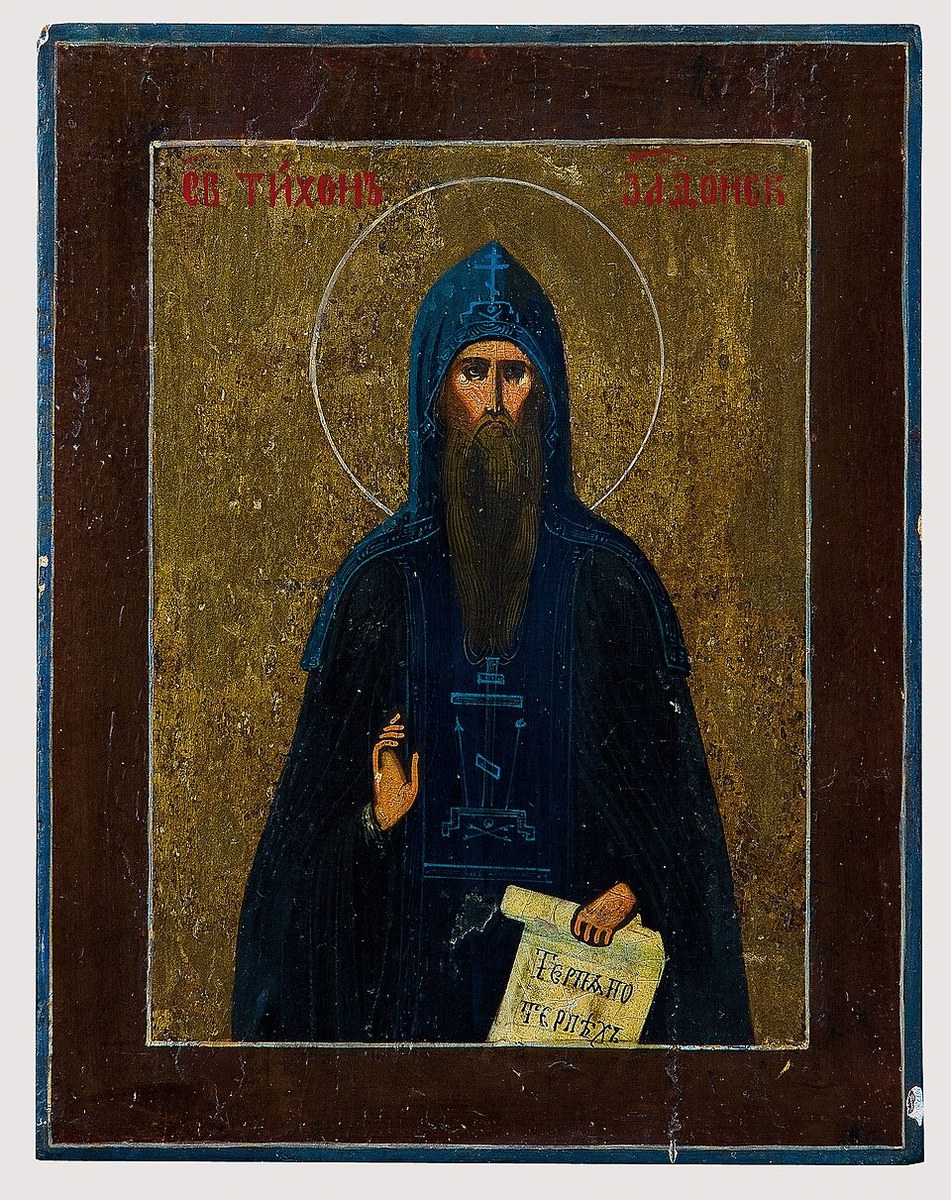
The monastic type, of which the nineteenth-century panel reproduced below is a good and characteristic example, shows him not as a bishop at all but as the monk of Zadonsk: dark mantle and black klobuk surmounted by a cross, the long straight beard, the right hand raised in blessing, an open scroll in the left. The face is deliberately worn and inward — narrow, hollow-cheeked, the eyes large and sorrowful — and the whole intention of the type is his renunciation of office. The inscription runs at the top on either side of the halo: СВ ТИХОНЪ / ЗАДОНСК — "Saint Tikhon of Zadonsk".
The hierarchical type, more usual in the churches of Voronezh and Lipetsk and in the vita-icons painted after the glorification of 1861, vests him fully as a bishop in sakkos and omophorion, with the mitre, the Gospel book in the left hand and the right raised in blessing; hagiographical borders around such icons show the coach-driver scene of his childhood, the drawing of the lot, the preaching against the Yarilo festival, the blow received at Yelets and the bishop kneeling before the man who struck him, and the uncovering of the relics in 1846. His scroll, when lettered, most often carries a phrase from the Spiritual Treasury.
Nineteenth-century Russian panel, private collection.
Disputed questions
- The dates of the works. As noted above, the composition dates of On True Christianity and A Spiritual Treasury differ between the standard reference accounts; the entry gives both traditions rather than choosing.
- The Arndt question. Whether Tikhon's dependence on Johann Arndt's Wahres Christentum is more than a borrowed title and a borrowed manner has been argued since Florovsky, who treated him as a case of "Western captivity"; the contrary view, now more usual, is that the borrowing is at the level of genre and that the doctrine is patristic. Both positions are held by serious historians.
- The date of the second finding. The return of the relics in 1991 is variously dated in August of that year; the Church keeps the commemoration on August 13 with the principal feast regardless.
- The date of the first uncovering. The uncovering of 1846 is entered here on May 14, following the notice already carried in this collection's May 14 calendar file; the May 15 file records the same event against that day. The discrepancy is one of Old- against New-Calendar reckoning in the secondary literature and should be resolved once, for the whole corpus.