
Tryphon of Campsada
The Holy Martyr Tryphon of Campsada
Martyr · Wonderworker · b. c. 232, at Campsada near Apamea in Phrygia — d. c. 250, at Nicaea in Bithynia
Commemorated 1 February — Martyrdom at Nicaea under Decius
Tryphon of Campsada (c. 232 – c. 250) is among the most beloved of the popular saints of the Orthodox world — a Phrygian peasant boy, keeper of geese, who from childhood was given power over unclean spirits and over the vermin and blights that ruin the fields. While still young he cast a demon out of the daughter of the emperor Gordian, and under the persecution of Decius he was seized, tortured, and condemned at Nicaea, giving up his spirit before the executioner's sword could fall, about the year 250. His memory is bound above all to the land and its labour: he is invoked against locusts, caterpillars, mice, and every pest of the crops, over gardens and vineyards, and the euchologia preserve a "Prayer of Saint Tryphon" adjuring the creatures that harm the fields to depart. Patron of gardeners, farmers, and (in the Russian tradition) of falconers and hunters, he is kept on February 1, the day of the forefeast of the Meeting of the Lord.
.jpg)
Origins: the goose-herd of Phrygia
Tryphon was born of poor and pious Christian parents in the village of Campsada (Greek Kampsádē), near the city of Apamea in Phrygia, in Asia Minor, about the year 232. (Some later notices, following the confusion of places, style him "of Lampsacus" or place his village near Apamea "in Syria"; the tradition and the Greek synaxarion set his home in Phrygia.) His family was of the humblest sort, and as a boy Tryphon was set to herding geese — a detail the tradition has never let fall, for it fixes him as one of the little ones of the earth, a labourer among beasts and fields, whose sanctity owed nothing to learning or rank. From this childhood among the flocks and furrows springs the whole character of his cultus: the saint of the countryside, the friend of those who work the soil.
Even as a child, the accounts say, he was granted by God a gift of grace over unclean spirits and over the creatures that plague the harvest — that at his word demons fled, sickness was healed, and the vermin and insects that devoured the crops were driven from the fields. The gift was exercised in simplicity and without payment, and his fame as a wonderworker spread through the region while he was yet a boy.
The healing of the emperor's daughter
The event that carried his name beyond Phrygia is the deliverance of the possessed daughter of the emperor. The tradition names the emperor Gordian (Gordian III, r. 238–244), whose daughter — called in the accounts Gordiana — was tormented by a demon that none could expel. When the imperial physicians and exorcists failed, the demon itself, pressed, confessed that it could be driven out by no one but Tryphon. Messengers were sent into Phrygia, and the boy — then about seventeen — was brought toward Rome. The tradition holds that the demon, unable to bear his approach, departed from the girl before Tryphon had even reached the city; and that Tryphon, questioned, made the spirit manifest in the sight of all in the form of a black dog, and compelled it to confess that it had power only over those who forsook God. Rewarded by the grateful emperor, the boy gave what he received to the poor and returned to his flocks and his village, to the same hidden and labouring life.
Arrest, torture, and martyrdom under Decius
When the emperor Decius (r. 249–251) unleashed his general persecution — the first empire-wide assault on the Church, in which every subject was required to sacrifice to the gods and receive a certificate of having done so — Tryphon was denounced as a Christian. He was seized and brought to Nicaea in Bithynia, before the eparch Aquilinus, and there confessed Christ openly and without fear, refusing to sacrifice.
The torments the accounts assign to him are those of the age of the martyrs: he was beaten, hung up and scourged, his flesh torn; iron nails were driven through his feet and he was dragged through the city in the frozen winter; he was scorched with torches and racked. Through all of it, the tradition says, he was preserved in joy and in confession, converting some of the onlookers by his constancy. At the last, when neither cruelty nor persuasion could move him, the eparch condemned him to be beheaded. But — as the synaxarion verse for the day remembers — Tryphon gave up his spirit in prayer before the sword fell, so that he received his crown a moment before the blow, dying of himself into the hands of God about the year 250.
Relics and cultus
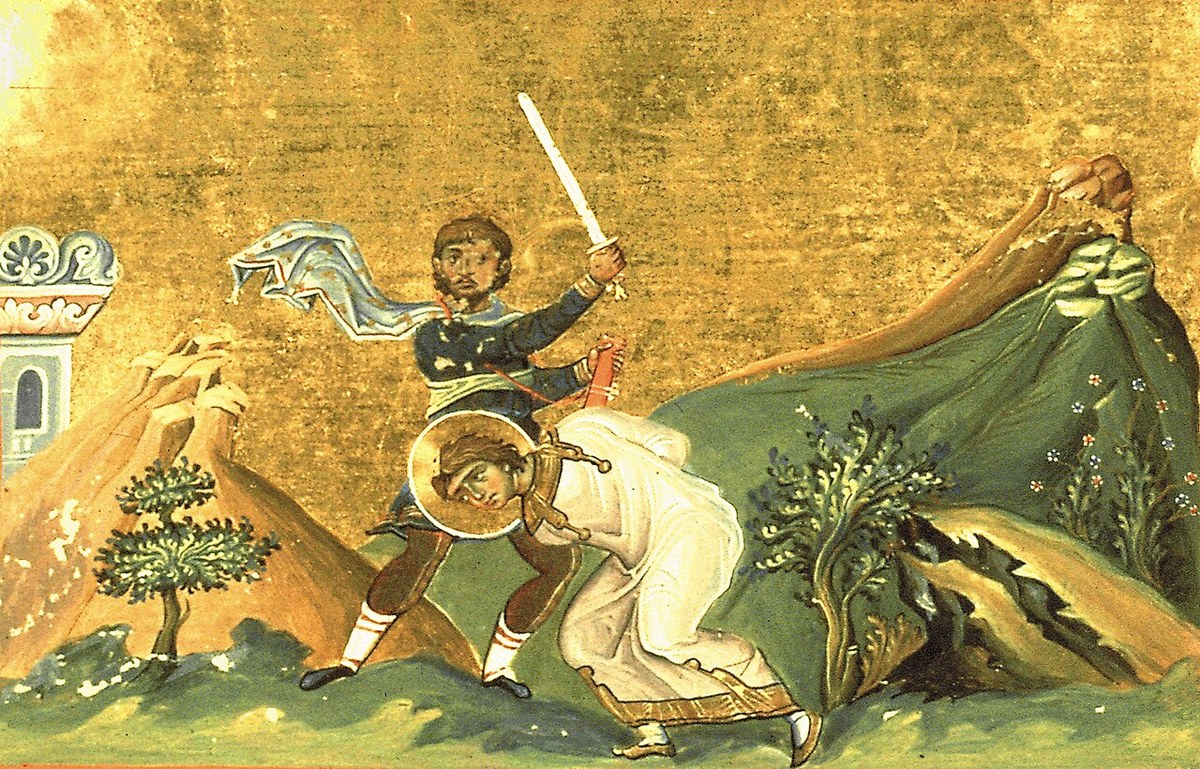
His body was carried, at his own dying request, back to his native village of Campsada for burial, that his own countryside might keep him; afterward his relics were translated and shared, as the veneration of the martyr spread. His head and portions of his relics came in time to be treasured in several places: he is the patron of Kotor (Cattaro) in Montenegro, whose cathedral of Saint Tryphon has guarded a relic of the martyr since the ninth century and keeps him as protector of the city; and his veneration took deep root in the Slavic world, above all in Russia, where from the seventeenth century the church of Saint Tryphon "at Naprudnoye" in Moscow made him one of the best-loved saints of the people. The Menologion of Basil II preserves a tenth-century miniature of his beheading among the martyrs of February 1.
Miracles and traditions
Tryphon's veneration is overwhelmingly a veneration of the fields. Because from childhood he had power over the creatures that harm the harvest, he became across the Orthodox world the protector of crops, gardens, and vineyards and the saint invoked against locusts, caterpillars, worms, beetles, mice, and every kind of pest and blight. In many places his feast on February 1 opened the agricultural devotions of the late winter: the vines were blessed in his name (in Bulgaria and the Balkans February 1 or the old-calendar equivalent is kept as Trifon Zarezan, the day of the first ceremonial pruning of the vineyards), and the fields and orchards were commended to his prayers for the coming season.
To this belongs the celebrated "Prayer of Saint Tryphon" (the Molitva or adjuration), preserved in the Slavic Trebnik and in Greek euchologia among the prayers for the blessing of fields: an exorcistic invocation, made in the name of the Holy Trinity and through the intercession of the martyr, commanding the vermin — the worms, caterpillars, locusts, beetles, and mice — to depart from the gardens, vineyards, fields, and orchards of the faithful and to do them no harm. It is one of the very few such agricultural adjurations to have entered the service-books, and it fixed Tryphon forever in the piety of the farming people.
In Russia a further tradition made him the patron of falconers and hunters: the story is told of a falconer of one of the tsars (in the usual telling, of Ivan the Terrible) who lost a favourite royal falcon and, in danger of his life, prayed to Saint Tryphon; the saint appeared to him on a white horse, bearing the lost bird, and so the church of Saint Tryphon at Naprudnoye was built in thanksgiving. The legend is late and local, but it made Tryphon the heavenly guardian of the hunt as he was of the harvest.
Feast and commemoration
Tryphon is commemorated on February 1 (church date; New Calendar civil February 1, Old Calendar civil February 14), the day of his martyrdom, which is also the day on which the Church keeps the forefeast of the Meeting of the Lord in the Temple (February 2). His office in the Menaion is therefore sung together with the forefeast hymns of the Meeting. The Antiochian, Greek, and Slavic calendars agree on the day, and his is the leading commemoration of February 1 in all of them. In the Balkans and among the Slavs his feast carries strong popular observances of the vineyards and fields (the Bulgarian Trifon Zarezan).
- Not to be confused with the later Russian saints who bear the same name: Tryphon of Pechenga (of Kola, †1583, the enlightener of the Lapps, kept December 15), Tryphon of Vyatka (†1612), and Tryphon, Bishop of Rostov (15th century) — all wholly distinct saints of the Russian North and later centuries. "The Martyr Tryphon" of February 1 is this Phrygian goose-herd of the third century alone. (These namesakes have no entry in this reference at the time of writing; the distinction is recorded here so that a future entry for any of them carries the reciprocal note.)
Hymns
Troparion — Tone 4
Thy martyr Tryphon, O Lord, in his contest received an incorruptible crown from Thee our God; for possessed of Thy might, he cast down the tyrants and shattered the feeble insolence of demons. By his supplications, O Christ God, save our souls.
Original translation from the Greek
Kontakion — Tone 8
By the steadfastness of the Trinity thou didst dissolve the worship of many gods from the ends of the earth, O renowned one; and having become precious in the Lord, and having conquered tyrants through Christ the Saviour, thou didst receive the crown of thy martyrdom and the gifts of divine healings, as one invincible.
Original translation from the Greek
Iconography
Tryphon is depicted as a beardless youth — the sign of his early martyrdom and of the goose-herd boy — with short curling hair, vested not as a soldier or churchman but in the simple tunic and cloak of a young layman, holding the martyr's cross in his right hand. His most distinctive attribute in the later tradition, especially in Russian and Balkan icons, is a white falcon or bird perched on his hand or wrist — the emblem of the falconer's legend and of his patronage of the hunt; in agricultural icons he may instead be shown with a sickle, a spade, or against a background of fields and vines. The narrative type is his beheading, the scene the Byzantine menologia illustrate.
The stored image is the Menologion of Basil II miniature for February 1 (Constantinople, c. 985; Vatican, Vat. gr. 1613): the young martyr Tryphon at the moment of his beheading, the executioner's sword raised over him — the visual form of the synaxarion verse that has him render his soul before the blow (source, public domain, pd-old-work).