
Twenty-six Martyrs of Zographou
The Holy Twenty-six Venerable Martyrs of the Monastery of Zographou on Mount Athos
Venerable Martyr · Martyr · d. 1276
Commemorated 22 September — Memory in the received Greek synaxarion; OCA lists September 21, 10 October — Anniversary of the burning (October 10, 1276), kept at Zographou and by the Bulgarian Church
The Twenty-six Martyrs of Zographou — twenty-two monks of the Bulgarian monastery of Zographou on Mount Athos, led by their abbot Thomas, together with four laymen — were burned alive in the monastery's tower in 1276, in the persecution that followed the Union of Lyons. Refusing the command of the emperor Michael VIII Palaiologos and the unionist patriarch John Bekkos to accept the union with Rome, they shut themselves in the tower, denounced the Latinizers from its height as lawless men and heretics, and were given to the flames. They are commemorated on September 22, and at Zographou and in the Bulgarian Church on October 10, the anniversary of the burning.
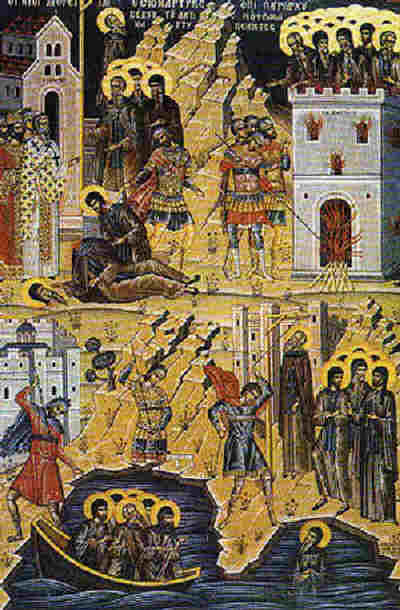

The Union of Lyons and Athos
In July 1274, hard pressed by Charles of Anjou in the West and by enemies on every frontier, the emperor Michael VIII Palaiologos accepted at the Second Council of Lyons a union with the Roman Church, engaging the Orthodox to recognise the papal primacy, the Filioque, and Latin usages. The patriarch Joseph, who would not subscribe, was deposed, and John Bekkos was raised to the patriarchal throne to enforce the union. Resistance was fiercest among the monks, and nowhere more than on Mount Athos, whose communities addressed protests to the emperor and refused the unionist commemorations. Imperial authority answered with force: the traditions of the Mountain remember a punitive expedition through the Athonite houses in the mid-1270s, with martyrdoms at Karyes, Iviron, Vatopedi, and Zographou.
The warning and the martyrdom
The Zographou tradition relates that an elder who tended a vineyard near the monastery was warned by the Mother of God, speaking through her icon before which he was reading the Akathist, that servants of the Latins were approaching, and that he must run to the monastery to warn the brethren: those who were weak should hide, and those who desired the martyr's crown should remain. The icon — held to have arrived at the monastery gate before the elder himself — is venerated at Zographou to this day as the "Forewarning" (Predvozvestitelnitsa) icon of the Theotokos.
Most of the brotherhood scattered into the forests and gorges of the Mountain. Twenty-six remained — the abbot Thomas with twenty-one monks and four laymen who worked at the monastery — and shut themselves in the monastery's tower. When the soldiery arrived and demanded submission to the union, the fathers answered from the height of the tower with a confession of Orthodoxy, censuring the Latinizing emperor and patriarch as lawless men and heretics and refusing every blandishment. The attackers heaped fuel about the tower and fired it, and the twenty-six were burned alive, on October 10, 1276 by the received reckoning.
The names of the martyred monks are transmitted in the Slavic-tradition roll as: Thomas the abbot, and the monks Barsanuphius, Cyril, Micah (Michaeas), Simon, Hilarion, James, Job, Cyprian, Sabbas, a second James, Martinian, Cosmas, Sergius, Menas, Joasaph, Joannicius, Paul, Anthony, Euthymius, Dometian, and Parthenius; the four laymen who suffered with them are unnamed. The tradition of the monastery adds that Parthenius, cast down from the burning tower, survived until the following day and was able to recount the martyrdom to the returning brethren.
Veneration
The martyrs became for the Slavic and Athonite world the exemplars of resistance to enforced union. Zographou keeps their memory with a proper service on October 10, and in 1873 a memorial (the "phial" monument) was raised in the monastery courtyard on the site of the burned tower, which had stood until the nineteenth century. The Bulgarian Church, of whose national monastery on Athos they are the chief martyrs, keeps October 10; the Greek synaxarion of September 22 carries their memory among the saints of that day, and the OCA commemorates them in September as well.
Feast and commemoration
September 22 (church date; Old Calendar civil October 5), with the divergences described above: OCA September 21, Zographou and the Bulgarian Church October 10 (church date; Old Calendar civil October 23). At the monastery the October feast is kept with a vigil at the courtyard memorial of the tower.
Hymns
Troparion — Tone 4
Thy martyrs, O Lord, in their sufferings received incorruptible crowns from thee, our God; for possessing thy strength they cast down the tyrants and broke the feeble insolence of the demons. By their prayers save our souls.
Original translation from the Greek
Iconography
The martyrs are shown as a company of monks, haloed, gathered in and upon the burning tower of the monastery, the flames rising about its base; fuller compositions add the arriving soldiery and the surrounding scenes of the Athonite persecution — monks slain by the sword or drowned from boats, as the traditions of Karyes, Iviron, and Vatopedi relate. The stored image is a Bulgarian icon of the 19th century of exactly this composite type: the tower of Zographou burns at the upper right with the fathers upon it, while around it the other martyrdoms of the unionist persecution are depicted.
Disputed questions
- Date of commemoration. Three placements coexist. The received Greek Menaion's synaxarion for September 22 includes "the holy twenty-six venerable martyrs of Zographou, who censured the Latin-minded — Michael the emperor Palaiologos and the patriarch John Bekkos — and were perfected by fire atop the tower" (verified live). The OCA calendar lists them under September 21 (2026, verified live), and its own life-text notes the October commemoration. October 10, the anniversary of the burning, is the principal feast at Zographou itself and in the Bulgarian Church. This entry keeps September 22 as primary per the Greek synaxarion witness, with October 10 as the secondary (anniversary) feast; the OCA's September 21 placement is recorded here and in the September 21 day file.
- Date of the martyrdom. The traditional date is October 10, 1276; some scholarship, re-dating the anti-unionist persecution on Athos, has proposed 1279–1284, and the year 1284 appears in part of the literature. The traditional 1276 is kept here.
- Historicity. The chief source is the Tale of the Zographou martyrs preserved in the monastery's own tradition, joined to the wider Athonite accounts of the unionist persecution (the martyrs of Karyes, Iviron, and Vatopedi). Some modern historians treat elements of these Athonite martyrdom-narratives as later anti-unionist elaboration, since the contemporary documentary record of Michael VIII's measures on Athos is thin; the Church's calendars, Greek and Slavic alike, receive the martyrdom as historical.
- The roll of names. The lists transmit twenty-two monastic names (including two Jameses) with minor variance between witnesses; the four laymen are everywhere unnamed. The roll is given above as transmitted, not asserted as a definitive register.