
Vladimir Yaroslavich of Novgorod
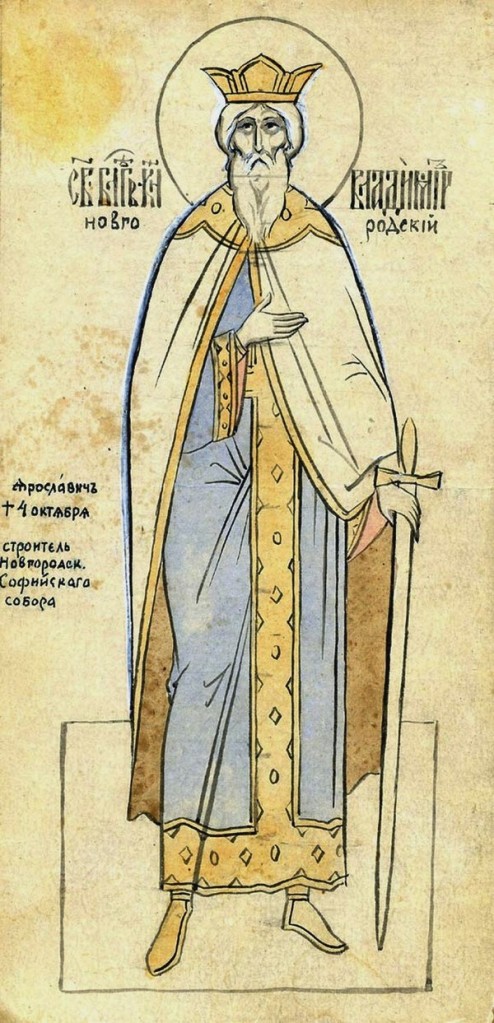
The Holy Right-believing Prince Vladimir Yaroslavich of Novgorod
Righteous · Prince · b. 1020 — d. 1052
Commemorated 4 October — Repose
Vladimir Yaroslavich (1020–1052), eldest surviving son of Yaroslav the Wise and the Swedish princess Ingegerd (Anna of Novgorod), was prince of Novgorod from 1034 until his early death. He is remembered above all as the builder of the cathedral of Holy Wisdom — St Sophia in Novgorod, the oldest church building of the Russian lands still standing — where he was buried and where his relics rest. The Russian Church venerates him among the right-believing princes; his feast is kept on October 4, the day of his repose.

Set over Novgorod by his father at fourteen, Vladimir ruled the northern capital for eighteen years under Yaroslav's overlordship. The chronicles credit him with campaigns against the Finnic Yam (1042) and with command of the last Rus' expedition against Constantinople (1043) — a disaster at sea from which the prince himself barely returned, and which the tradition remembers chiefly for the peace and dynastic marriage that followed it.
His enduring work was the great stone cathedral of Holy Wisdom, raised 1045–1050 with his father's blessing after fire took the older wooden Sophia: a five-domed church on the Kievan model that became the heart and symbol of Novgorod — "Where St Sophia is, there is Novgorod," the city's later proverb ran. Vladimir died on October 4, 1052, aged thirty-two, within two years of the cathedral's consecration, and was buried in it. His mother Anna (Ingegerd), who had taken the veil, died in Novgorod about 1050 and lies in the same church; mother and son came to be venerated together, and the uncovering of their relics in 1439 under Archbishop Euthymius II is remembered as the beginning of their formal local veneration, later extended through the Russian Church.
Feast and commemoration
October 4 (church date; Old Calendar civil October 17), his repose, kept in the Russian tradition and by the OCA; he is also remembered with his mother Anna on February 10 in Novgorod usage, and in the Synaxis of Novgorod Saints.
Hymns
Troparion — Tone 4 (from the common of a righteous prince)
From thy youth thou didst love Christ, O blessed one, and didst raise a house to the Wisdom of God in thy city; adorning thy princely rank with faith and almsgiving, thou didst finish thy course in peace. O right-believing prince Vladimir, entreat Christ God that our souls may be saved.
Original translation from the Slavonic
Iconography
Vladimir is depicted as a young prince in the fur-trimmed cap and mantle of the Novgorod princely type, often holding the five-domed St Sophia in his hand as its founder, sometimes beside his mother Anna. The stored icon is a pre-revolutionary Russian icon of this type.
Disputed questions
- Character of the cultus. The veneration is Novgorodian in origin (1439) and remains a commemoration of the Russian calendar and those following it (including the OCA); the Greek books do not carry him.
- The chronology of the 1043 campaign and the degree of Vladimir's personal command are debated among historians; the chronicle account is followed with its limits noted.