
William of Gellone
Our Venerable Father William, Monk of Gellone, formerly Count of Toulouse
Venerable · b. c. 755 — d. 28 May 812, at Gellone
Commemorated 28 May — Repose in the monastery of Gellone in Languedoc
William (c. 755–812) was a Frankish count and duke of Toulouse, a kinsman of Charlemagne and one of the commanders who held the Pyrenean frontier of Christendom against the emirate of Córdoba — he was in the field at the disaster on the Orbieu in 793 and at the capture of Barcelona in 801 — who then laid down his arms, founded the monastery of Gellone in the wild gorge of the Hérault in 804, enriched it with a relic of the True Cross given him by the emperor, and in 806 entered it himself as a simple monk. He died there on 28 May 812 and was formally canonised at Rome in 1066; the abbey and the village that grew around it are called Saint-Guilhem-le-Désert to this day. He is among the pre-schism saints of the West received into Orthodox commemoration, and he is the historical seed of an enormous cycle of medieval French epic, the Geste de Guillaume d'Orange, which buried the real man under a legendary one.

Origins and the march of Septimania
William was born about 755, the son of Count Theuderic (Thierry) and of Aldana, who by the Frankish genealogies was a daughter of Charles Martel — which made William a first-cousin of Charlemagne's generation and a member of the extended Carolingian kin. In 790 Charlemagne gave him the county of Toulouse, and with it the military command of the south-western frontier: the marca Hispanica, the belt of Septimania and the Pyrenean valleys facing the Muslim emirate of Córdoba.
He held that command for twenty years, and it was the hardest in the empire. In 793 the army of the emir Hisham I, under Abd al-Malik, invaded Septimania; William met it on the river Orbieu near Villedaigne and was beaten — but the Frankish stand was costly enough that the invaders turned back rather than press on to Narbonne, and William's conduct in a lost battle made his reputation rather than ruined it. In 801 he served in the great campaign of the young Louis the Pious against Barcelona, and it was largely by his generalship that the city was taken, the first substantial Frankish conquest south of the Pyrenees and the foundation of the Spanish March.
Gellone
In 804, still in the world and still count, William founded a monastery in the desert gorge of the Hérault at Gellone, in the Cévennes foothills of Languedoc, and placed it under the guidance of St Benedict of Aniane — the great reformer of Frankish monasticism, whose own house lay a few miles away and whose recension of the Benedictine Rule was about to be imposed on the whole empire. To this foundation William gave the possession that made it a place of pilgrimage: a relic of the True Cross, said to have been sent to Charlemagne from Jerusalem and given by the emperor to his kinsman.
In 806 — some accounts say after the death of his wife — William resigned his honours, put off his arms, and was received into Gellone as a monk, in the lowest place and under obedience like any other. The tradition dwells on the reversal: the commander who had taken Barcelona now carrying water and grinding corn. He lived there six years, and died on 28 May 812 (some sources 814).
Cultus, canonisation, and the legend
The tomb at Gellone drew pilgrims almost at once, standing as it did on one of the roads toward Compostela; the abbey church was rebuilt on a great scale in the eleventh century and remains one of the finest Romanesque buildings of southern France. In 1066 Pope Alexander II canonised him formally — one of the earlier papal canonisations — and the abbey and its village took his name: Saint-Guilhem-le-Désert.
What happened next to his memory is unique among the saints of this day. William became the central hero of a whole cycle of chansons de geste, the Geste de Garin de Monglane or Cycle de Guillaume d'Orange, some two dozen poems of the twelfth and thirteenth centuries in which he appears as Guillaume Fierebrace ("Strong-arm"), Guillaume au Court Nez ("of the short nose," from a wound), lord of Orange, husband of the converted Saracen queen Guibourc, the tireless and rather comic scourge of the pagans, who ends his career — as the real man did — in a monastery. The poems are not history and were not meant for it: they fused the count of Toulouse with other Williams, with the memory of the Saracen wars generally, and with pure invention. Their popularity is nevertheless the reason his name survived so widely in western devotion.
Feast and commemoration
May 28 (church date; New Calendar civil May 28, Old Calendar civil June 10), the day of his repose, always within the Pentecostarion. He is kept in OCA usage and among the Orthodox of France and Occitania; he has no Byzantine propers and is served from the common of a venerable father. Saint-Guilhem-le-Désert keeps the feast with the relic of the True Cross exposed, and the site remains a station on the pilgrim road to Compostela.
Hymns
Apolytikion — Tone 8 (common of a venerable father)
Having guarded the borders of the Christian people with the sword, thou didst lay the sword aside for the Cross, O William, and didst enter the desert of Gellone as the least of the brethren; and where thou hadst commanded armies thou didst learn to obey. O venerable father, intercede with Christ God that our souls may be saved.
Iconography
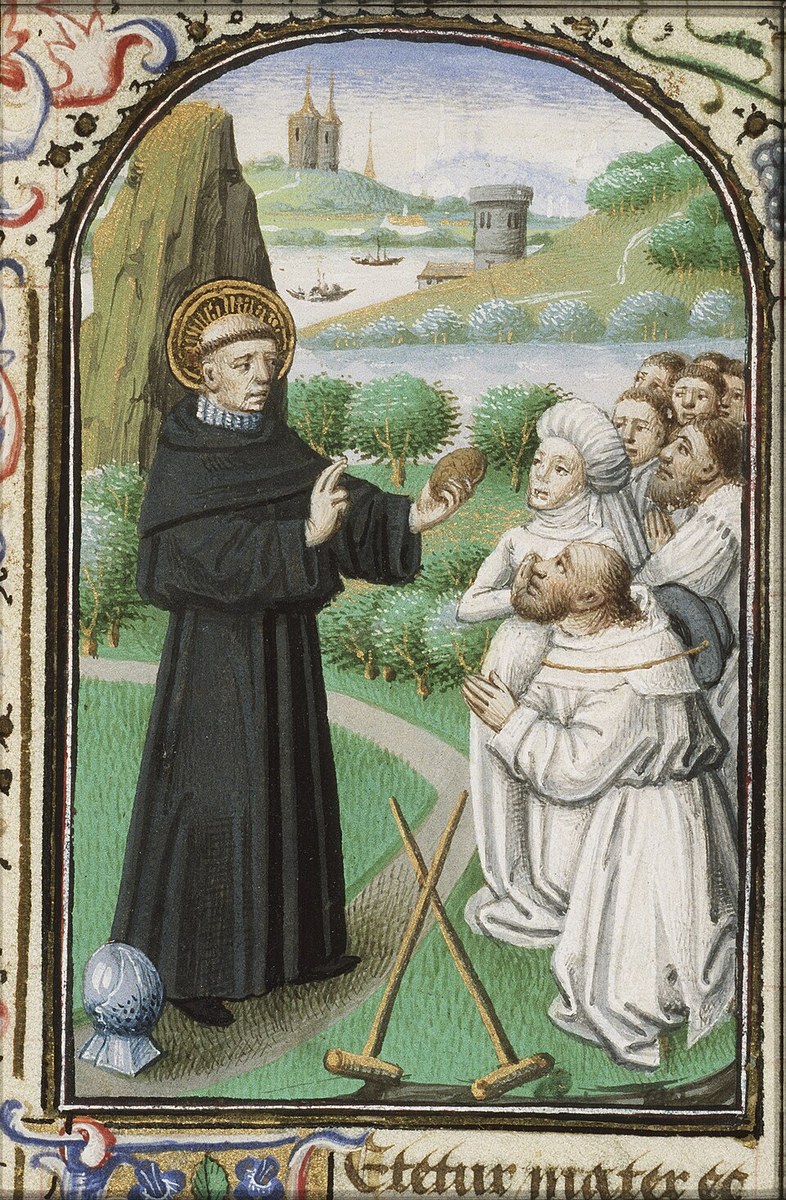
The subject given to William by Western art, and the one an Orthodox iconographer would naturally keep, is the soldier who became a monk: the saint in the black Benedictine habit, tonsured and haloed, with his armour cast off at his feet — most often a helmet, sometimes a shield, banner or gauntlets — the discarded arms carrying the whole meaning of his life. Where he is shown as a monk teaching or preaching, the helmet on the ground identifies him. A second Western type, far commoner but belonging by rights to William of Maleval, shows a knight in full armour kneeling before a vision; images of that kind should not be used for this saint.
The stored image is a manuscript miniature of 1455 from the Book of Hours of Simon de Varie (Koninklijke Bibliotheek, The Hague, KB 74 G37, fol. 88r), painted by the Master of Jean Rolin II: William stands in the black habit with the golden nimbus, teaching, one hand raised and a loaf in the other, before a company of kneeling monks and lay folk, with a river landscape and a castle behind; his helmet lies on the grass at his feet, and a pair of crossed mattocks — the tools of the monastic labour he took up — lie between him and the kneeling monks. The library's own catalogue record identifies the subject as William of Gellone / of Aquitaine, Benedictine monk and duke, and the helmet attribute confirms it: this is the soldier-saint of Gellone and not one of the armoured Williams.
Disputed questions
- The year of death: 812 or 814. Both are transmitted; the abbey's own tradition and most modern reference works give 28 May 812, and the day is not in doubt.
- The date of the Barcelona campaign is given as 801 in the Frankish annals; some notices, including the summary on which the Orthodox day-lists draw, place it in 803, conflating the siege with the consolidation that followed.
- Not to be confused with the other holy Williams with whom he has been merged for centuries, all of them "William of Aquitaine" in one source or another: William of Maleval (†1157), the penitent hermit of Tuscany, founder of the Williamite order — the confusion is ancient and pervasive, and much Western art labelled "St William of Aquitaine" belongs to him; William Firmatus (†1103) of Normandy; and William X, Duke of Aquitaine (†1137), the father of Eleanor, who was not a saint at all. Post-medieval paintings of a kneeling knight in armour receiving a vision, titled San Guglielmo d'Aquitania, are usually William of Maleval.
- Not to be confused with the legendary Guillaume d'Orange of the epics, who is a literary construction built on him: the lordship of Orange, the wife Guibourc, the short nose and most of the battles are the poets'.
- His Orthodox commemoration rests on the reception of the pre-schism saints of the West — he is carried on May 28 by the OCA and in the Orthodox western-saints lists derived from the Latin martyrologies — and not on any Byzantine cultus. The Greek Great Synaxaristes for May 28 does not list him.