
Xenia of Rome
Our Venerable Mother Xenia of Rome, the Deaconess
Venerable · Deaconess · d. c. 450, at Mylasa in Caria
Commemorated 24 January — Repose at Mylasa; kept with her two maidservants
Xenia of Rome (†c. 450), called in the world Eusebia, was the only daughter of an eminent Roman senator who, to escape a marriage her parents had arranged, fled her father's house with two devoted maidservants. Reaching first the island of Kos and then Mylasa in Caria (in south-western Asia Minor), she took the name Xenia — "the stranger" — to hide her identity and to name the life she had chosen, and there, under the guidance of the local presbyter and later bishop Paul, she built a church of the Protomartyr Stephen and gathered a community of women, being ordained deaconess. She lived in fasting, humility, and boundless charity — benefactress to the poor, comforter of the grieving, guide of sinners to repentance — until her repose about the year 450, at which, the tradition says, a luminous sign of a cross wreathed in stars was seen above the convent. Her two maidservants, who had shared her flight and her ascesis, were buried at her feet. She is the ancient namesake of the Russian Xenia of Petersburg, with whom she shares January 24.

Flight from Rome
The Life of Xenia, transmitted in the Byzantine synaxaria and depicted in the imperial Menologion, sets her origin at Rome, in the household of a great senator whose only daughter she was, and names her in the world Eusebia. Her parents, as befitted her rank, betrothed her to a noble husband; but Eusebia had already, in secret, given her heart to Christ and to the life of virginity, and she resolved to flee rather than be married against her vocation. Taking with her two faithful maidservants, she left her father's house by stealth and put out to sea.
Mylasa, and the name "stranger"
The fugitives came first to the island of Kos in the Aegean, and thence to Mylasa, a town of Caria on the mainland opposite. There, to keep herself hidden from any search her family might make, Eusebia laid aside her own name and called herself Xenia — the Greek word for a stranger, a foreigner, a sojourner — so that her very name became the confession of her state: she was a stranger and a pilgrim upon the earth, seeking a homeland not made with hands. The wordplay is the heart of her whole veneration, and the hymns of her feast turn upon it: she "lived a stranger's life in the world and bore a stranger's name."
At Mylasa she attached herself to a holy presbyter named Paul, who later became bishop of Mylasa; under his direction she and her companions built a church of the Holy Protomartyr Stephen, about which a small women's community gathered, and Bishop Paul, discerning her virtue, ordained her deaconess — an office of the early and Byzantine Church proper to women of tried holiness, in the service of the Church's charity and the ministry to women. In this office Xenia gave herself wholly to others: the tradition remembers her as a benefactress to the destitute, a consoler of the sorrowful, and a patient guide leading sinners back to repentance, while for herself she kept the strictest fasting and the deepest humility, so that she seemed the servant of all.
Repose
Xenia is said to have foreseen her own death, and to have reposed in peace, at prayer, about the year 450. At the hour of her burial a heavenly sign was seen over the convent — a radiant cross encircled by a wreath of shining stars, brighter than the sun, that accompanied the bearing of her body to the grave and was witnessed by the whole town — a seal set by God upon the hidden life of the stranger. Her two maidservants, who had followed her from Rome and shared her whole ascesis, did not long survive her, and were laid to rest at her feet; the three are commemorated together.
Feast and commemoration
January 24 (church date; New Calendar civil January 24, Old Calendar civil February 6), a universal commemoration of the Byzantine rite, kept together with her two maidservants. On this same day the Russian Church keeps the Blessed Xenia of Petersburg, the fool-for-Christ, so that the two Xenias are honoured side by side. The day falls within the weeks of the pre-Lenten Triodion.
Hymns
Troparion — Tone 3
A stranger's life didst thou accomplish in the world, and a stranger's name didst thou receive, showing forth in that calling thy manner of life; for forsaking the bridegroom of a passing hour, thou wast wedded in holiness to the Immortal One. O glorious Xenia, entreat Christ our God, that He grant unto us His great mercy.
Original translation from the Greek
Iconography
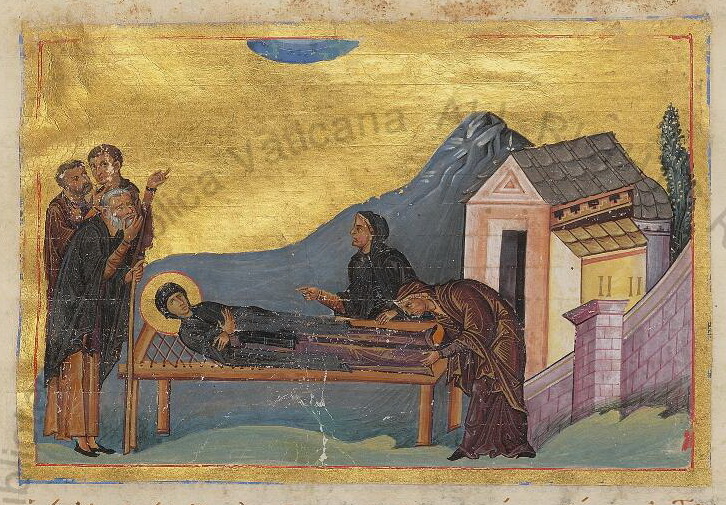
Xenia is shown as a woman in the dark monastic maphorion, often holding a cross or a scroll; her narrative image, transmitted from the earliest illustrated menologia, is the scene of her repose — the saint laid upon a bier, her sisters and the townsfolk gathered in mourning, the convent buildings behind, and above, in the golden sky, the luminous sign that appeared at her death.
The stored image is the miniature for January 24 from the Menologion of Basil II (Constantinople, c. 1000; Vatican, Vat. gr. 1613): the haloed Xenia lies upon her deathbed as monastics and mourners attend her before the walls and roofs of the Mylasa convent, while overhead the heavenly sign shines in the gold (source, public domain, pd-old-work).
Disputed questions
- Not to be confused with Xenia of Petersburg, the Russian fool-for-Christ (†c. 1803), who bore this saint's name — Xenia, "the stranger" — from her baptism and made it, like the Roman Xenia before her, the emblem of a life of voluntary estrangement from the world. The two are wholly distinct saints of different ages, and the Church keeps them on the one day, January 24; the elder Xenia gave the younger both her name and, in a sense, her pattern.
- The saint's own baptismal name Eusebia ("piety") is sometimes given as her proper name and Xenia as the assumed one; the calendars commemorate her as Xenia.