
Zenobius and Zenobia of Aegae
The Holy Hieromartyr Zenobius, Bishop of Aegae, and his Sister the Martyr Zenobia
Hieromartyr · Bishop · Martyr · Virgin · b. c. 250 — d. c. 285
Commemorated 30 October — Martyrdom at Aegae in Cilicia
Zenobius, bishop of Aegae in Cilicia, and his sister Zenobia were a brother and sister of a wealthy Christian family who gave away their inheritance to the poor and were glorified together in martyrdom around the year 285. A physician graced with the gift of healing, Zenobius was made bishop of his native city and was among the first seized when persecution broke out; when his sister saw him tortured she came forward and confessed Christ of her own accord, and the two were beheaded together after enduring the cross, the red-hot iron bed, and the boiling cauldron. They are commemorated on October 30, their joint feast keeping the memory of a family sanctified as a single company of witnesses.
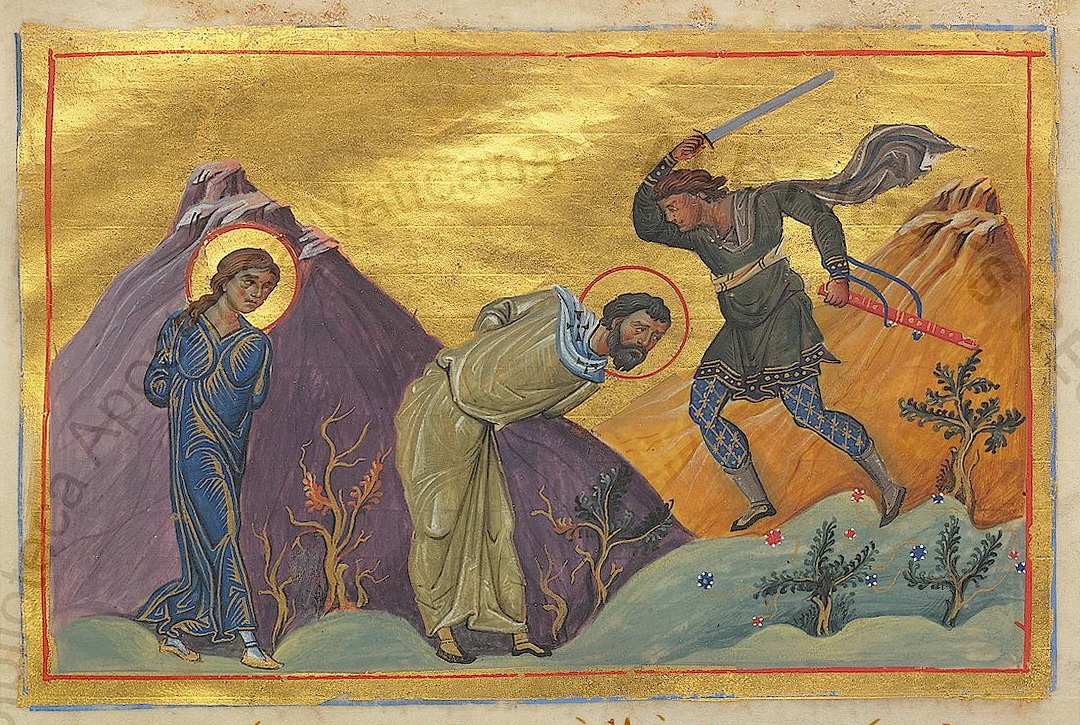

Origins and the giving-away of wealth
Zenobius and Zenobia were born at Aegae (Αἰγαί), a coastal city of Cilicia, to Christian parents who raised them from childhood in the faith and in a life of chastity and piety. Come to their inheritance in adulthood, the two — according to the received account, unmarried and of one mind — refused to be held by the love of money and distributed their wealth among the poor, choosing to serve Christ in voluntary simplicity. For this mercy and purity of life, the tradition says, the Lord granted Zenobius the gift of healing, so that he cured many diseases by grace alone; and on account of his holiness the Christian community of Cilicia chose him as its bishop, in which office he laboured zealously to spread the faith among the pagans of the region.
Martyrdom
When the persecution of Diocletian reached Cilicia, Zenobius as bishop was among the first arrested and brought before the governor — named Lysias (Licius) in the accounts. Offered the customary choice between sacrifice to the gods with his life spared, or death, the bishop answered that a life lived without Christ is itself death, and that it was better to bear a passing torment for his Creator and live with him eternally than to deny him for the sake of the present life and be tormented forever. He was nailed to a cross and tortured. His sister Zenobia, seeing his sufferings, came forward and boldly confessed her own faith in Christ before the governor, and so was given over to the same torments. The tradition records that by the power of God they survived being laid upon a red-hot iron bed and then cast into a boiling cauldron, and that the two were at last put to the sword together. A priest named Hermogenes secretly recovered their bodies and buried brother and sister in a single grave.
Veneration
Their memory was kept on October 30 from an early date: the Menologion of Basil II (c. 1000) carries a miniature of their martyrdom, and the received Greek Menaion provides a proper service, with stichera and a canon ascribed to Joseph the Hymnographer. In later Western devotion Zenobius came to be invoked by those suffering from diseases of the breast, a patronage noted by the OCA; the Byzantine sources emphasise rather the healing grace of his lifetime and the constancy of the two witnesses.
Feast and commemoration
October 30 (church date; Old Calendar civil November 12). Brother and sister are commemorated jointly, as they suffered; the Greek Menaion keeps the full service of the two martyrs on this day, and the OCA, Slavonic, and Greek calendars all list them together as "Zenobius the bishop and Zenobia his sister."
Hymns
Troparion — Tone 4
Your martyrs, O Lord, in their contest received incorruptible crowns from you, our God; for possessed of your might, they cast down the tyrants and broke the feeble insolence of demons. By their intercessions, O Christ God, save our souls.
Original translation from the Greek
Kontakion — Tone 4
Let us honour the two martyrs of the truth and heralds of true worship, the pair of kindred — Zenobius together with the venerable Zenobia — who lived their life as one and through martyrdom obtained an incorruptible crown.
Original translation from the Greek
Iconography
The two are shown together as a bishop and a woman — Zenobius vested as a hierarch, in the omophorion and holding a Gospel book, Zenobia beside him as a young woman of the martyrs — or in the scene of their common death. The stored image is the martyrdom miniature from the Menologion of Basil II (Vatican, Vat. gr. 1613, p. 150, c. 1000), which depicts the beheading of the brother and sister side by side.
Disputed questions
- Date and reign. The sources place the martyrdom under Diocletian and most give the year 285, at the very opening of that reign (284–305); the round date is traditional rather than documentary. The governor's name appears as both Lysias and Licius in the transmission.
- Not to be confused with the several other saints named Zenobius in the synaxaria, nor with Zenobia the third-century queen of Palmyra, with whom the martyr shares only a name.