
Zlata of Meglen
The Holy Virgin New-Martyr Zlata (Chryse) of Meglen
New Martyr · Virgin · d. 1795
Commemorated 13 October — Martyrdom at Slatino in Meglen, 1795
Zlata of Meglen (†1795), called Chryse in Greek — both names mean "golden" — is one of the best-loved virgin new-martyrs of the Ottoman period: a poor villager's daughter from Slatino in the Meglen district of Macedonia who was abducted by a Turk determined to make her his wife and a Muslim, and who through months of imprisonment, the pleading of her own terrified family, and three months of torture refused to deny Christ, until she was hung upon a tree and cut to pieces on October 13, 1795. Her martyrdom, recorded by her spiritual father, entered the Neon Martyrologion of Nikodemos the Hagiorite within four years of her death. Bulgarians, Macedonian Slavs and Greeks all honour her as their own.

Origins
Zlata was born in the village of Slatino (Slatena) in the Meglen (Moglena) district of Macedonia — today the village of Chrysi in the Pella prefecture of northern Greece, renamed after her Greek name — in the years when the whole region lay under Ottoman rule. Her father was a poor peasant with four daughters and no sons. The accounts dwell on what the family could not give her in dowry being supplied in person: she was strikingly beautiful, strong-willed beyond her years, and firmly grounded in the faith of Christ from childhood. The hagiographers, playing on her name, call her the "golden vessel of virginity, and undefiled bride of Christ."
Abduction and confession
One day, as Zlata went out with other women to gather firewood (some retellings say to fetch water), a Turk of the district who had become infatuated with her seized her and carried her to his house. There he pressed her, by promises of marriage and by flattery, to accept Islam. Zlata answered that she knew Christ alone as her Bridegroom and would not deny him though she be torn to shreds. When persuasion failed, the man and his kin turned to threats, and held her for some six months while they worked on her resolve. Failing themselves, they summoned her parents and sisters and ordered them to persuade her, on pain of torture and death for the whole family. Her family came weeping and begged her to deny Christ "only in appearance," to save her life and theirs. Zlata's reply became the most famous word of her passion: those who urged her to deny Christ were no longer her father, mother and sisters; she had the Lord Jesus Christ for father, the Lady Theotokos for mother, and the saints of the Church for her brothers and sisters.
Martyrdom
Enraged at their defeat, her captors tortured the maiden over some three months: she was beaten with clubs, strips of skin were peeled from her body so that the ground reddened with her blood, and a skewer heated in the fire was passed through her ears. Through it all she sent word to her spiritual father, the hieromonk Timothy of the Athonite monastery of Stavronikita, who was nearby, asking his prayers that she might endure to the end — and it was he who afterwards set down the account of her martyrdom. At the last, the Turks hung her upon a tree and cut her body to pieces with their knives, on October 13, 1795. Christians of the village gathered the pieces of her relics secretly and buried them with reverence. The tradition crowns her twice, with the crown of virginity and the crown of martyrdom.
Veneration and later cultus
The martyrdom recorded by her confessor was taken up almost at once by Nikodemos the Hagiorite into the Neon Martyrologion (1799), the classical collection of the new-martyrs of the Turkish yoke, where she stands as Chryse (Χρυσῆ) of Slatena. The Slavic world venerates her as Zlata: the Prologue of Ohrid keeps her on October 13 and calls her a Bulgarian village girl; the Bulgarian Church honours her among its national saints; churches bear her name among the Macedonian Slavs, including the church of Sveta Zlata Meglenska at Saraj near Skopje and the Macedonian parish dedicated to her in Zagreb; and the Russian calendar carries her feast with a full set of common hymns and a modern akathist. In Greece the village of her birth now bears her name, Chrysi. She is invoked especially as a protectress of young women and of Christians pressed to abandon the faith.
Feast and commemoration
October 13 (church date; Old Calendar civil October 26), the day of her death, kept by the Greek calendars (as Chryse the New), by the Serbian and Russian calendars and the OCA (as Zlata of Meglen), and by the Bulgarian Church, whose commonly reported October 18 date is noted above. She is a post-Byzantine saint, so the old printed Menaia carry no notice of her; the day's Menaion service remains that of the martyrs Carpus and Papylus, with the new-martyr's service supplied from modern compositions where her feast is kept solemnly. The Slavic tradition styles her "great-martyr" (the Russian calendar prints "вмц."), the Greek "new-martyr" or "virgin-martyr"; the difference of styling is recorded here.
Hymns
Troparion — Tone 4
Thy lamb Zlata crieth to thee with a great voice, O Jesus: Thee, my Bridegroom, do I love, and seeking thee I contend, and am crucified and buried with thee in thy baptism; I suffer for thy sake, that I may reign with thee, and I die for thee, that I may live in thee. Receive me then as a spotless sacrifice, slain with love for thee. By her intercessions, as thou art merciful, save our souls.
Original translation from the Greek
Iconography
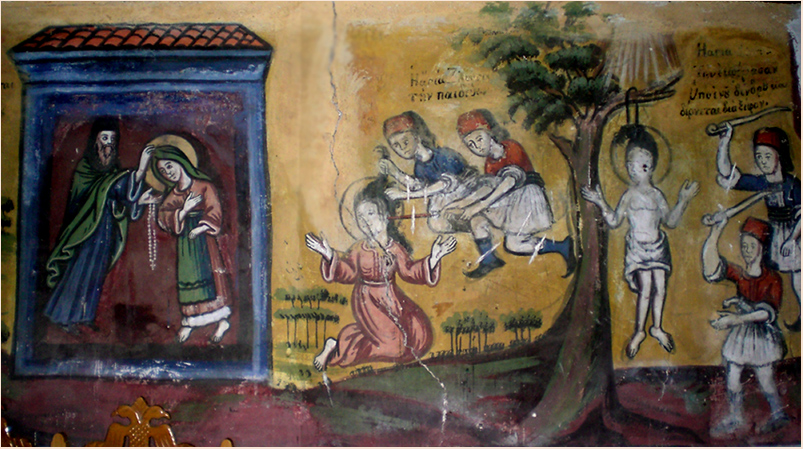
Zlata is painted as a village maiden of Macedonia in festive dress, often with a head-cloth, holding the cross of martyrdom, sometimes with the palm branch or with the tree of her passion behind her; most icons of her are works of the twentieth and twenty-first centuries. The stored image is older: an anonymous fresco from Aegean Macedonia, dated on the Commons file page to before 1925, showing the cycle of her martyrdom — the saint kneeling in prayer, her torturers flaying her, and the maiden hung upon the tree as the knives do their work — with Greek inscriptions naming the holy Chryse.
Disputed questions
- Whose saint? Nikodemos calls her a Bulgarian; the Serbian Prologue of Ohrid follows him; Greek usage counts her among the neomartyrs of the Greek church as Chryse; and the Slavs of North Macedonia venerate her as Zlata Meglenska, their own. The village was a Slavic-speaking one in a region of mixed speech, and the competing national claims are a nineteenth- and twentieth-century quarrel laid over an eighteenth-century martyr; this entry records all the claimants and adjudicates nothing.
- Geography. The OCA's notice places Slatena "on the border of Bulgaria and Serbia," a loose usage from the older, wider sense of "Bulgaria"; the Meglen district in fact lies in southern (Aegean) Macedonia, north-west of Thessalonica, and the village is the present-day Chrysi in Greece.
- Her age. The accounts agree she was a young unmarried woman; popular retellings give ages from thirteen to eighteen, but the early sources fix no number, and none is asserted here.
- The Bulgarian date. The Bulgarian Church is widely reported to keep her memory on October 18 rather than October 13; this could not be verified against a live Bulgarian calendar witness and is flagged for verification rather than entered in the feast data.