
Akhtyrka Icon of the Mother of God
Kept 2 July — The finding of the icon in a field at Akhtyrka, 2 July 1739
The Akhtyrka (Akhtyr) Icon of the Mother of God is a Ukrainian wonderworking icon found on 2 July 1739 by a priest of the town of Akhtyrka in the Kharkov region, who came upon it shining in the long grass of a field he was mowing. It is of an unusual type: the Theotokos alone, bare-headed, her hands crossed on her breast, gazing towards the Crucified who is shown beside her on Golgotha — an image of the Mother standing by the Cross rather than of the Mother and Child. Its healings, particularly of fever and ague, were investigated three times by the Holy Synod and confirmed in 1751; the empress Elizabeth built the stone cathedral that housed it. The original was stolen in 1905 and vanished for most of the twentieth century, resurfacing by way of Harbin, San Francisco and Brazil, and was returned to Russia in 2010.
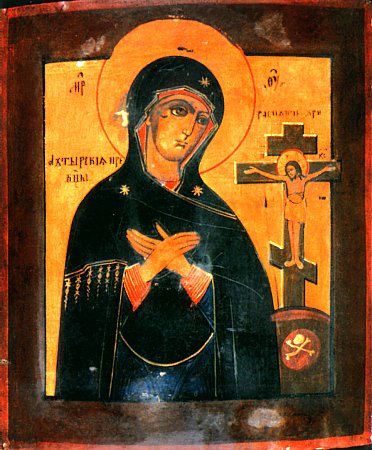

The finding, 1739
Vasily (Basil) Danilov, priest of the church of the Protection at Akhtyrka in the Sloboda Ukraine, was cutting grass in the field beside his church on 2 July 1739 — the feast of the Deposition of the Robe — when he saw an icon lying in the grass and shining with an unearthly brightness. He crossed himself, took it up, and carried it home. For three years it stood in his house, but no one could pass a night in the room where it was: an inexplicable dread drove them out.
At the end of the third year the Mother of God appeared to the priest in sleep and reproached him that her image lay unclean; he woke and washed the icon, and was carrying the water to pour it away when a second time he was told, in a dream, to keep the water, for by it fever would be healed. His own daughter, lying sick of the ague, drank of it and recovered. An iconographer named John, to whom the icon had been given for restoration, saw the like happen to his son. The report spread; the sick came; and the icon was moved into the church.
The Synod's enquiry and the cathedral
Reports of healings in the Russian empire were not accepted quickly. The Holy Synod examined the Akhtyrka miracles three times, over some years, before declaring them genuine in 1751 and permitting the veneration of the icon. The empress Elizabeth Petrovna, who had a particular devotion to it, gave for the building of a stone cathedral of the Protection at Akhtyrka; the design is attributed to the court architects of the Rastrelli circle, and the church was finished in 1768. Under Nicholas I a yearly procession was established carrying the icon between the town's cathedrals about the time of Pentecost, and Akhtyrka became one of the great pilgrimage places of the Ukrainian lands.
The theft and the wandering of the icon
On 1 April 1905 the icon was stolen from the Protection cathedral, and was not recovered. It reappeared long afterwards among the Russian emigration — in Harbin in Manchuria, then in San Francisco, and afterwards in Brazil, with the bishops of the Russian Church Abroad. In 2010 it was handed over by the president of the Russian Federation to the Church, and placed in the Novodevichy convent at Moscow, where it now is. Copies of the Akhtyrka icon, several of them themselves reputed wonderworking, are found across Ukraine and southern Russia, and the type spread as far as the Balkans and Hungary in the eighteenth century.
Feast and commemoration
July 2 (church date; New Calendar civil July 2, Old Calendar civil July 15) — the anniversary of the finding, which fell on the feast of the Deposition of the Robe of the Theotokos and has been kept with it ever since. The commemoration is Russian and Ukrainian and is carried in the OCA calendar; it does not appear in the Greek or Antiochian books. Two other icons of the Mother of God share the day in the Russian calendars — the Pozhaisk icon (Pažaislis in Lithuania, 17th c.) and the Feodotievo icon (Ryazan, 1487) — neither of which has an entry in this repository at the time of writing. The Akhtyrka icon is invoked especially in fevers and in every kind of grief, and, from the wording of its prayer, by those with daughters to provide for.
Hymns
Troparion — Tone 4
Most blessed Virgin, pure Mother of God, standing by the Cross of thy Son and our God thou didst endure a great sorrow, and didst receive from him the grace to comfort those that are in sorrow. Therefore, gazing in reverence upon thine all-pure image, and beholding thee portrayed upon it before the Cross of our Saviour, we cry to thee with compunction: O fervent advocate, good and merciful, make haste to deliver us from every sorrow, need and sickness, and save our souls, that we may glorify thee with thanksgiving unto the ages.
Original translation from the Slavonic
Kontakion — Tone 8
Let us hasten, O faithful, to the gracious fountain of mercies and compassion, the wonderworking image of the most pure Virgin; for it was given us from on high for the salvation of our souls and bodies. Venerating it with love, let us cry aloud to the Theotokos: O Mother hymned of all, O all-merciful Queen, shelter us and keep us from every evil by thy motherly intercession before God.
Original translation from the Slavonic
Appointed readings
Epistle — Philippians 2:5–11
5Let this mind be in you, which was also in Christ Jesus: 6Who, being in the form of God, thought it not robbery to be equal with God: 7But made himself of no reputation, and took upon him the form of a servant, and was made in the likeness of men: 8And being found in fashion as a man, he humbled himself, and became obedient unto death, even the death of the cross. 9Wherefore God also hath highly exalted him, and given him a name which is above every name: 10That at the name of Jesus every knee should bow, of things in heaven, and things in earth, and things under the earth; 11And that every tongue should confess that Jesus Christ is Lord, to the glory of God the Father.
Gospel — Luke 10:38–42; 11:27–28
38Now it came to pass, as they went, that he entered into a certain village: and a certain woman named Martha received him into her house. 39And she had a sister called Mary, which also sat at Jesus’ feet, and heard his word. 40But Martha was cumbered about much serving, and came to him, and said, Lord, dost thou not care that my sister hath left me to serve alone? bid her therefore that she help me. 41And Jesus answered and said unto her, Martha, Martha, thou art careful and troubled about many things: 42But one thing is needful: and Mary hath chosen that good part, which shall not be taken away from her. 27And it came to pass, as he spake these things, a certain woman of the company lifted up her voice, and said unto him, Blessed is the womb that bare thee, and the paps which thou hast sucked. 28But he said, Yea rather, blessed are they that hear the word of God, and keep it.
Iconography
The Akhtyrka type stands apart from the great Byzantine families of Marian icons. There is no Child. The Theotokos is shown half-length, turned slightly to the right, her head uncovered — the dark hair visible beneath the edge of the maphorion, which is a rarity in Orthodox iconography — and her hands crossed upon her breast in the gesture of acceptance; before her, on the right of the panel, rises the Cross with the crucified Christ, planted on the mount of Golgotha with the skull of Adam in the cave beneath. It is, in effect, a Crucifixion reduced to the Mother alone, and its theme is the sword foretold by Symeon: the icon is contemplative and western-touched in feeling, and its eighteenth-century date shows in the modelling of the face. The composition is sometimes read as an icon of the Compassion (Umilenie u Kresta).
The stored image is an eighteenth-century panel of the type, close in date to the original, inscribed at the left АХТЫРСКІЯ ПРЕ[СВЯТЫЯ] Б[ОГОРОДИ]ЦЫ: the Virgin in dark blue maphorion with hands crossed, the golden ground, and the Crucifix with the skull at the right.