
Deposition of the Robe of the Theotokos at Blachernae
On July 2 the Church keeps the laying-up of the precious Robe of the Most Holy Theotokos in the Holy Reliquary (Hagia Soros) of the shrine at Blachernae, in the north-western corner of Constantinople by the Golden Horn. The tradition tells of two patricians, Galbius and Candidus, who on pilgrimage to the Holy Land lodged with a Jewish widow near Nazareth in whose house the burial-robe of the Mother of God had been kept from generation to generation, and who carried it off to the imperial city, where the emperor Leo I and the empress Verina built for it the reliquary chapel that became the greatest Marian sanctuary of Byzantium. From that day the City counted the Robe its wall: it was carried round the ramparts in the Avar siege of 626 and again when the fleet of the Rus fell upon Constantinople in 860 — the deliverance that opens the history of Christianity among the Slavs — and the feast passed with the relic's fame into Rus', where Moscow keeps it for its own deliverance from the Tatars on this same day in 1451.
_-_икона_11021_Положение_честныя_ризы_Пречистыя_Девы_Богородицы.png)
The shrine at Blachernae
The quarter of Blachernae lay outside the Theodosian land walls, at the head of the Golden Horn, beside a holy spring. There, about the year 450, the empress Pulcheria — with her husband Marcian — raised a church of the Mother of God; her successors enlarged it, and it was the emperor Leo I (457–474) and his wife Verina who added to it the round chapel called the Hagia Soros, "the Holy Reliquary," to house the Robe. The Greek synaxarion notice for the day names them precisely so: the deposition was made "in the Holy Reliquary at Blachernae, under Leo the Great and Verina his wife." Later emperors kept enriching the place; Justinian rebuilt it; Heraclius in 627 threw out a new wall to bring the shrine inside the defences of the City, so much did Constantinople reckon its safety bound up with what lay there.
What the shrine held is described by the service books in two words that must be kept distinct. The Esthes (ἐσθής, Slavonic riza) is the Robe proper, honoured on July 2; the Zone (ζώνη), the Cincture or Girdle, has its own feast on August 31 and was for most of its history kept not at Blachernae but at the Chalkoprateia church. The July 2 apolytikion names both together — "the Robe and the Girdle of thine undefiled body" — because by the middle Byzantine period both relics, together with a portion of the maphorion, the Virgin's veil or outer head-covering, were spoken of as the one treasure of the Mother of God at Constantinople; but the feast of this day is the feast of the Robe.
Galbius and Candidus
The narrative that the Church reads on this day is preserved in a Greek Logos on the deposition, transmitted in several recensions and associated in the manuscripts with Theodore Synkellos, the priest of Hagia Sophia who preached on the deliverance of 626. Two brothers, patricians of senatorial rank named Galbius and Candidus — men who in some recensions had been Arians and were brought to the Orthodox faith — set out in the reign of Leo I on pilgrimage to Jerusalem. Passing through Galilee they sought a night's lodging in a village near Nazareth, and were given a room in the house of an aged Jewish woman, a widow living in great modesty. In an inner chamber they saw lamps burning and incense rising and sick people lying about the place, waiting; and pressing their hostess with questions they drew from her at last that the house held a relic of surpassing holiness — the robe of the Mother of God, which the Virgin, before her Dormition, had given to one of two poor maidens who served her, and which had been kept ever since in that family, passed always from virgin to virgin, and that from it healings flowed.
The brothers went on to Jerusalem, but they went back by the same road; and in the night, the account says, they took the measure of the chest in which the relic lay, had another made exactly like it in the city, and on their return exchanged the one for the other, taking the Robe away to Constantinople. They first built a church for it on their own estate at Blachernae; but the thing could not be hidden, and when it came to the ears of the emperor Leo and the patriarch Gennadius the relic was received, its authenticity examined, and it was laid up with all solemnity in the Hagia Soros, whence it never afterwards departed.
The pious theft is told without embarrassment by the sources — the age reckoned that a relic went where it willed to go, and that the Mother of God had chosen the City. Modern scholarship reads the Logos as a Constantinopolitan composition of the sixth or seventh century, framed to explain a relic already venerated; and the reader should hold the narrative as the Church holds it, as the received account of the feast, without pressing its details as chronicle.
The Robe and the deliverances of the City
Whatever its origin, the relic became the palladium of Constantinople, and the history of the shrine is a history of sieges lifted.
In 626, while the emperor Heraclius was far away campaigning against the Persians, the Avars and their Slav levies came against the walls from the land side and the Persians stood across the water at Chalcedon. The patriarch Sergius carried the icon of the Mother of God about the ramparts and the people kept vigil; the Avar assault broke, their fleet of dug-out canoes was destroyed in the Horn, and the khagan withdrew. Theodore Synkellos preached on the deliverance, and it is to that year that the tradition attaches the great hymn of thanksgiving to the Theotokos, the Akathist with its kontakion "To thee the Champion Leader." The Robe itself had been carried to Hagia Sophia for safety at the start of the siege and was brought back to Blachernae after it; the Byzantine memory afterwards drew the two things together, and the shrine of the Robe became the place where the City gave thanks for having been spared.
In 860 the danger came from a quarter Constantinople had not known before. On 18 June a fleet of some two hundred vessels of the Rus came down the Bosporus while the emperor Michael III was away in Asia Minor fighting the Arabs, and for some weeks burned and plundered the suburbs and the islands of the Propontis unopposed. The patriarch of the City was Photius the Great, and two homilies of his survive, preached while the enemy was still at the gates and after they had gone — our only contemporary account. He describes the attack as a sudden swarm, "a nation unnamed, a nation of no account," calls the people to repentance, and then gives thanks that the City was delivered without a battle. The Rus withdrew on 4 August.
Of how the deliverance came Photius says nothing beyond the mercy of God and the intercession of the Mother of God, whose robe he had carried in procession about the walls. The famous scene — the patriarch and the emperor bearing the Robe down to the shore, the edge of it dipped into the sea, and a sudden storm rising to scatter the enemy ships — belongs to the later Byzantine chroniclers, and thence to the Slavonic tradition and the Russian Primary Chronicle, which tells it under the names of the Kievan princes Askold and Dir. Modern historians (Constantine Zuckerman and others) point out that the eyewitness knows nothing of any storm and that the Rus most likely sailed away having got what they came for. The Church keeps the memory of the deliverance; the storm is the tradition's way of confessing it, and this entry records the distinction rather than resolving it.
The sequel matters more than the storm. In the autumn of 860 an embassy of the Rus came to Constantinople to treat for peace, and the peace carried with it the first Christian mission to the Rus: a bishop was sent to Kiev, Askold is said to have received baptism with the name Nicholas, and in the same years Cyril and Methodius were making the Slavonic letters and the Slavonic Scriptures. Photius could write not long after that the Rus had exchanged their heathenism for the faith and received a bishop. The conversion lapsed with Askold's death, and the baptism of the Rus had to be made again under Vladimir in 988; but the Russian Church has always looked back to the July 2 deliverance as the beginning of its own history, and that is why the feast of a Constantinopolitan relic is kept with such warmth in the north.
The end of the relic, and the Robe in Moscow
The shrine at Blachernae was sacked with the rest of the City by the Latins in 1204, and relics of the Robe and the veil were dispersed westward — Chartres in France has claimed a portion of the Virgin's garment since the ninth century, by a quite separate line of transmission. The church itself, rebuilt and reduced, burned down in 1434, by accident, when boys hunting pigeons in the roof set fire to it; and the Byzantine sources say nothing further of the relic. Portions of the Robe are shown today in Georgia (at Zugdidi), on Mount Athos, and in several Greek and Russian treasuries.
In Rus' the feast acquired a second, native content. On the night of 2 July 1451 the Tatar force of the prince Mazovsha, which had come up to Moscow and fired the posad, unaccountably broke camp and withdrew, leaving its baggage behind; the city ascribed its escape to the Mother of God on her own festival, and the metropolitan Jonah built in the Kremlin a church of the Deposition of the Robe in thanksgiving. It burned and was rebuilt in stone by Pskov masters in 1484–1486, and the little Church of the Deposition of the Robe still stands between the Dormition and Faceted palaces as the house-church of the metropolitans and afterwards the patriarchs of Moscow — a small building carrying the memory of a Constantinopolitan relic and of a night in July when the Tatars went away.
Feast and commemoration
July 2 (church date; New Calendar civil July 2, Old Calendar civil July 15). The feast is universal: it stands in the Greek Menaion, in the Slavonic books, and in the Antiochian and Greek calendars for the day, where it is the principal commemoration, joined by the martyr Quintus in the Greek synaxarion and by Juvenal of Jerusalem everywhere. In Russian usage it carries a polyeleos and a magnification and is reckoned among the greater commemorations of the Theotokos of the summer, with the Akhtyrka, Pozhaisk and Feodotievo icons attached to the same day; Russian practice vests in blue, the colour there appointed for feasts of the Mother of God, while Greek practice knows no fixed system of colours. The day falls in the weeks after the Apostles' Fast, outside any fasting season.
The feast is one of a pair. This day keeps the Robe at Blachernae; August 31 keeps the Cincture (Zone) of the Theotokos, deposited at the Chalkoprateia and now on Mount Athos at Vatopedi — and the two are constantly confused in English writing, the more so because the apolytikion of July 2 names both relics in one breath. A third relic-feast of the Theotokos, the deposition of her maphorion, is not separately kept: the maphorion is counted with the Robe. Nor should this feast be confused with the deposition of the Robe of the Lord (the seamless tunic), which the Russian Church keeps on July 10.
Hymns
Apolytikion — Tone 8 (plagal of the fourth)
O Theotokos ever-virgin, shelter of mankind, thou hast bestowed upon thy city, for a mighty rampart, the Robe and the Girdle of thine undefiled body, which by thy seedless childbearing have remained incorrupt; for in thee both nature and time are made new. Wherefore we entreat thee: grant peace to the world, and to our souls the great mercy.
Kontakion — Tone 4
A garment of incorruption for all the faithful hast thou given, O pure one full of God's grace, even thy sacred Robe, wherewith thou didst cover thy sacred body, O divine shelter of mankind. Its deposition we keep with longing, and we cry aloud in faith: Rejoice, O Virgin, thou boast of Christians.
Original translation from the Greek
Magnification
We magnify thee, O most holy Virgin, maiden chosen of God, and we honour the precious deposition of thy holy Robe.
Original translation from the Slavonic
Appointed readings
Epistle — Hebrews 9:1–7
1Then verily the first covenant had also ordinances of divine service, and a worldly sanctuary. 2For there was a tabernacle made; the first, wherein was the candlestick, and the table, and the shewbread; which is called the sanctuary. 3And after the second veil, the tabernacle which is called the Holiest of all; 4Which had the golden censer, and the ark of the covenant overlaid round about with gold, wherein was the golden pot that had manna, and Aaron’s rod that budded, and the tables of the covenant; 5And over it the cherubims of glory shadowing the mercyseat; of which we cannot now speak particularly. 6Now when these things were thus ordained, the priests went always into the first tabernacle, accomplishing the service of God. 7But into the second went the high priest alone once every year, not without blood, which he offered for himself, and for the errors of the people:
Gospel — Luke 10:38–42; 11:27–28
38Now it came to pass, as they went, that he entered into a certain village: and a certain woman named Martha received him into her house. 39And she had a sister called Mary, which also sat at Jesus’ feet, and heard his word. 40But Martha was cumbered about much serving, and came to him, and said, Lord, dost thou not care that my sister hath left me to serve alone? bid her therefore that she help me. 41And Jesus answered and said unto her, Martha, Martha, thou art careful and troubled about many things: 42But one thing is needful: and Mary hath chosen that good part, which shall not be taken away from her. 27And it came to pass, as he spake these things, a certain woman of the company lifted up her voice, and said unto him, Blessed is the womb that bare thee, and the paps which thou hast sucked. 28But he said, Yea rather, blessed are they that hear the word of God, and keep it.
Iconography
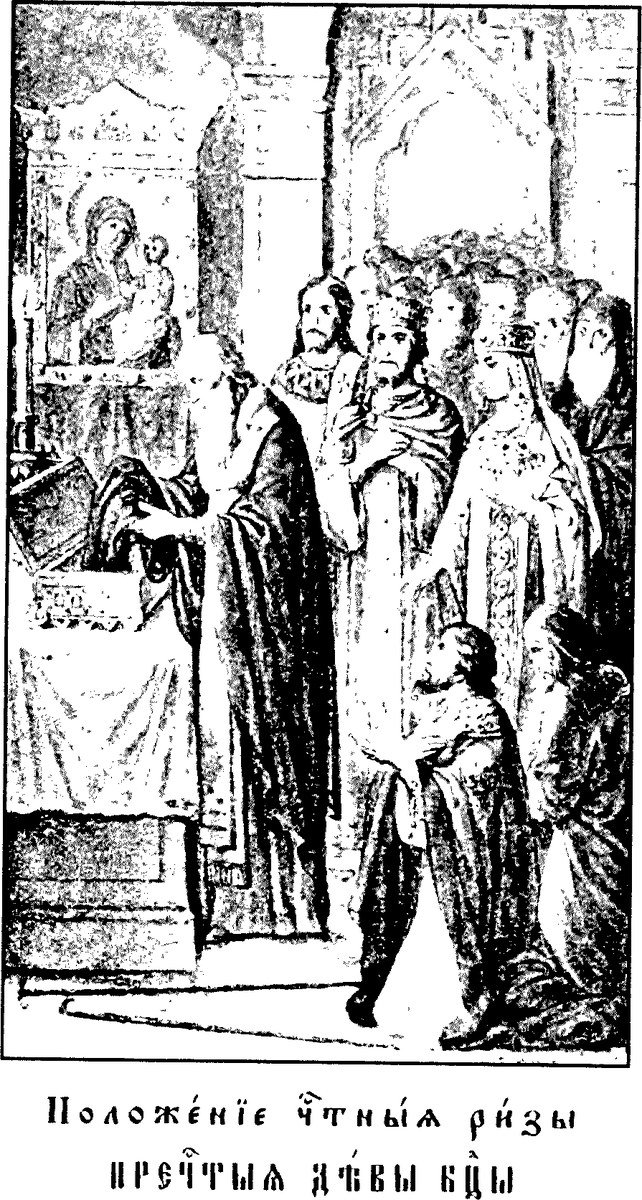
The image of the feast is a liturgical scene rather than a narrative one. Within a domed church, before the altar or before the round canopy of the Holy Reliquary, the patriarch stands and lays the folded Robe — usually a deep red cloth — into a casket, while the emperor and empress attend crowned, with clergy in phelonia, deacons with censers, and the people crowding behind; over the altar or on the wall above, an icon of the Mother of God presides over what is being done for her. Some Russian recensions add the earlier episodes in the corners: the two patricians at the widow's house, the lamps burning about the chest, the substituted casket, the journey by sea. Later menaion-icons for July place the scene at the head of the month's second register. Because the feast is one of the two "deposition" feasts, its icon is frequently confused with that of the Cincture (August 31), where the relic laid up is a girdle and not a robe.
The stored image is the engraved plate for July 2 from the Russian illustrated Lives of the Saints after St Dimitry of Rostov (1903–1911), inscribed ПОЛОЖЕНІЕ ЧЕСТНЫЯ РИЗЫ ПРЕЧИСТЫЯ ДѢВЫ БОГОРОДИЦЫ: the hierarch at the reliquary with the Robe in his hands, the crowned emperor and empress and their court behind him, a suppliant kneeling in the foreground, and the Hodegetria above the altar.