
Bogolyubskaya Icon of the Mother of God
The Bogolyubskaya ("of Bogolyubovo," or "of the God-loving one") is among the oldest surviving Russian icons and the only one painted to record a vision at the moment of the vision. In the summer of 1155 Prince Andrew Yurevich, later called Bogolyubsky, was carrying north from Vyshgorod the Greek icon of the Mother of God that would become the Vladimir icon, when seven versts short of Vladimir the horses stopped and would not go on. Keeping vigil through the night, the prince saw the Mother of God standing before him with a scroll in her hand, who told him not to take her icon to Rostov but to set it in Vladimir, and to build on that spot a church and monastery of her Nativity. He built them, named the place Bogolyubovo, and had the vision painted exactly as he had seen it: the Theotokos standing at full height, the scroll in her right hand, her face lifted to the Saviour who blesses from the corner of heaven. The feast of June 18 is the feast of that appearance.

The journey from Vyshgorod, 1155
The icon that set the whole story moving had come to Rus' from Constantinople about 1131, a gift to Grand Prince Mstislav, and was placed in the convent of the Maidens (Devichy monastyr) at Vyshgorod near Kiev. Andrew Yurevich, son of Yuri Dolgoruky, held Vyshgorod for his father and wanted no part of the endless southern succession wars; his mind was on the north-east, the Suzdal country his father had colonised, where a prince might build rather than campaign.
In 1155 he left the south — by the account, without his father's leave — and took the icon with him. The party moved north toward Rostov, then the senior city of the region. Seven versts short of Vladimir, at the confluence of the Nerl and the Klyazma, the horses drawing the cart that carried the icon stopped and would not move; fresh horses were harnessed and they would not move either.
The appearance
Andrew had a tent pitched and spent the night in prayer before the icon. In that night the Mother of God appeared to him standing, holding a scroll in her hand, and said that she did not wish her icon taken to Rostov: it was to be set in Vladimir, and on the place where he stood he was to raise a stone church and a monastery in honour of her Nativity.
He did precisely that. The Nativity of the Theotokos church rose on the spot, and around it the fortified princely residence which he made his own seat, calling it Bogolyubovo — the place of the love of God — from which he took the by-name Bogolyubsky that history has kept for him. The wonderworking Greek icon went on to Vladimir and became the Vladimir icon of the Mother of God, the palladium first of Vladimir and then of Muscovy; and Andrew, having given that one away to the city, commissioned for his own church an icon of what he had seen.
The icon itself
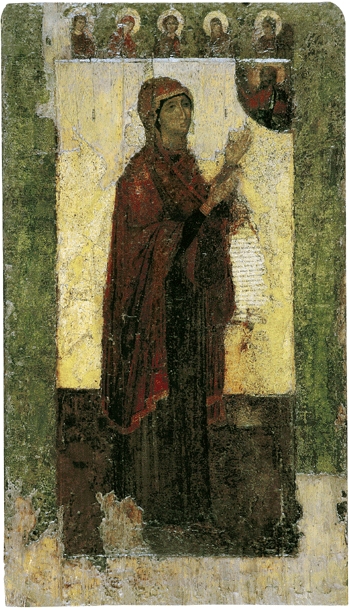
The iconographers were told, according to the tradition, to paint the Mother of God exactly as she had appeared — and the result is an image with no Byzantine model behind it and no Child in it. The Theotokos stands alone at full length, in the deep red maphorion, turned three- quarters to her left and slightly bowed; the right hand holds an unrolled scroll of supplication, the left is raised toward the Saviour, who appears small in the upper corner of the field, blessing. It is an icon of intercession rather than of incarnation: the whole composition is a petition being made and received, and it is the ancestor of the whole Russian family of Bogolyubskaya images and akin to the Deesis figure of the Mother of God.
The scroll is inscribed with the prayer the tradition assigns her: O most merciful Master, Lord Jesus Christ, my Son and my God, hear the prayer of Thy Mother, who prays for the world. The panel is of cypress, and it is large — a standing figure at something near life scale, meant to be seen down the length of a church.
The icon in later centuries
The Bogolyubskaya remained at Bogolyubovo and became the protectress of the Vladimir land. From an early date it was carried in an annual procession into Vladimir, going up on May 21 and remaining in the city until July 16, the citizens dividing among themselves the honour of bearing it; in 1820 the people of Vladimir had a rich metal cover made for it. In 1771, when the plague that devastated central Russia reached the Vladimir region and passed, the deliverance was ascribed to the Mother of God's intercession before this icon, and a further thanksgiving commemoration was added to the annual round.
Copies multiplied, and several took on a life of their own:
- the Bogolyubskaya of Moscow, whose tradition goes back to 1157, kept at the Varvarsky gate of Kitay-gorod, in which the Theotokos of the original type is surrounded by a company of Moscow saints and intercessors — the metropolitans Peter, Alexis, Jonah and Philip, with Basil the Blessed, Maximus the Fool for Christ, and the great martyrs Barbara and Catherine — kneeling at her feet;
- the Zimarovskaya, of the village of Zimarovo in the Ryazan country, an image of the thirteenth century with its own tradition of deliverances;
- and a long series of local Bogolyubskayas, each adding to the group of saints at the Mother of God's feet those whom its own town venerated.
The original panel, more than eight centuries old and painted on wood that has moved and split, has been in fragile condition for a long time; it was kept in the twentieth century as a museum object, was returned to the Dormition (Knyaginin) convent in Vladimir at the beginning of the 1990s, and has since been the subject of a prolonged and difficult conservation campaign. Its early photographs — including the one reproduced here — show it before the most recent interventions, with the losses to the lower field and the register of small figures across the top.
Feast and commemoration
June 18 (church date; Old Calendar civil July 1), Russian, Ukrainian and OCA usage; the Greek books do not keep it. The day commemorates the appearance of the Mother of God to Prince Andrew in 1155 and the painting of the icon that records it — not a translation or a finding, which is unusual among the icon-feasts and follows from the unusual origin of the image.
The thanksgiving for the ending of the plague of 1771 and the commemorations of the several copies (the Zimarovskaya, the Moscow Bogolyubskaya) are kept locally and on days that vary from place to place; they are not given dated feast entries here.
June 18 falls inside the window of the Apostles' Fast in most years but not in all, the fast having no fixed start; the fast always ends on June 28.
Hymns
Troparion — Tone 1
All-hymned and most glorious Queen, Mother of God, receive this hymn of praise from thine unworthy servants, and cease not to pray to thy Son and our God for the city and for the people that hope in thee, but be a wall of defence and a shelter, granting to the faithful peace and great mercy.
Original translation from the Slavonic
Kontakion — Tone 3
Thou didst appear standing to the God-loving prince, holding in thy hand the writing of thy prayer for the world, and thou didst choose thyself a dwelling in this land; wherefore we cry to thee: as thou didst stay the plague and the sword, so stay every evil from us who honour thine image, O Mother of God who lovest mankind.
Original translation from the Slavonic
Appointed readings
Epistle — Philippians 2:5–11
5Let this mind be in you, which was also in Christ Jesus: 6Who, being in the form of God, thought it not robbery to be equal with God: 7But made himself of no reputation, and took upon him the form of a servant, and was made in the likeness of men: 8And being found in fashion as a man, he humbled himself, and became obedient unto death, even the death of the cross. 9Wherefore God also hath highly exalted him, and given him a name which is above every name: 10That at the name of Jesus every knee should bow, of things in heaven, and things in earth, and things under the earth; 11And that every tongue should confess that Jesus Christ is Lord, to the glory of God the Father.
Gospel — Luke 10:38–42; 11:27–28
38Now it came to pass, as they went, that he entered into a certain village: and a certain woman named Martha received him into her house. 39And she had a sister called Mary, which also sat at Jesus’ feet, and heard his word. 40But Martha was cumbered about much serving, and came to him, and said, Lord, dost thou not care that my sister hath left me to serve alone? bid her therefore that she help me. 41And Jesus answered and said unto her, Martha, Martha, thou art careful and troubled about many things: 42But one thing is needful: and Mary hath chosen that good part, which shall not be taken away from her. 27And it came to pass, as he spake these things, a certain woman of the company lifted up her voice, and said unto him, Blessed is the womb that bare thee, and the paps which thou hast sucked. 28But he said, Yea rather, blessed are they that hear the word of God, and keep it.
Iconography
The Bogolyubskaya type is defined by four things: the Mother of God alone and standing at full length, without the Child; the unrolled scroll in her right hand, on which her petition is written; the raised left hand and the inclination of the head and body toward the upper right; and the small figure of Christ blessing from the segment of heaven in that corner, to whom the petition is addressed. She wears the dark red maphorion over a blue-green chiton, and stands on a ground that in the original is a bare landscape.
Two families of derivative develop from it. In the first, the figure is kept alone and the type is repeated as a devotional image. In the second — of which the Moscow Bogolyubskaya is the chief example — a company of kneeling intercessors is added along the lower edge, hierarchs, fools-for-Christ and martyrs of the city that owns the copy, all turned toward the Mother of God as she is turned toward her Son; the result is a diagram of intercession in three stages, running from the local saints through the Theotokos to Christ. Some copies also carry a register of half-figure saints across the top of the panel, as the original does.
The stored image is a photograph of the original twelfth-century panel from the Bogolyubovo church, taken before the recent conservation: the Theotokos in the red maphorion standing on a dark ground, the scroll held out and inscribed, the hand raised toward the blessing Christ in the upper right corner, and above the field a row of five haloed half-figures. The losses to the paint layer along the lower edge and the abraded gold are plainly visible, and are themselves part of the record of this icon's history.