
Vladimir Icon of the Mother of God
The Vladimir Icon of our Most Holy Lady the Theotokos and Ever-Virgin Mary
Kept 26 August — The Meeting (Sretenie) of the icon at Moscow and the turning back of Tamerlane, 1395, 21 May — The deliverance of Moscow from Mehmed Girey of the Crimea, 1521, 23 June — The deliverance of Moscow from Akhmat of the Great Horde and the standing on the Ugra, 1480
The Vladimir Icon is the most venerated icon of the Russian Church and, in the judgement of art historians, one of the supreme surviving works of Byzantine painting. A Constantinopolitan panel of about 1130 in the Eleousa or Umilenie ("Loving-kindness," "Tenderness") type — the Child's cheek pressed to his Mother's, his arm about her neck, her eyes turned not to him but out toward the beholder in sorrow — it came to Kiev as a patriarchal gift, was carried north to Vladimir by Prince Andrei in 1155, and was brought to Moscow in 1395 before the advance of Tamerlane. Three deliverances of Moscow from the steppe were ascribed to it and gave it three feasts: August 26 for 1395, June 23 for 1480, and May 21 for the retreat of the Crimean khan Mehmed Girey in 1521. For four centuries it stood beside the royal doors of the Dormition Cathedral in the Kremlin, where tsars were crowned and the lots for the election of metropolitans and patriarchs were laid in its case; it is the national palladium of Russia in the same sense in which the Hodegetria was the palladium of Constantinople.
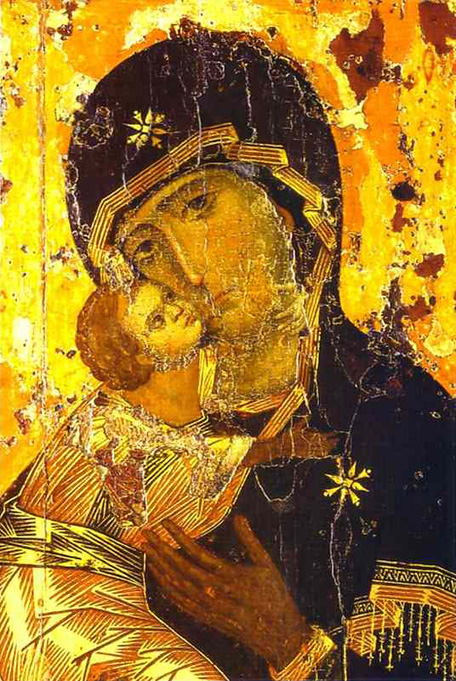

The panel and its painter
The received tradition holds that the icon was painted by the Evangelist Luke on a board taken from the table at which the Holy Family ate at Nazareth, and that the Theotokos, seeing it, said, "Henceforth all generations shall call me blessed." Every ancient Eleousa of high standing carries some form of this tradition; it expresses the Church's conviction that the type itself — not the particular panel — goes back to a first-hand memory of the Mother of God, and it is not a claim about the wood.
The panel itself is a work of the finest Constantinopolitan workshop of about 1130: tempera and gold on limewood, some 104 by 69 centimetres. Only the faces of the Mother and the Child, and a part of the gold ground, are the original twelfth-century painting; the garments, hands and background were repainted after the damage done by fire in 1195 and by the metal riza fastened over the surface, and the icon has passed through at least five substantial restorations, one of them in the fifteenth century by a hand of the school of Andrei Rublev. The surviving faces are enough. The Mother's face is one of the great achievements of Christian art: the sorrow in it is not sentiment but foreknowledge, and the whole later Russian tradition of the Umilenie descends from it.
From Constantinople to Vladimir
About 1131 the icon was sent from Constantinople to Kiev — the tradition names the Patriarch Luke Chrysoberges as the giver and the grand prince Yuri Dolgoruky as the recipient — and was placed in the convent of the Dormition at Vyshgorod, the town above Kiev where Boris and Gleb had been buried.
In 1155 Yuri's son Andrei Yuryevich, called Bogolyubsky ("the God-loving"), determined to leave the south for his own north-eastern principality, and took the icon with him. The chronicle account, which is the foundation of the whole later cult, relates that when the party was some ten versts short of Vladimir the horses drawing the icon stopped and could not be made to go on; that the prince kept vigil there through the night; that the Theotokos appeared to him and bade him leave the icon at Vladimir and build a church on the spot where she had appeared; and that he founded on that spot the palace and monastery of Bogolyubovo, and had painted the icon of the vision that is still called the Bogolyubskaya. In Vladimir he built the great Dormition Cathedral of white stone (1158–1160) and set the icon in it in gold and jewels — hence its name, and hence the extraordinary status the icon lent to the young northern principality, which soon eclipsed Kiev altogether. Andrei carried it on campaign against the Bulgars of the Volga in 1164 and ascribed his victory to it.
The Meeting at Moscow, 1395
This is the principal commemoration of the icon and the principal commemoration of August 26 in the whole Slavic calendar, and it deserves to be told at length.
The danger. In 1395 Tamerlane (Timur), master of Transoxiana and of Persia and the most feared soldier alive, came up through the Caucasus in pursuit of his rebellious protégé Tokhtamysh, khan of the Golden Horde, broke him on the Terek, and then destroyed the Horde's own cities — Sarai, Astrakhan, Azov — with a completeness from which the steppe empire never recovered. Turning north, he entered Russian territory on the upper Don and took and burned Yelets, carrying off its prince. Moscow had been sacked by Tokhtamysh only thirteen years before, in 1382, and knew exactly what was coming. Timur's army was reckoned at several hundred thousand; the grand prince Vasily I Dmitrievich, son of Demetrius Donskoy, could put nothing comparable into the field. He drew what he had up at Kolomna on the Oka, the last river-line before the capital, and sent to Vladimir for the icon.
The bringing of the icon. The metropolitan Cyprian — the Bulgarian-born hierarch who was then rebuilding the ruined discipline of the Russian Church, and second in the succession from St Alexis — ordered a fast and a general procession. The icon was taken from the Dormition Cathedral at Vladimir on the feast of the Dormition, 15 August, after the Liturgy, and carried the hundred and eighty versts to Moscow on men's shoulders in ten days, between two unbroken walls of people kneeling on both sides of the road the whole way and crying, in the words the chronicle records, "Mother of God, save the land of Russia." The chronicler notes the detail that gives the scene its force: the country people who came out to meet it had never seen the icon in their lives, and were seeing it now because the state was about to end.
The Meeting. On 26 August, at the Kuchkovo field outside the walls of Moscow — the site of the later Sretensky ("Meeting") monastery, on the road that is still called Sretenka — the icon was met by Metropolitan Cyprian with the bishops, the whole clergy of the city, the grand-princely family, the boyars and the population, who went out in procession with candles and censers and received it prostrate. It was carried into the Kremlin and set in the Dormition Cathedral.
The withdrawal. On that same day — the tradition is emphatic about the simultaneity — Timur, encamped near Yelets, turned about and left Russian soil without fighting a battle. The Russian account explains it by a dream: the conqueror saw a great mountain, and coming down from it a multitude of hierarchs with golden staves, and above them a radiant Woman in unapproachable light surrounded by armies, who commanded him to leave the Russian land; and his own diviners, asked what it meant, told him that it was the Mother of God, the protectress of the Christians, and that she was not to be fought. The historians give other reasons, and good ones — that Timur's quarrel was with Tokhtamysh and not with Moscow, that his object in the north was the destruction of the Horde's trade and not the conquest of forest principalities, that the season was late and his lines impossibly long, and that Anatolia and the Ottomans were already in his mind. The two explanations are not in competition in the Church's reading of the event. What the chronicler asserts is not a mechanism but a coincidence of days, and it is the day that the feast keeps.
The consequences. Moscow did not give the icon back. Vladimir was compensated with a copy — one of the finest of the fifteenth century, sometimes attributed to the school of Andrei Rublev — and the original stayed in the Kremlin, where it remained for over five hundred years. The Sretensky monastery was founded on the Kuchkovo field in 1397 to keep the day, and an annual cross-procession from the Kremlin to the monastery on August 26 became one of the fixed public rites of Muscovy, kept until the Revolution. A festal service was composed, and the Tale of the Meeting of the Icon of Vladimir written to carry the story. Politically, the transfer completed what Prince Andrei had begun in 1155: the palladium followed the power, from Kiev to Vladimir and from Vladimir to Moscow, and the young grand principality acquired the visible sign of its claim to be the heir of both. The feast of the Sretenie on August 26 remains the icon's principal day.
1480: the standing on the Ugra
In 1480 Akhmat, khan of the Great Horde, marched on Moscow to reimpose the tribute that Ivan III had ceased to pay. The two armies faced each other for weeks across the Ugra river, neither willing to cross; then, in November, both withdrew — the Russians in good order, the Tatars in something like panic. The Russian Church has always regarded that day as the end of the Mongol yoke, and ascribed it to the intercession of the Theotokos through her Vladimir icon and to the exhortations of Archbishop Vassian of Rostov; the bank of the Ugra came to be called the Girdle of the Mother of God. The feast is June 23.
1521: the deliverance from Mehmed Girey — the commemoration of May 21
In the summer of 1521 Mehmed Girey, khan of the Crimea, came north with his own horsemen, the Nogai, and the forces of his brother Sahib Girey of Kazan, in the most dangerous raid Muscovy had suffered for a generation. The Russian armies on the Oka were broken; the khan came up to the very walls of Moscow, burned the suburbs and the surrounding country, and carried away an immense multitude of captives. Vasily III was absent from the city. And then Mehmed Girey withdrew without assaulting the Kremlin — historically, on receiving from the boyars in the city a written acknowledgement of tribute and, it seems, on hearing that the Astrakhan Tatars were moving on his own rear.
The Church's memory of the deliverance rests on two visions recorded in the Muscovite tradition. A blind nun of the Ascension convent in the Kremlin saw, in the night, a great light and a procession of the holy hierarchs of Moscow — Peter, Alexis and Jonah — coming out of the Kremlin through the Spassky gate and carrying the Vladimir icon away with them, because of the sins of the people; and she saw Sergius of Radonezh and Varlaam of Khutyn meet them, fall at their feet, and beg them with tears not to abandon the city, until the hierarchs turned back, brought the icon into the cathedral again, and blessed the walls. The second vision was granted to the holy fool Basil the Blessed, who saw fire come out of the doors of the Dormition Cathedral and fill the square, and then withdraw. The Tatars, in the account, looked toward the city and saw an immense host drawn up around it, and fled.
The commemoration established for the deliverance is 21 May, the day the Church keeps the memory of Constantine and Helen; the two commemorations are served together, and the coincidence has always been felt as apt, since the Cross that Constantine saw and the icon that guarded Moscow were both understood as the same kind of gift — a visible sign given to a Christian people at the moment of their danger. The two visions are the Church's way of reading the event: not that Moscow was innocent and therefore spared, but that it was guilty and spared nonetheless, at the entreaty of its saints. That is an unusual note in a deliverance-narrative and is worth marking.
The icon in the life of Russia
For four centuries the icon stood at the left of the royal doors in the Dormition Cathedral of the Kremlin. The coronation of tsars took place before it; the oaths of fealty of princes and boyars were sworn on it; and at the election of metropolitans and, from 1589, of patriarchs, the lots bearing the candidates' names were sealed in its icon-case overnight and drawn from it in the morning, so that the choice was formally the Mother of God's. Copies of it multiplied beyond counting, and several achieved independent fame and their own feasts — the Zaonikievskaya (1588), the Krasnogorskaya or Chernogorskaya (1603), and the Oranskaya (1634) — all three of which the Russian calendar also keeps on May 21 with the original.
In 1918 the icon was taken from the cathedral for scientific restoration; the cleaning of 1918–1919 revealed the twelfth-century faces beneath the accumulated overpainting for the first time. From 1930 it was held in the Tretyakov Gallery, and from 1999 in the church of St Nicholas in Tolmachi attached to the gallery, where it was venerated liturgically under museum conditions. In April 2026 it was transferred to the Cathedral of Christ the Saviour in Moscow under an agreement giving the Russian Orthodox Church free use of it for forty-nine years — a change of custody widely debated among conservators.
Feast and commemoration
Three fixed feasts, all Russian in origin and kept in Russian, OCA and other Slavic usage rather than in Greek or Antiochian books:
- August 26 (Old Calendar civil September 8) — the Sretenie, the Meeting of 1395; the principal feast, with a full festal office, and the one from which the Sretensky monastery takes its name.
- June 23 (Old Calendar civil July 6) — the deliverance of 1480 and the standing on the Ugra.
- May 21 (Old Calendar civil June 3) — the deliverance from Mehmed Girey in 1521, kept together with Constantine and Helen; the OCA day-list titles it "Meeting of the Vladimir Icon," carrying over the language of the August feast.
The Greek and Antiochian Menaia do not carry the icon; it is one of the clearest cases of a wholly national commemoration that has nonetheless become universal in practice through the Russian diaspora, and the Vladimir type is now painted and venerated everywhere in the Orthodox world.
Hymns
Troparion — Tone 4
Today the most glorious city of Moscow is arrayed in gladness, having received thy wonderworking icon, O Sovereign Lady, as the dawning of the sun; and now, running to it and praying, we cry to thee: O all-wondrous Lady Theotokos, entreat Christ our God, who was made flesh of thee, that he preserve this city and all the cities and lands of the Christians unharmed from every device of the enemy, and save our souls, for he is merciful.
Original translation from the Slavonic
Kontakion — Tone 8
To thee, our Champion Leader, we ascribe the prizes of victory, for we have been delivered from evils by the coming of thine honoured image, O Lady Theotokos; and we keep with gladness the festival of thy Meeting, and cry to thee as we have been taught: Rejoice, O Bride unwedded.
Original translation from the Slavonic
Appointed readings
Epistle — Philippians 2:5–11
5Let this mind be in you, which was also in Christ Jesus: 6Who, being in the form of God, thought it not robbery to be equal with God: 7But made himself of no reputation, and took upon him the form of a servant, and was made in the likeness of men: 8And being found in fashion as a man, he humbled himself, and became obedient unto death, even the death of the cross. 9Wherefore God also hath highly exalted him, and given him a name which is above every name: 10That at the name of Jesus every knee should bow, of things in heaven, and things in earth, and things under the earth; 11And that every tongue should confess that Jesus Christ is Lord, to the glory of God the Father.
Gospel — Luke 10:38–42; 11:27–28
38Now it came to pass, as they went, that he entered into a certain village: and a certain woman named Martha received him into her house. 39And she had a sister called Mary, which also sat at Jesus’ feet, and heard his word. 40But Martha was cumbered about much serving, and came to him, and said, Lord, dost thou not care that my sister hath left me to serve alone? bid her therefore that she help me. 41And Jesus answered and said unto her, Martha, Martha, thou art careful and troubled about many things: 42But one thing is needful: and Mary hath chosen that good part, which shall not be taken away from her. 27And it came to pass, as he spake these things, a certain woman of the company lifted up her voice, and said unto him, Blessed is the womb that bare thee, and the paps which thou hast sucked. 28But he said, Yea rather, blessed are they that hear the word of God, and keep it.
Iconography
The type is the Eleousa or, in Russian, Umilenie — "Loving-kindness," usually rendered "Tenderness." The Mother of God holds the Child on her right arm; he presses his cheek to hers and throws his left arm up around her neck, his right hand hidden in the folds of her maphorion; his legs are drawn up so that the sole of his left foot is turned outward toward the beholder, a detail unique to the Vladimir panel among the early Eleousai and endlessly copied after it. The Mother does not look at her Son. Her head is inclined to him but her eyes go past him, out of the picture, dark and unconsoled: the icon is a picture of the Incarnation and of the Passion at once, the caress and the foreknowledge in the same gesture. The colouring of what survives is a deep blue-black maphorion with gold hem and gold stars, over a blue tunic, against a gold ground; the Child is in gold-striated ochre.
The stored image is the panel itself. The losses are severe and visible — the gold ground abraded away at the upper right, the craquelure across both faces — and are part of the object's history; what is seen here is the original twelfth-century paint of the two faces.
Two narrative subjects belong to the icon rather than to the Theotokos: the Meeting of 1395, painted as a procession of clergy and people going out of the gates of Moscow to receive the icon; and the vision of the nun of the Ascension convent, in which the three hierarchs of Moscow are shown leaving the Kremlin with the icon while Sergius and Varlaam kneel before them — a rare subject, found in seventeenth-century Muscovite work and in the wall-paintings of the Sretensky monastery.