
Conception of the Theotokos
Kept 9 December — Conception of the Most Holy Theotokos by the Righteous Anna
The Conception of the Most Holy Theotokos by the Righteous Anna (December 9), popularly the "Conception of Saint Anne," commemorates the conceiving of the Virgin Mary in the womb of her mother Anna, an aged and barren wife whose reproach God ended in answer to prayer. The Church keeps the event from ancient tradition, above all the second-century Protoevangelium of James, and reads in it the first stirring of the mystery of the Incarnation — the appearing in the world of the vessel prepared for the Word. The feast falls exactly nine months before the Nativity of the Theotokos (September 8) and is kept within the Nativity Fast. It is carefully distinguished from the Roman Catholic dogma of the Immaculate Conception, with which it shares neither its theology nor its date: the Orthodox feast celebrates a natural conception, of two human parents in their old age, and confesses Mary conceived as a true daughter of Adam.

The narrative of the Protoevangelium
Neither the Gospels nor any other book of the New Testament says anything of the parents of the Mother of God or of her conception and birth. What the Church keeps of these things she keeps from tradition, whose oldest and most influential written witness is the Protoevangelium of James, an apocryphal infancy narrative composed about the middle of the second century. The book was never received as Scripture — its statements on matters treated by the canonical Gospels were firmly set aside — but its account of the Virgin's parentage and birth passed into the Church's devotional memory, shaped the synaxaria and the festal hymns, and fixed the iconography of the December feast down to the present.
By that narrative Joachim and Anna, a righteous couple of the tribes of Judah and of Levi living at Nazareth, had grown old through some fifty years of marriage without a child, and bore the reproach that Israel laid upon the barren. When at a great feast the offering of the childless Joachim was refused at the Temple, he searched the genealogies, found that every righteous man in Israel had raised up seed, and would not go home in his shame, but withdrew into the wilderness to his flocks and fasted forty days and forty nights. Anna, left alone and reckoning herself doubly bereaved, went into her garden; and seeing a nest of fledgling sparrows in a laurel tree she poured out the lament that the hymnographers never tire of paraphrasing — that she alone was fruitless before the Lord, when the birds of the air, the beasts, the waters and the earth itself all bring forth in their season. To each of them, apart, the angel of the Lord then appeared with the same promise: Anna would conceive, and her child would be spoken of in all the world. Anna vowed the child to God as a gift, to minister before Him all its days. The couple met and embraced at the gate — the scene the tradition locates at the Golden Gate of Jerusalem and iconography made into the tender image of the feast — and Anna, as the Protoevangelium has her cry, "who was a widow am no longer a widow, and I who was childless shall conceive." In due time she conceived and, at the term the Church counts to September 8, bore a daughter and named her Mary.
The feast of December 9 fixes on the first term of that story — the conceiving itself — and celebrates it as the answer to the prayer of the barren and the opening of the whole economy of salvation that runs through it. The Orthodox hymnography is insistent on the manner of the conception: it was miraculous in that God loosed a barrenness which nature could no longer overcome, but natural in kind, of Joachim and Anna together in their old age, in the way of all human generation. The wonder is set expressly in the biblical line of the barren wombs opened by God — Sarah who bore Isaac, and above all Hannah who bore the prophet Samuel, whose song the day's oikos places on Anna's own lips; the Prophetess Hannah, mother of Samuel, is for that reason commemorated on the same December 9.
Theology: the beginning of the mystery of the Incarnation
The feast has a single great theme: this obscure conception in a barren womb is the first visible stirring of the mystery of the Incarnation. Nothing of the redemption is yet accomplished, and yet everything is quietly begun, for here begins the coming-to-be of the one human being in whom God would take flesh. The kontakion of the Nativity gathers the whole arc into one sentence — that in Mary's birth Joachim and Anna are freed from the reproach of childlessness and Adam and Eve from the corruption of death — and the December feast celebrates the first moment of that freeing: the "foundation of our salvation and the ground of grace," as the day's canon sings, laid in the conceiving of her who would conceive the Word. The Church therefore keeps this day, alone among the conceptions of the saints, with festal solemnity, as it keeps only one other conception in the whole year — that of the Forerunner (September 23) — because these two conceivings, of the Mother and of the friend of the Bridegroom, stand at the threshold of the Gospel.
The distinction from the Roman Catholic Immaculate Conception
The Orthodox feast of December 9 and the Roman Catholic feast of the Immaculate Conception must not be confused, and the difference is not merely one of a day in the calendar. It touches the doctrine of sin, the person of the Mother of God, and the very reason the two Churches keep the day.
The Roman Catholic dogma, defined by Pope Pius IX in the bull Ineffabilis Deus (December 8, 1854), holds that the Blessed Virgin Mary, "in the first instant of her conception, by a singular grace and privilege of Almighty God, in view of the merits of Jesus Christ, was preserved immune from all stain of original sin." The doctrine presupposes the Augustinian understanding of original sin as an inherited guilt — a culpability for Adam's transgression transmitted to every child of Adam at conception — from which Mary is uniquely exempted, in advance, by the anticipated merits of her Son. The medieval West long disputed the point (Bernard of Clairvaux and, later, Thomas Aquinas with the Dominicans opposed it, on the ground that it seemed to remove Mary from the need of redemption; Duns Scotus and the Franciscans defended it through the notion of a "prevenient" or anticipated redemption), and it became binding Roman Catholic dogma only in 1854.
The Orthodox Church venerates Mary as no other creature — Panagia, the All-Holy; Achrantos, the spotless and immaculate; ever-virgin; more honourable than the cherubim and beyond compare more glorious than the seraphim. In this sense the East, too, unhesitatingly calls her "immaculate," and her own hymns of December 9 do so. But the Orthodox Church has never defined, and does not teach, that Mary was exempted at her conception from the common condition of fallen humanity — and it does not, because the Augustinian framework that makes such an exemption necessary is not the Eastern doctrine of the fall. The East speaks of ancestral sin (τὸ προπατορικὸν ἁμάρτημα) as the inheritance from Adam not of his personal guilt but of the consequences of his fall: mortality, corruptibility, and a nature weakened and inclined toward sin. Where there is no inherited guilt to be remitted, there is no exemption to be dogmatised; the "problem" the Immaculate Conception was framed to solve does not arise in the same terms. The Orthodox books therefore honour the same event — the conception of Mary — without the doctrinal construction the West built upon it, and the mainstream Orthodox theological consensus, articulated sharply in reaction to the 1854 definition, positively rejects the dogma.
Two reasons are given for that rejection, and both are more than negative. First, the Orthodox tradition holds that Mary was conceived and born as a true daughter of Adam, subject like every human being to mortality and to the possibility of temptation, and that she committed no personal sin not because she was lifted out of our nature but by grace freely and continuously received and freely answered — supremely at the Annunciation, when the Holy Spirit came upon her and cleansed her wholly for the conceiving of the Word. Saint Ambrose of Milan is invoked to the effect that Christ alone was born perfectly holy and sinless; were Mary a "deified creature" set apart from the rest of humanity, she would not have been truly human, and the human nature the Word took from her would not be truly ours — so that our own salvation would be put in doubt. Mary's sinlessness, on this reading, is a real victory won within the fallen condition she shared, not a privilege that removed her from it; to exempt her from that condition would be, paradoxically, to diminish her. Second, the Orthodox note that the dogma is a late definition resting on a doctrine of inherited guilt the East never held, and that Scripture and the earlier tradition are silent on it.
The one-day difference of date carries the same meaning in miniature. The East keeps the conception on December 9 and the birth on September 8 — an interval of nine months and a day, deliberately not a perfect nine months. Only one conception in the calendar is counted at a perfect nine months from its feast of birth: the conception of Christ at the Annunciation (March 25), nine months exactly before the Nativity (December 25). The single day's "imperfection" in the Virgin's reckoning is an old Eastern token that her conception, unlike her Son's, was an ordinary human conceiving of two parents — not virginal, and not set outside the common lot of the race. The Western feast, by contrast, settled on December 8 and came to celebrate not the event of Anna's conceiving but the condition of Mary — the Immaculate Conception of the Virgin, rather than, as in the Christian East, the conception by the righteous Anna. (A qualification is owed to history: in the centuries when Latin theology pressed toward the West, some Orthodox writers under Latin influence — certain seventeenth- and eighteenth-century schoolmen of Kyiv among them — spoke approvingly of the immaculate-conception idea; but this was never the mind of the Church, and the Orthodox consensus after 1854 is settled against it.)
History of the feast
The feast arose in the Christian East, and probably at Jerusalem, where the cult of the Theotokos and of her parents was anchored in the shrines of the Holy City. It is attested from at least the seventh and eighth centuries, when the Palestinian and Constantinopolitan calendars carry the "Conception of Saint Anna," and it was firmly established in Byzantium by the ninth century; homilies on the conception survive under the names of Eastern preachers of that age, and the emperors reckoned it among the feast days on which the courts did not sit. From Byzantium the observance passed westward. It entered the Greek regions of southern Italy, spread to Anglo-Saxon England by the eleventh century (where it was kept, then briefly suppressed after the Conquest, then revived), and thence into the wider medieval West — where, over the following centuries and amid the scholastic controversy described above, the plain "Conception of Saint Anne" was gradually reinterpreted as the "Immaculate Conception of the Blessed Virgin Mary," fixed to December 8, and at last defined as dogma in 1854. In the East the feast kept both its original date and its original, unspeculative content. In the Slavic lands the Conception of Anna became a beloved feast of the ordinary faithful, especially cherished by married and expectant women, who invoked Anna and her daughter for the gift and safe bearing of children.
Feast and commemoration
December 9 (church date; Old Calendar civil December 22), a feast of the Mother of God kept universally in the Byzantine rite, ranked in most usages with a polyeleos or a great doxology. It falls within the Nativity Fast, and the fast is relaxed in its honour (wine and oil, and in many usages fish). The Greek Menaion joins to the Conception on this day the commemoration of the Prophetess Hannah, mother of the prophet Samuel — the great Old Testament figure of the barren wife whose prayer was heard, and whose song of thanksgiving (1 Kingdoms 2) underlies the day's oikos — and the memory of the venerable Stephen "the New Light" of Constantinople, together with, in some recensions, the dedication (encaenia) commemorations of the day. In the Russian tradition the day also carries the feast of the icon of the Mother of God "The Unexpected Joy." The Conception itself is the day's principal and universal commemoration; the righteous Anna, whose conceiving is celebrated, is honoured on this day among her three feasts of the year (with July 25, her Dormition, and September 9, the Synaxis of the Ancestors of God), and Joachim and Anna are in any case named at the dismissal of every Orthodox service. In the Roman rite the corresponding feast is the Immaculate Conception on December 8; the difference of date and of doctrine is set out above.
Hymns
Troparion — Tone 4
Today the bonds of childlessness are broken; for God, hearkening unto Joachim and Anna, plainly promiseth that, beyond their hope, they shall bear a divine child, of whom He Himself, the Uncircumscribable, was born, when He had become mortal; and through an Angel He commanded that unto her be cried: Rejoice, thou that art full of grace, the Lord is with thee.
Original translation from the Greek
Kontakion — Tone 4
Today the whole inhabited earth keepeth feast at the conception of Anna, which came to pass by God; for she herself gave birth to her who, beyond all reason, conceived the Word.
Original translation from the Greek
Appointed readings
Epistle — Galatians 4:22–31
22For it is written, that Abraham had two sons, the one by a bondmaid, the other by a freewoman. 23But he who was of the bondwoman was born after the flesh; but he of the freewoman was by promise. 24Which things are an allegory: for these are the two covenants; the one from the mount Sinai, which gendereth to bondage, which is Agar. 25For this Agar is mount Sinai in Arabia, and answereth to Jerusalem which now is, and is in bondage with her children. 26But Jerusalem which is above is free, which is the mother of us all. 27For it is written, Rejoice, thou barren that bearest not; break forth and cry, thou that travailest not: for the desolate hath many more children than she which hath an husband. 28Now we, brethren, as Isaac was, are the children of promise. 29But as then he that was born after the flesh persecuted him that was born after the Spirit, even so it is now. 30Nevertheless what saith the scripture? Cast out the bondwoman and her son: for the son of the bondwoman shall not be heir with the son of the freewoman. 31So then, brethren, we are not children of the bondwoman, but of the free.
Gospel — Luke 8:16–21
16No man, when he hath lighted a candle, covereth it with a vessel, or putteth it under a bed; but setteth it on a candlestick, that they which enter in may see the light. 17For nothing is secret, that shall not be made manifest; neither any thing hid, that shall not be known and come abroad. 18Take heed therefore how ye hear: for whosoever hath, to him shall be given; and whosoever hath not, from him shall be taken even that which he seemeth to have. 19Then came to him his mother and his brethren, and could not come at him for the press. 20And it was told him by certain which said, Thy mother and thy brethren stand without, desiring to see thee. 21And he answered and said unto them, My mother and my brethren are these which hear the word of God, and do it.
Iconography
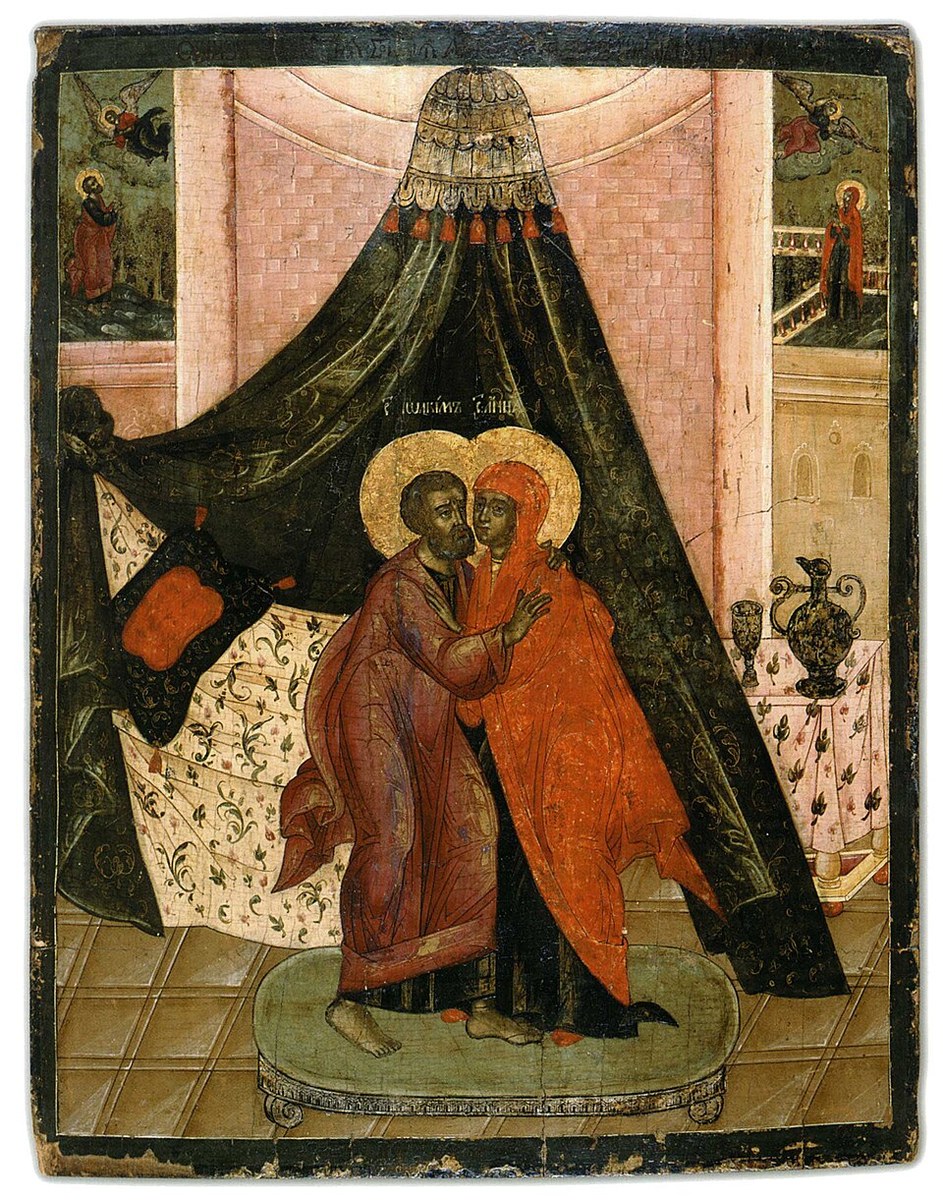
The icon of the feast is that of the parents rather than of the child, for the conception itself cannot be depicted: it shows Joachim and Anna meeting and embracing, cheek to cheek, before the gate of Jerusalem or within the bedchamber, the two aged figures inclining together in tenderness, Joachim in a patriarch's mantle and Anna in the red maphorion she wears in every Marian scene. In the corners the two annunciations are commonly added — the angel appearing to Joachim among his flocks in the wilderness, and to Anna in her garden — so that the whole story of the answered prayer is gathered around the embrace. This is the same "Conception of the Theotokos" type used for the Ancestors of God Joachim and Anna; the two entries carry two distinct panels of it. A second, later type, more common in Russia and coloured by Western influence, shows Saint Anna holding the infant Mary on her arm, or the Virgin standing upon an orb encircled by the serpent she treads underfoot — a composition that draws near the Western immaculate-conception imagery and is best read with the doctrinal distinctions of this feast in mind.
The stored image is a Russian icon of the late seventeenth century (private collection), titled in Church Slavonic across the canopy "The Conception of Joachim and Anna." Beneath a green bed-curtain drawn back over a flowered coverlet, the two embrace at the centre, haloed and cheek to cheek; at the upper left the angel appears to Joachim in the wilderness, at the upper right to Anna upon the steps of her house, and a table set with vessels stands at the right — the meeting and the two annunciations combined in a single panel.