
Joachim and Anna
The Holy and Righteous Ancestors of God Joachim and Anna
Righteous · Forefather · d. 1st century BC (traditional chronology)
Commemorated 25 July — Dormition (repose) of the Righteous Anna, 9 September — Synaxis of the Righteous Ancestors of God, the day after the Nativity of the Theotokos, 9 December — Conception by the Righteous Anna of the Most Holy Theotokos
Joachim and Anna were the parents of the Most Holy Theotokos and the grandparents of Christ according to the flesh, honoured by the Church with the unique title "Ancestors of God" (Theopatores). An aged couple childless through fifty years of marriage, they bore the reproach of barrenness with patience and prayer until an angel announced to each of them the conception of a daughter whose name would be spoken of in all the world; their embrace at the Golden Gate of Jerusalem, and the birth of Mary that followed, are the matter of the feast of September 8. They are commemorated together on September 9, the day after the Nativity of the Theotokos, and are invoked by name at the dismissal of every Orthodox service.
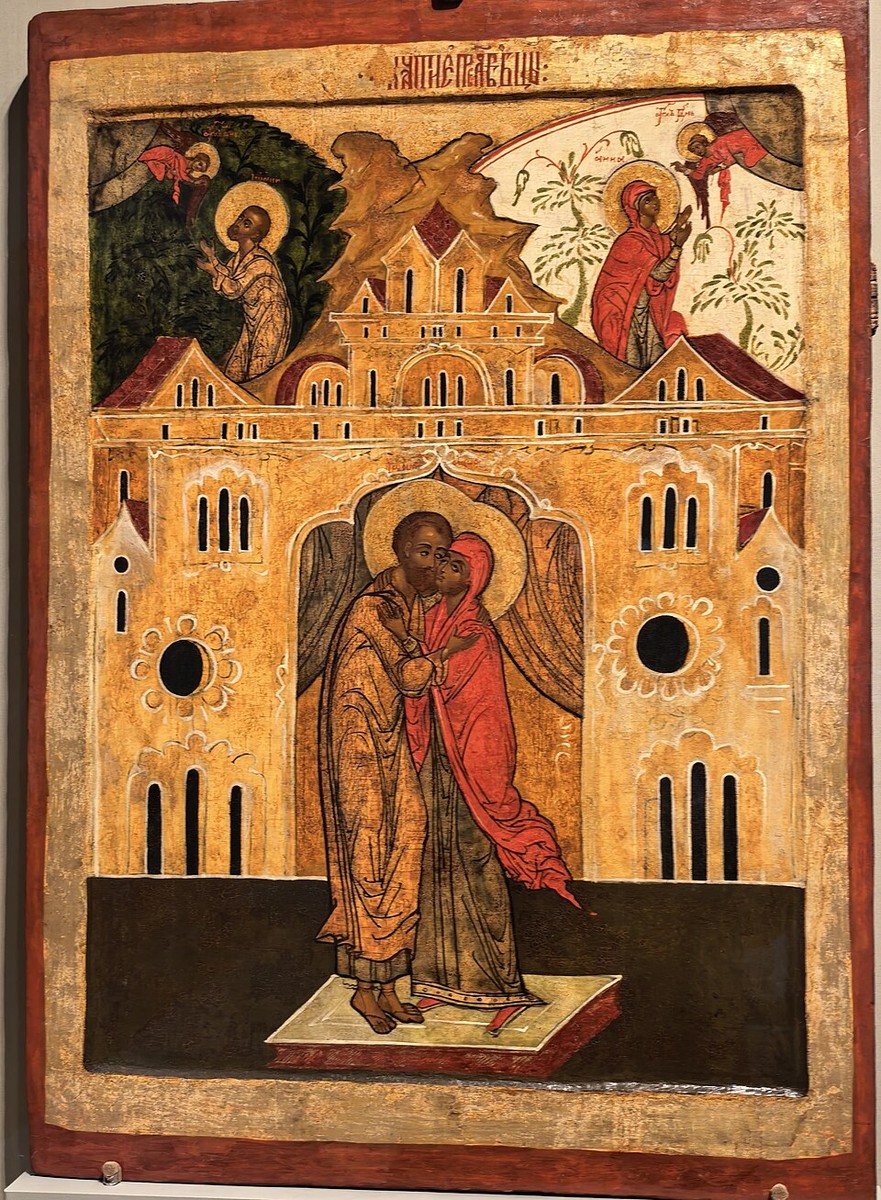
._Icon_Meeting_of_Joachim_and_Anna_at_the_Golden_Gate.jpg)
Origins and early life
The New Testament nowhere names the parents of the Mother of God. Everything the Church relates of them descends from the Protoevangelium of James, a narrative of the second century whose opening chapters are devoted entirely to Joachim and Anna, and from the synaxaria and hymnography that received and elaborated its account. The Protoevangelium was never canonical Scripture, and the Church has never treated it as such; but its story of the conception and birth of Mary was received into the liturgical tradition so thoroughly — three fixed feasts of the year (September 8, November 21, December 9) rest upon it — that its outline may fairly be called the Church's own tradition of the Theotokos's parentage.
Joachim (Hebrew Yehoyaqim, "the Lord will raise up") was of the tribe of Judah and of the royal house of David, to whom God had promised that of his seed the Saviour would be born; the synaxarial tradition transmitted by the OCA gives his father's name as Barpathir. The Protoevangelium introduces him as a man of great wealth who brought double gifts to the Lord, saying, "That which is over and above shall be for the whole people, and that which is for my forgiveness shall be for the Lord, for a propitiation for me." Anna (Hebrew Hannah, "grace") was the daughter of Matthan, a priest of the tribe of Levi and line of Aaron, her family being of Bethlehem — so that in his two grandparents the Lord's descent joined the royal and the priestly houses of Israel. A traditional genealogy makes Anna one of three daughters of Matthan, whose sister Sobe was the mother (or grandmother) of Elizabeth, mother of John the Forerunner; the kinship of Elizabeth and the Theotokos implied by Luke 1:36 is variously drawn through this line (see the entry for Zachariah and Elizabeth and Disputed questions below).
The couple lived at Nazareth in Galilee. Through some fifty years of marriage they remained childless, and they bore what their contemporaries accounted a disgrace and a mark of divine disfavour — the synaxaria dwell on the derision they endured — without murmuring, in fasting, almsgiving and prayer, vowing that a child granted to them would be given to the Lord.
The annunciation and the birth of the Theotokos
The Protoevangelium opens with a public humiliation. At a great feast Joachim brought his gifts to the temple, and they were refused — by the priest Reuben, in the account the OCA transmits — on the ground that a man who had raised up no seed in Israel was not worthy to offer first. Wounded past bearing, Joachim did not return home but went into the wilderness to the shepherds of his flocks, and there fasted forty days and forty nights, saying that prayer should be his meat and drink until the Lord looked upon him. Anna, learning of her husband's grief and reckoning herself now doubly bereaved, lamented in her garden; seeing a nest of sparrows in a laurel tree she cried out that she alone was fruitless — unlike the birds of the air, the beasts, the waters, and the earth itself, which all bring forth in season and bless the Lord.
To each of them, separately, the angel of the Lord then appeared: Anna would conceive, and her seed would be spoken of in the whole world. Anna vowed her child to God as a gift, to minister before Him all the days of its life. Told that her husband was coming, she went to meet him, and the two embraced at the Golden Gate of Jerusalem — the scene that became the icon of the feast of the Conception, Anna crying, "Now I know that the Lord God hath greatly blessed me: for behold the widow no longer a widow, and I the childless shall conceive." The tradition received in the synaxaria adds that the angel foretold the daughter's dedication in the temple and her part in the salvation of the world; the Orthodox hymnography of December 9 is emphatic that the conception that followed was by nature, of Joachim and Anna in their old age, and miraculous in that God loosed a barrenness that nature could not.
In the ninth month Anna bore a daughter and named her Mary — Mariam — and the Church keeps the day of that birth on September 8, the first Great Feast of her liturgical year. The Protoevangelium relates the child's first steps, the sanctuary Anna made of her bedchamber, and the great feast Joachim made in her first year, at which the priests blessed her with a name renowned unto all generations. When Mary was three years old her parents fulfilled the vow, bringing her with lamps to the temple of the Lord, where the priest received her and set her on the third step of the altar — the event kept on November 21 as the feast of the Entry of the Theotokos into the Temple.
Repose
The tradition the OCA transmits is that Joachim reposed a few years after the Entry, at the age of eighty, while his daughter was living in the temple; and that Anna, having removed from Nazareth to Jerusalem to be near the child, reposed two years after her husband, at the age of about seventy, and was buried near the place later enclosed by the church of the Theotokos by the Sheep Pool. By this traditional chronology both deaths fall shortly before the Annunciation and the Incarnation — on the civil reckoning, in the last years of the old era. The Church accounts them the last and greatest of the righteous of the Old Covenant: they died, as the hymns of September 9 sing, in sure hope, having given to the world the one through whom the promise to their forefather David would be kept.
Relics and translations
The traditions of the relics of Anna are various and none can be documented to antiquity. In Constantinople a church of Saint Anna was raised in the quarter of the Deuteron by Justinian I in the sixth century, and Byzantine sources record what were held to be relics of the saint in the capital, the object of imperial veneration; from Byzantium, portions passed to the Latin West and to the monasteries of Mount Athos, where the skete of Saint Anna — the oldest and largest of the Athonite sketes, whose principal church holds a relic venerated as the saint's left foot — keeps her name and cultus to this day. In the medieval West, Apt in Provence and Düren in the Rhineland advanced celebrated claims to her body or head. These are recorded as the traditions of those places; no relic tradition of comparable prominence attaches to Joachim.
Veneration and later cultus
The pair bear in Orthodox usage the title Θεοπάτορες, "Ancestors of God" — ancestors of God the Word according to the flesh he took of their daughter. The title is shared in the liturgical books only with the royal prophet David (and, in the broad sense, the forefathers of the genealogy), but it belongs to Joachim and Anna par excellence, and with it comes an honour unique in the calendar: they are named in the dismissal of every Orthodox service. At the apolysis the priest asks the mercy of Christ through the prayers of the Theotokos, of the saints of the day and of the temple, "and of the holy and righteous Ancestors of God Joachim and Anna, and of all the saints" — so that no Liturgy, Vespers or Matins ends anywhere in the Orthodox world without their commemoration. The reason the tradition gives is fitting: as the Church never ceases to magnify the Theotokos, so she never forgets those whose prayers and whose flesh gave the Theotokos to the world.
Joachim and Anna are invoked above all by childless couples, whose patrons they have always been; prayers for the gift of children are addressed to them in every Orthodox tradition. Anna's veneration in particular grew immense in both East and West: churches and monasteries without number bear her name, from Justinian's Constantinople to the Athonite skete, and in the later medieval and modern West her cult (Sainte-Anne-d'Auray in Brittany, Sainte-Anne-de-Beaupré in Quebec) became one of the most popular of any saint. In Russia the Conception of Anna was a beloved feast of the ordinary faithful, and icons of the embrace at the Golden Gate — the "Conception of the Theotokos" type — hung in homes as a blessing on marriage and childbearing.
Hymnographic and literary legacy
Few saints so pervade the hymnography of the Church. The names of Joachim and Anna frame the whole festal cycle of the Theotokos: the kontakion of the Nativity of the Theotokos proclaims that by Mary's birth "Joachim and Anna were freed from the reproach of childlessness, and Adam and Eve from the corruption of death"; the canons of September 8, the stichera and canon of the Synaxis of September 9 (the canon of the Theopatores in Tone 2 carries the acrostic "Thy parents, O all-pure one, I hymn with glad heart"), the services of the Entry (November 21), of the Conception (December 9), and of the Dormition of Anna (July 25) all sing of them; and the exapostilarion of their Synaxis gathers the whole economy into two lines — "Adam, be renewed, and Eve, be magnified... from the righteous Joachim and Anna today is born the Theotokos." Beyond the Menaion, the Protoevangelium's narrative of the pair shaped festal homiletics from Andrew of Crete and John of Damascus onward, and their lament and thanksgiving became a standing figure, in preaching and iconography alike, of prayer heard in old age.
Feast and commemoration
The principal joint commemoration is September 9 (church date; Old Calendar civil September 22), the day after the Nativity of the Theotokos. It is a synaxis in the classical sense: as the Church honours on December 26 her who bore Christ, and on March 26 the archangel of the Annunciation, so on the morrow of Mary's birth she "assembles" in honour of those through whom the feast came to pass. The day falls within the afterfeast of the Nativity, and the Menaion sings the Ancestors of God and the feast together; the service of the Theopatores has its own stichera, canon, exapostilarion, apolytikion and kontakion. Anna has two further feasts of her own, kept universally: the Dormition (repose) of the Righteous Anna on July 25, and the Conception of the Most Holy Theotokos by Anna on December 9 — both listed above as secondary feasts of this entry. Joachim and Anna are also embraced in the movable commemoration of the holy Forefathers on the second Sunday before the Nativity of Christ, and — their unique honour — they are named at the dismissal of every Orthodox service throughout the year. In the Roman rite Joachim and Anne are now commemorated together on July 26; older Western calendars kept Anne on July 26 and Joachim variously on March 20 or August 16. The divergence is one of calendar tradition, not of identity.
Hymns
Troparion — Tone 2
Celebrating the memory of Thy righteous Ancestors of God, O Lord, through them we entreat Thee: save our souls.
Original translation from the Greek
Kontakion — Tone 2
Anna now rejoiceth, loosed from the bonds of barrenness, and nourisheth the all-pure one, calling all together to hymn Him who from her womb hath given to mortals the only Mother who knew not man.
Original translation from the Greek
Iconography
The proper icon of Joachim and Anna is the embrace before the Golden Gate of Jerusalem — the "Conception of the Theotokos" type: the two aged figures meet and embrace, cheek to cheek, Joachim in the mantle of a patriarch, Anna in the red maphorion in which she also appears in the Nativity-of-the- Theotokos icon; behind them rise the gate and walls of Jerusalem, and in the upper corners the two annunciations are often shown — the angel appearing to Joachim among his flocks in the wilderness, and to Anna in her garden by the laurel with the sparrows' nest. The pair appear constantly elsewhere: seated at the birth-bed in the icon of the Nativity of the Theotokos (September 8); leading the three-year-old Mary with lamps in the Entry into the Temple (November 21); and standing in supplication beside the Theotokos in numerous deesis-like compositions. Anna alone is depicted enthroned with the infant Mary in her arms — a type beloved on Athos — and in the scene of her repose on July 25. Joachim wears the long hair and rounded beard of the Old Testament righteous; both are inscribed simply "the righteous" or "the Ancestors of God."
The stored image is a Russian icon of the Meeting of Joachim and Anna at the Golden Gate, of the first half of the seventeenth century (Arkhangelsk region), now in the State Hermitage Museum: the embrace at centre before the gate, with the annunciation to Joachim in the wilderness at upper left and to Anna in her garden at upper right.
Disputed questions
- The source is apocryphal. The narrative of Joachim and Anna rests on the Protoevangelium of James, a second-century writing never received into the canon of Scripture. The Church received its account liturgically — three fixed feasts rest upon it — without canonising the book; this entry presents the narrative as the Church's tradition, not as Scripture. The bare fact that the Theotokos had parents, and the Church's certainty of their sanctity, do not depend on the document.
- Genealogical variants. The OCA synaxarion gives Joachim's father as Barpathir; other lines of the tradition transmit other names, and the medieval genealogies of the "holy kinship" cannot be harmonised. Anna is uniformly the daughter of the priest Matthan, but the exact kinship by which Elizabeth was the Theotokos's "kinswoman" (Luke 1:36) is drawn differently in different sources — Elizabeth as Anna's sister (so the OCA synaxarion for September 5), or as the daughter of Anna's sister Sobe. Both are recorded in the entry for Zachariah and Elizabeth.
- The Western "trinubium" legend. Later medieval Western legend gave Anna three successive husbands and three daughters named Mary. This has no place in the Orthodox tradition, which knows Anna as the wife of Joachim alone, and it was discarded in the West as well.
- The conception of Mary. The Orthodox feast of December 9 celebrates a conception miraculous in the loosing of barrenness but natural in kind — of aged parents, in the way of all flesh. The Roman Catholic dogma of the Immaculate Conception (1854), attached to the Western feast of December 8, frames the event within a doctrine of original sin the Orthodox Church does not share; the Orthodox books honour the same event without that doctrinal construction. The one-day difference of date (December 9, not 8) is itself an old Eastern token that this conception, unlike her Son's, was not virginal.
- Chronology. By the traditional account both parents reposed before the Annunciation — on the civil reckoning, late in the first century BC. The frontmatter follows this (century: -1), while the calendars simply place them on the threshold of the Incarnation.
- Not to be confused with Anna the Prophetess, daughter of Phanuel, who met the Lord in the temple (Luke 2:36–38, commemorated February 3), nor with the righteous Hannah, mother of the prophet Samuel, whose story of barrenness answered by God (1 Kingdoms 1) the hymns of December 9 invoke as the figure and forerunner of Anna's own; nor with the medieval princess Anna of Novgorod (Ingegerd of Sweden, †1050), kept February 10.