
Elevation of the Precious and Life-giving Cross
The Universal Elevation (Exaltation) of the Precious and Life-giving Cross
Kept 14 September — Great Feast of the Lord; strict fast day
The Universal Elevation (Exaltation) of the Precious and Life-giving Cross, September 14, is the Great Feast of the Lord on which the Church lifts up the Cross of Christ before the world and venerates it as the instrument of salvation. It unites three histories: the finding of the true Cross at Jerusalem by the empress Helena (c. 326) and its first elevation by the bishop Macarius before the people; the dedication of Constantine's great churches at the Holy Sepulchre in 335, on whose second day the Cross was displayed; and its recovery from Persian captivity by the emperor Heraclius (628–630). Uniquely among the Great Feasts, the day is kept as a strict fast.

The finding of the Cross
After the peace of the Church, the empress Helena, mother of Constantine the Great, journeyed to Palestine — the received dating is about the year 326 — to seek out the holy places of the Lord's life and Passion. At Jerusalem the site of Golgotha and the tomb lay buried under a pagan terrace; the tradition relates that a temple of Aphrodite had been raised over the place, whether by design to efface the Christian memory or not. At Helena's direction and with the concurrence of Macarius, bishop of Jerusalem, the terrace was torn down and the ground opened, and there were found the tomb, and near it three crosses, together with the nails and, separately, the titulus — the board inscribed by Pilate's order "Jesus of Nazareth, the King of the Jews" — which lay apart from the crosses, so that it could not certify which of the three was the Lord's.
The question was resolved, the fifth-century historians relate, by a test of power. At Macarius's proposal the three crosses were brought to the bedside of a noblewoman lying near death (the account best known in the Byzantine tradition; Rufinus and the church historians Socrates, Sozomen and Theodoret all carry it); prayer was made, and the touch of two crosses availed nothing, but at the touch of the third the woman rose healed. Later retellings add that a dead man being carried to burial was raised by the same touch — the form of the test most often shown in the icons. By these signs the true Cross was known.
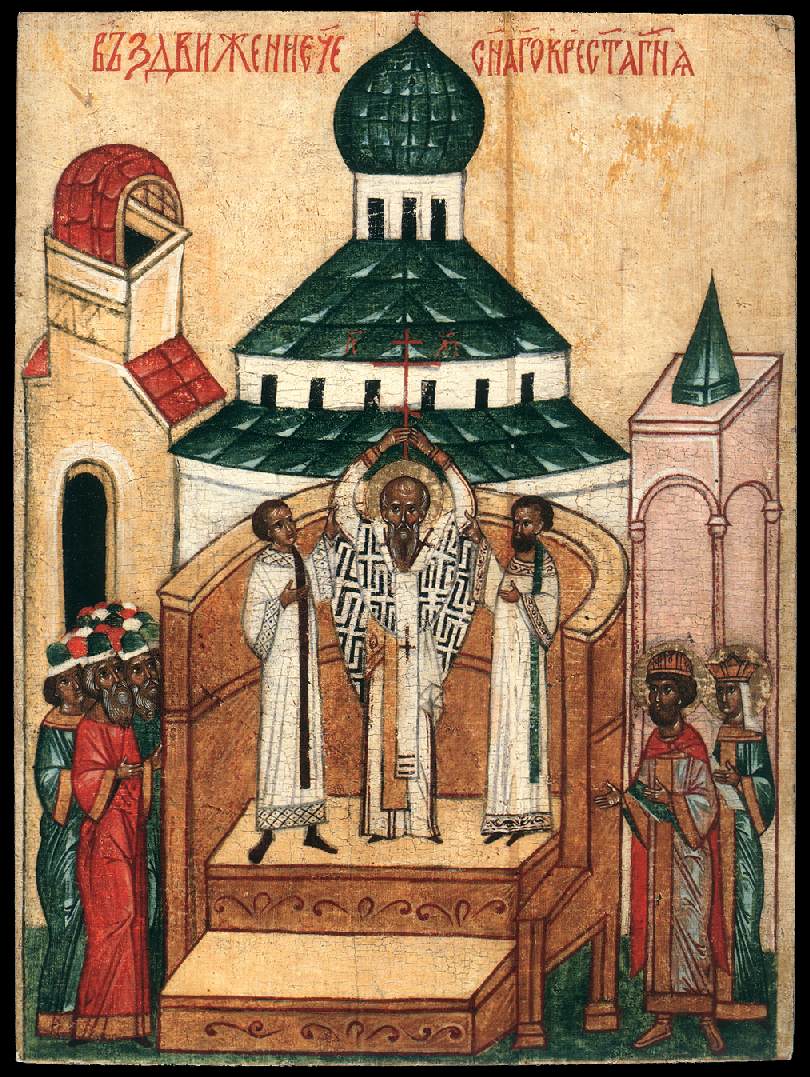
The multitude that pressed around could not come near enough to venerate the wood, and begged at least to see it. Then Macarius, standing upon a raised place, lifted the Cross high with both hands and showed it to the people, turning it about, while they cried out repeatedly Kyrie eleison — "Lord, have mercy." This is the first hypsosis, the "elevation" or "exaltation" from which the feast takes its name and whose gesture its rite reproduces to this day.
The Encaenia of 335 and the birth of the feast
Over the holy places Constantine raised a great complex of buildings — the Martyrium basilica, the courtyard of Golgotha, and the rotunda of the Anastasis over the tomb itself. Their consecration, the Encaenia ("dedication"), was celebrated with immense solemnity on September 13 of the year 335, with bishops gathered from the whole East; and on the following day, September 14, the wood of the Cross was brought out and elevated before the assembled people. The anniversary of the Encaenia became one of the greatest feasts of the Jerusalem church — the pilgrim Egeria, toward the end of the fourth century, describes it as an eight-day festival ranking with Pascha and Epiphany, drawing crowds of monks and bishops from as far as Mesopotamia and Egypt, and notes that the day of the Cross's finding was kept together with it. The feast of the Elevation is thus, in origin, the second day of the Encaenia: the Church still keeps the two together, commemorating the Dedication of the Church of the Resurrection on September 13 as the forefeast of the Cross.
From Jerusalem the observance of September 14 spread through the whole East, carried in part by the fame of the relic itself. In Constantinople the feast is attested from the sixth century and grew steadily in solemnity; by the time of the Typikon of the Great Church (ninth–tenth century) the Elevation was a fixture of the capital's year, celebrated in Hagia Sophia with the patriarchal rite of elevation described below. In the West the feast appears at Rome in the seventh century — the veneration of the Cross on this day is associated with Pope Sergius I (687–701), a Syrian by descent — under the title Exaltatio Sanctae Crucis, while the older Western feast of the finding itself ("the Invention of the Cross") was kept on May 3.
The Persian captivity and the return under Heraclius
In 614, in the great war of the Persian king Chosroes (Khosrow) II against the empire, the general Shahrbaraz took Jerusalem by storm. The city was sacked, thousands of Christians were massacred or deported, the churches of the holy places were burned, and the relic of the Cross was carried away into Persia together with the captive patriarch Zacharias. The captivity of the Cross lasted some fourteen years, while the emperor Heraclius, in the campaigns of 622–628, fought the war that broke the Persian power. After the overthrow and death of Chosroes in 628, the peace concluded with his successor restored the relic, and Heraclius returned the Cross in triumph to Jerusalem — the traditional date of the restoration is March 21 of the year 630, though the sources permit 629 and the chronology is debated.
The received account of the return, carried in the synaxaria of the East and the legendaries of the West alike, relates that the emperor, entering the city in the imperial purple and diadem and bearing the Cross on his shoulders, was halted by an unseen power at the gate leading to Golgotha and could not advance a step. The patriarch Zacharias, walking beside him, perceived the cause: the Lord had carried his Cross by that way in poverty and humiliation, not in splendour. The emperor put off the diadem and the purple, and, barefoot and in a simple garment, took up the Cross again and carried it unhindered to its place. The Cross was then elevated once more before the people — the memory of this second great elevation fused with the first in the meaning of the feast, and it was in the generation after Heraclius that the feast's observance became truly universal, its title "the Universal Elevation" (παγκόσμιος Ὕψωσις) reflecting both its spread through the whole Church and its proclamation of the Cross to the whole world.
Within a few years of the restoration the Arab conquest overwhelmed Palestine; the chronicles record that the relic was removed from Jerusalem to Constantinople in the 630s, before the city's fall, though portions remained in or returned to Jerusalem, where a relic of the Cross is attested for centuries afterward.
The relic and its fragmentation
The history of the relic itself is one of continual division. Helena, the tradition relates, left the greater part of the Cross at Jerusalem, enshrined in a silver casket in the keeping of the bishop, and sent a portion with the nails to Constantine at Constantinople; the titulus was taken to Rome, where it is claimed by the basilica of Santa Croce in Gerusalemme. Division began at once and never ceased. Cyril of Jerusalem, catechising in the city about 348 — the earliest unambiguous witness to the relic — says already that fragments of the wood of the Cross, distributed piecemeal from Jerusalem, had filled nearly the whole world. Egeria, describing the Good Friday veneration at Jerusalem in the 380s, records that the bishop held the relic firmly at both ends while the faithful filed past to kiss it, deacons standing guard, because a pilgrim had once bitten off a piece to steal it. Paulinus of Nola, sending a fragment to a friend about 403, repeats the pious belief that the wood, though daily divided, was never diminished.
The Jerusalem portion perished from history in 1187, when the relic carried into battle by the Latin kingdom was captured by Saladin at the Horns of Hattin and never recovered. The Constantinopolitan treasury of relics of the Cross and Passion was dispersed after the Latin sack of 1204, seeding the churches of western Europe. Among the fragments venerated today, the largest in the Orthodox world is held by the monastery of Xeropotamou on Mount Athos. The scattering itself became an argument against the relics — the jibe that the fragments together would make a forest — but the celebrated survey of Charles Rohault de Fleury (1870), measuring the known surviving fragments, found their combined volume a small fraction of a single cross: the legend of the "forest" is itself the fiction.
The finding narrative and historical criticism
The historical record of the finding is layered, and the entry records it honestly. Eusebius of Caesarea, the contemporary of the events, describes Helena's pilgrimage, the excavation of the tomb, and the building of the churches, but says nothing of the finding of the Cross — a silence much discussed. Cyril of Jerusalem attests the relic in the city by the 340s and, in his letter to the emperor Constantius, says the wood was found at Jerusalem in Constantine's days; but the earliest surviving source to name Helena as the finder is Ambrose of Milan, in his funeral oration for Theodosius (395), followed by Rufinus, the fifth-century church historians (Socrates, Sozomen, Theodoret), and Paulinus of Nola, with the test-miracle in varying forms. Beside this account stand two other ancient narrative traditions: the Syriac Protonike legend, which ascribes a first finding to a fictitious first-century empress, and the widely copied legend of Judas Kyriakos, the Jew who under duress revealed the site to Helena, believed, and became bishop of Jerusalem. Modern scholarship generally holds that a relic venerated as the Cross was present at Jerusalem within some twenty years of the excavations of 325–326, that the connection with Helena's pilgrimage cannot be verified from the earliest witnesses, and that the feast's date derives from the Encaenia of 335 rather than from the day of any finding. The Church's calendar commits itself to the veneration of the Cross, not to a critical chronology.
Feast and commemoration
September 14 (church date; New Calendar civil September 14, Old Calendar civil September 27), a feast of the Lord and one of the Twelve Great Feasts, kept universally in the Byzantine rite. The feast has a one-day forefeast (September 13, joined to the commemoration of the Dedication of the Church of the Resurrection) and an afterfeast of seven days, with the leavetaking (apodosis) on September 21; the Saturdays and Sundays before and after the Elevation have their own proper Epistle and Gospel readings. Because the services of the Great Feast displace all other commemorations, the saints of the day are transferred or reduced: most notably, September 14 is the actual day of the repose of John Chrysostom (†407), whose feast is for this reason kept on November 13 — a transfer already noted in the Menaion's own synaxarion.
Uniquely among the Great Feasts, the day is a strict fast, whatever day of the week it falls on: wine and oil are permitted, but meat, dairy and fish are not. The fast — kept, as the canonists explain, in compassion for the Crucified on the day his Cross is lifted up — makes the Elevation the only feast of the first rank celebrated in fasting; in this the day is of one family with the other fixed fast-commemorations of the Cross-bearing Lord (the Beheading of the Forerunner, August 29). Where a liturgical colour is appointed, Russian practice vests in the dark red (burgundy) of the feasts of the Cross — some Russian books direct purple — while Greek practice knows no fixed colour system for the day.
The September feast is the principal of several commemorations of the Cross in the year, to be distinguished from the movable Veneration of the Cross on the third Sunday of Great Lent, the Procession of the Precious Wood on August 1, and the commemoration of the apparition of the Cross over Jerusalem on May 7. Of them all, only September 14 carries the full rite of elevation.
The rite of the Elevation
The feast's proper rite, descended from the patriarchal usage of Hagia Sophia recorded in the Typikon of the Great Church, is performed at the end of festal Matins. During the Great Doxology the priest, having censed the precious Cross where it has lain on the altar, lifts it upon his head and bears it in procession — preceded by candles and incense — out of the sanctuary to a stand (tetrapodion, analogion) in the midst of the church, while the choir sings the troparion of the Cross. Then follows the fivefold elevation (in cathedral practice performed by the bishop): standing before the stand, the celebrant raises the Cross on high toward the east and then toward each of the quarters of the world in turn, completing the circle to the east again — five elevations in all. At each elevation the deacon intones a petition, and the choirs answer with Kyrie eleison sung a hundred times, the celebrant slowly lowering the Cross toward the ground and raising it again as the hundred is sung — five hundred "Lord, have mercy" in all, the ancient cry of the people at the first elevation under Macarius. At the last elevation the celebrant sings the kontakion "Thou who wast lifted up upon the Cross of thine own will," lays the Cross upon the stand, and the hymn "Before thy Cross we bow down in worship, O Master" is sung thrice, with the veneration of all the faithful, while the appointed idiomela are chanted. The Cross remains in the midst of the church for veneration until the leavetaking. In Greek practice the tray of the Cross is adorned with basil — the fragrant "royal herb" which, the popular tradition holds, grew over the place where the Cross lay buried — and sprigs are distributed to the faithful; in parish usage the hundredfold repetitions are commonly abbreviated, and in Russian parish practice the full rite of elevation is usually reserved to cathedrals and monasteries, others keeping the procession and veneration alone.
At the Divine Liturgy the Trisagion is replaced by "Before thy Cross we bow down in worship, O Master, and thy holy Resurrection we glorify," and the festal antiphons and entrance verse of the Cross are appointed.
Hymns
Troparion — Tone 1
O Lord, save thy people and bless thine inheritance, granting to kings victories over the barbarians, and by thy Cross guarding thine own commonwealth.
Original translation from the Greek
Kontakion — Tone 4
Thou who wast lifted up upon the Cross of thine own will, bestow thy compassions upon the new commonwealth that bears thy name, O Christ God; gladden with thy power our faithful kings, granting them victories over their enemies: may they have thine alliance as a weapon of peace, a trophy invincible.
Original translation from the Greek
Appointed readings
Epistle — 1 Corinthians 1:18–24
18For the preaching of the cross is to them that perish foolishness; but unto us which are saved it is the power of God. 19For it is written, I will destroy the wisdom of the wise, and will bring to nothing the understanding of the prudent. 20Where is the wise? where is the scribe? where is the disputer of this world? hath not God made foolish the wisdom of this world? 21For after that in the wisdom of God the world by wisdom knew not God, it pleased God by the foolishness of preaching to save them that believe. 22For the Jews require a sign, and the Greeks seek after wisdom: 23But we preach Christ crucified, unto the Jews a stumblingblock, and unto the Greeks foolishness; 24But unto them which are called, both Jews and Greeks, Christ the power of God, and the wisdom of God.
Gospel — John 19:6–11, 13–20, 25–28, 30–35
6When the chief priests therefore and officers saw him, they cried out, saying, Crucify him, crucify him. Pilate saith unto them, Take ye him, and crucify him: for I find no fault in him. 7The Jews answered him, We have a law, and by our law he ought to die, because he made himself the Son of God. 8When Pilate therefore heard that saying, he was the more afraid; 9And went again into the judgment hall, and saith unto Jesus, Whence art thou? But Jesus gave him no answer. 10Then saith Pilate unto him, Speakest thou not unto me? knowest thou not that I have power to crucify thee, and have power to release thee? 11Jesus answered, Thou couldest have no power at all against me, except it were given thee from above: therefore he that delivered me unto thee hath the greater sin. 13When Pilate therefore heard that saying, he brought Jesus forth, and sat down in the judgment seat in a place that is called the Pavement, but in the Hebrew, Gabbatha. 14And it was the preparation of the passover, and about the sixth hour: and he saith unto the Jews, Behold your King! 15But they cried out, Away with him, away with him, crucify him. Pilate saith unto them, Shall I crucify your King? The chief priests answered, We have no king but Cæsar. 16Then delivered he him therefore unto them to be crucified. And they took Jesus, and led him away. 17And he bearing his cross went forth into a place called the place of a skull, which is called in the Hebrew Golgotha: 18Where they crucified him, and two other with him, on either side one, and Jesus in the midst. 19And Pilate wrote a title, and put it on the cross. And the writing was, JESUS OF NAZARETH THE KING OF THE JEWS. 20This title then read many of the Jews: for the place where Jesus was crucified was nigh to the city: and it was written in Hebrew, and Greek, and Latin. 25Now there stood by the cross of Jesus his mother, and his mother’s sister, Mary the wife of Cleophas, and Mary Magdalene. 26When Jesus therefore saw his mother, and the disciple standing by, whom he loved, he saith unto his mother, Woman, behold thy son! 27Then saith he to the disciple, Behold thy mother! And from that hour that disciple took her unto his own home. 28After this, Jesus knowing that all things were now accomplished, that the scripture might be fulfilled, saith, I thirst. 30When Jesus therefore had received the vinegar, he said, It is finished: and he bowed his head, and gave up the ghost. 31The Jews therefore, because it was the preparation, that the bodies should not remain upon the cross on the sabbath day, (for that sabbath day was an high day,) besought Pilate that their legs might be broken, and that they might be taken away. 32Then came the soldiers, and brake the legs of the first, and of the other which was crucified with him. 33But when they came to Jesus, and saw that he was dead already, they brake not his legs: 34But one of the soldiers with a spear pierced his side, and forthwith came there out blood and water. 35And he that saw it bare record, and his record is true: and he knoweth that he saith true, that ye might believe.
Iconography
The icon of the feast depicts not Golgotha but the liturgical elevation itself, compressing the first hypsosis and the Church's perpetual rite into one image: in the midst, on a raised ambo before a many-domed church (the Church of the Resurrection, rendered as the painter's own cathedral), the bishop — Macarius of Jerusalem, vested as a hierarch — lifts the Cross high over his head, his arms often supported by deacons on either side, exactly as the rite is performed; below and around press the clergy and people, and to one side stand the emperor Constantine and the empress Helena, crowned and haloed, witnesses uniting the icon to the finding. The composition is fixed by the tenth century — the Menologion of Basil II (c. 1000) already shows the bishop on the ambo raising the Cross — and became a particular favourite of the Novgorod school, where the fullest form (great ambo, deacons, imperial pair, crowd of the faithful against the white-and-green mass of the church) was perfected. The stored icon is of this tradition: a Novgorod-school panel of the 1490s by an unknown master, inscribed in Slavonic "The Elevation of the Precious Cross of the Lord," showing the hierarch in polystavrion elevating the Cross on the ambo between two deacons, the people at the left, and Constantine and Helena at the right.