
Commemoration of the Great Earthquake of 740
Commemoration of the Great and Fearful Earthquake at Constantinople
Kept 26 October — Deliverance from the earthquake of 740, kept with Demetrius
On 26 October, joined to the feast of the Great-martyr Demetrius, the Church of Constantinople keeps the memory of a great and destructive earthquake that shook the city in the year 740, in the reign of the iconoclast emperor Leo III the Isaurian. Churches, houses, statues and long stretches of the great land walls were thrown down; the people, reading the calamity as a chastisement for their sins, turned to repentance and made supplicatory processions, invoking the protection of the Most Holy Theotokos and of Saint Demetrius. The city was spared worse, the walls were rebuilt, and the deliverance was written into the calendar as one of the Byzantine commemorations "of the earthquake," with a proper hymn that became the Church's general prayer in time of earthquake.

The earthquake of 740 is among the best attested seismic events of the early medieval world, recorded by the chroniclers Theophanes the Confessor and the patriarch Nikephoros. It struck on 26 October in the reign of Leo III (717–741), the emperor who had inaugurated the imperial policy of iconoclasm. The shock was severe: in the capital and along the coasts of the Sea of Marmara it toppled buildings, brought down churches and porticoes and the statues that adorned the public places, and — most consequentially for the city's safety — ruined large sections of the Theodosian land walls and their towers, the bulwark on which Constantinople's survival depended. The repair of the walls that followed is commemorated in surviving inscriptions naming Leo III and his son and co-emperor Constantine V, and the emperor is reported to have levied a special exaction upon the population to pay for the rebuilding.
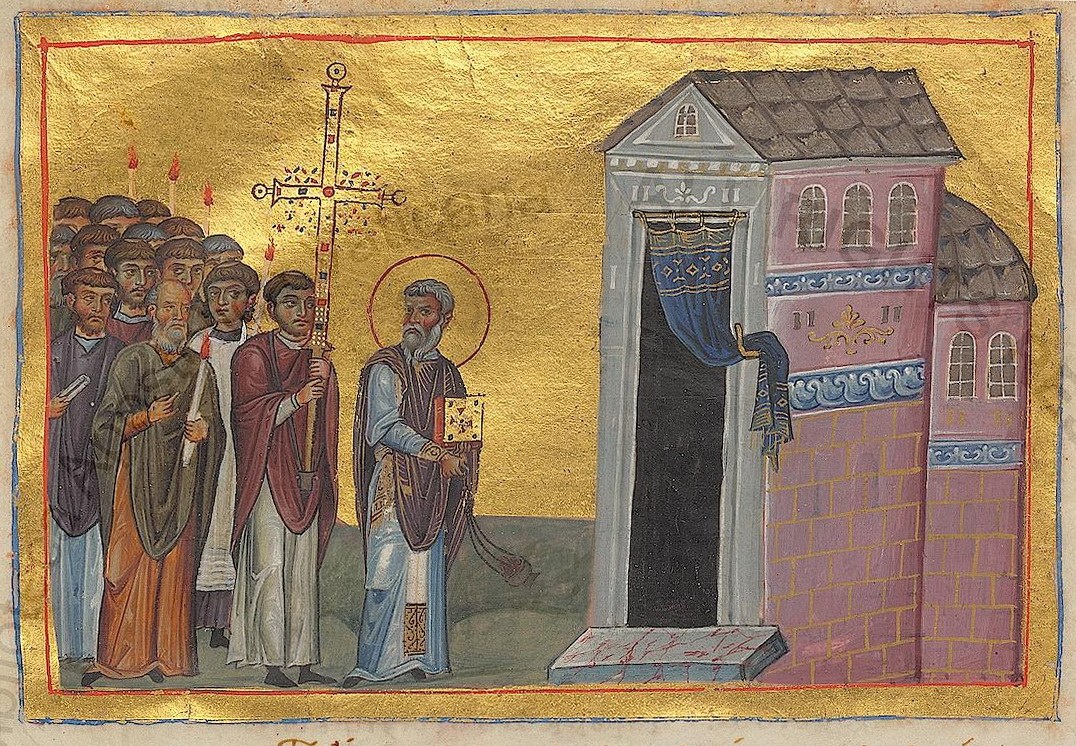
In the memory the Church preserved, the meaning of the event lay not in its geology but in the response it drew: the people, seeing in the shaking of the earth the just anger of God at human sin, gave themselves to repentance, and went out of the churches in litanies and processions (litai) through the stricken city, crying for mercy and calling upon the Mother of God and upon the Great-martyr Demetrius — whose own feast the day already bore — to stay the destruction. God, the tradition concludes, had mercy: the earth was stilled, the city preserved, and the walls raised again. The deliverance was therefore appointed to be remembered every year, so that the city's rescue should be ascribed to God's compassion and the intercession of his saints and not forgotten in security.
The commemoration belongs to a small family of Byzantine "earthquake memorials" — the most famous being the earthquake of 447 under Theodosius II (kept on other days) — by which Constantinople, a city built on a seismic land and repeatedly shaken, turned each great tremor into an occasion of corporate penitence and thanksgiving. That the earthquake of 740 fell in the reign of an iconoclast emperor was not lost on later Orthodox reflection, which could read the shaking of the city as a sign against the impiety of the age; but the office itself keeps to the older and simpler theme of sin, repentance, and merciful deliverance.
Feast and commemoration
26 October (church date; Old Calendar civil 8 November), kept in the Byzantine rite together with, and subordinate to, the feast of Demetrius the Myrrh-streamer: the Greek Menaion heads the day "Demetrius the Myrrh-streamer and the Commemoration of the earthquake that occurred," and the two share a single service, the earthquake contributing its proper apolytikion and its own canon and stichera of supplication. The joining is fitting: it was to Demetrius, among the saints, that the people of the shaken city cried for help. The commemoration is a deliverance observance — a remembrance of an act of divine protection — and its chief hymn, addressed to Christ "who lookest upon the earth and makest it tremble," passed into general use as the troparion appointed to be sung whenever the earth quakes.
Hymns
Troparion — Tone 8
O thou who lookest upon the earth and makest it tremble, deliver us from the fearful threat of earthquake, O Christ our God, and send down upon us thy rich mercies, through the intercessions of the Theotokos, O thou who alone lovest mankind.
Original translation from the Greek
Appointed readings
Epistle — Hebrews 12:6–13, 25–27
6For whom the Lord loveth he chasteneth, and scourgeth every son whom he receiveth. 7If ye endure chastening, God dealeth with you as with sons; for what son is he whom the father chasteneth not? 8But if ye be without chastisement, whereof all are partakers, then are ye bastards, and not sons. 9Furthermore we have had fathers of our flesh which corrected us, and we gave them reverence: shall we not much rather be in subjection unto the Father of spirits, and live? 10For they verily for a few days chastened us after their own pleasure; but he for our profit, that we might be partakers of his holiness. 11Now no chastening for the present seemeth to be joyous, but grievous: nevertheless afterward it yieldeth the peaceable fruit of righteousness unto them which are exercised thereby. 12Wherefore lift up the hands which hang down, and the feeble knees; 13And make straight paths for your feet, lest that which is lame be turned out of the way; but let it rather be healed. 25See that ye refuse not him that speaketh. For if they escaped not who refused him that spake on earth, much more shall not we escape, if we turn away from him that speaketh from heaven: 26Whose voice then shook the earth: but now he hath promised, saying, Yet once more I shake not the earth only, but also heaven. 27And this word, Yet once more, signifieth the removing of those things that are shaken, as of things that are made, that those things which cannot be shaken may remain.
Gospel — Matthew 8:23–27
23And when he was entered into a ship, his disciples followed him. 24And, behold, there arose a great tempest in the sea, insomuch that the ship was covered with the waves: but he was asleep. 25And his disciples came to him, and awoke him, saying, Lord, save us: we perish. 26And he saith unto them, Why are ye fearful, O ye of little faith? Then he arose, and rebuked the winds and the sea; and there was a great calm. 27But the men marvelled, saying, What manner of man is this, that even the winds and the sea obey him!
Iconography
The earthquake commemorations have no fixed portrait in the manner of a saint, but a recognisable pictorial type appears in illustrated menologia and later wall-painting: the city with its towers and columns tilting and crumbling, figures fleeing or fallen among the ruins, and above them the segment of heaven or the hand of God from which the shaking proceeds, while the clergy and people process with cross and icon imploring mercy — the composition making visible both the chastisement and the penitential supplication that is the feast's theme. The stored image is the miniature of the Menologion of Basil II (Constantinople, 985) for the commemoration: the clergy and people of the City in procession behind the jewelled cross, the hierarch bearing the Gospel, before the doors of the church — the litany of supplication by which Constantinople kept the anniversary of the shaking.