
Demetrius of Thessalonica
The Holy and Glorious Great-martyr Demetrius the Myrrh-streamer of Thessalonica
Great Martyr · Wonderworker · b. c. 270 — d. c. 306
Commemorated 26 October — Martyrdom at Thessalonica
Demetrius the Myrrh-streamer (†c. 306) is, with George, one of the two most beloved warrior-martyrs of the Christian East and the patron of Thessalonica, where he suffered under Galerius. The received tradition makes him a young nobleman — proconsul or military commander of the city — who used his office to teach the faith openly; imprisoned for it, he blessed the youth Nestor, who then killed the emperor's champion gladiator Lyaeus in the arena crying "O God of Demetrius, help me!" For this Demetrius was run through with spears in the baths where he was held. From his tomb in the great basilica of Hagios Demetrios there flowed a fragrant myron, whence his title "the Myrrh-streamer," and from that basilica he was believed repeatedly to defend his city, most famously against the Avaro-Slavic sieges recorded in the Miracles of Saint Demetrius. He is depicted as a soldier and, in the mounted type, on a red horse — the counterpart of George on the white.

Origins and the proconsul tradition
The historical Demetrius stands, like George, behind a rich and layered hagiographic tradition whose earliest strata are hard to recover. What the Byzantine synaxaria transmit, and what the whole later cult presupposes, is this: that Demetrius was a young man of noble Thessalonican family, born about the year 270, distinguished in bearing and learning, whom the emperor — the tradition names Maximian, in the tetrarchic years when Galerius ruled the Illyrian and Balkan provinces from nearby Sirmium and Thessalonica — appointed to high office in his own city, as proconsul (anthypatos) or, in other versions, as commander (dux) of the Thessalonican garrison. The office is remembered less for its administration than for its irony: charged among other things with the suppression of Christians, Demetrius used his position and his rank to do the opposite, gathering the people and teaching the faith of Christ openly, a catechist in the seat of a persecutor.
A parallel and very ancient strand of the tradition remembers Demetrius not as a soldier but as a deacon — a cleric of the Church put to death for his ministry. The two memories are not easily reconciled, and modern scholarship (see Disputed questions) has argued that the martial figure is a later development of an originally clerical one, and even that the cult itself was carried to Thessalonica from Sirmium. The Church keeps and honours the received portrait — the young confessor of high station — while the critical questions remain open.
Confession, imprisonment, and the blessing of Nestor
When the emperor came to Thessalonica — the tradition sets it after a victorious campaign against the Sarmatians — Demetrius's open preaching was denounced. Summoned and questioned, he confessed Christ without evasion and would not be moved; the emperor, unwilling at first to destroy a man of such rank, had him shut up under guard in a chamber of the public baths adjoining the hippodrome, there to reconsider while the games proceeded.
The centrepiece of the emperor's spectacle was a gladiator of prodigious strength, a Vandal named Lyaeus, whom he set on a high platform to fight all comers, the defeated being thrown down upon a thicket of upright spears. Lyaeus had killed many, and the crowd's blood-lust and the emperor's pride in his champion had become a public exaltation of paganism. A young Christian of Thessalonica named Nestor, grieved at this, went secretly to the imprisoned Demetrius and asked his blessing to face the giant. Demetrius signed him with the cross on the forehead and said that he would both overthrow Lyaeus and suffer for Christ. Nestor went up against the champion, and before the whole assembly cried out, "O God of Demetrius, help me!" — and threw the great gladiator down upon the very spears prepared for his own victims, so that Lyaeus died as he had made others die.
Martyrdom
The emperor's triumph was turned to public humiliation, and his fury fell upon both youths. Nestor he ordered beheaded — a distinct martyr, commemorated the day after Demetrius, on 27 October. Learning that it was the prisoner Demetrius who had emboldened and blessed Nestor, he sent soldiers to the baths, who ran Demetrius through with their spears where he stood, so that he was not so much executed as speared to death — the manner of his martyrdom fixed for ever in the icons, which show the lances driven into his side as he prays. His death is placed about the year 306, in the last and fiercest of the pagan persecutions before the peace of the Church. His body was cast out; Christians of the city took it up and buried it secretly on the spot, over which his great church would later rise.
A faithful servant of the martyr, Lupus, is remembered as having been present at his death and having steeped his own garment in the martyr's blood and taken from his hand a ring; by the blood-soaked cloth and the ring many were healed, until Lupus too was seized and put to death — himself venerated as a martyr on the same day in the Slavic and Antiochian usage (see Feast and commemoration).
The myrrh-streaming relics and the basilica
Over the martyr's grave, by the fifth century, there stood the great five-aisled basilica of Hagios Demetrios, one of the largest and most splendid churches of the early Byzantine world, raised — the tradition and its own mosaics say — by the eparch Leontius in thanksgiving for healing. Within it, over the site of the tomb, was set a silver ciborium (κιβώριον), a hexagonal canopied shrine which became the focus of the cult; the Miracles describe the saint dwelling in it as in a house, and its destruction and renewal in the church's fires. From the shrine, the tradition uniformly reports, there issued a sweet-smelling myron — a fragrant oil or myrrh — which the faithful gathered in flasks and carried across the Christian world for healing. From this ceaseless outflowing Demetrius received the title by which the East knows him above all others: ὁ Μυροβλύτης, the Myrrh-streamer (Myroblytes). The myrrh, and not at first any bodily relic, was the treasure of his church: for centuries it was believed that no body remained beneath the ciborium, only the myrrh-giving tomb — a peculiarity that shaped both the devotion and the later history of the relics.
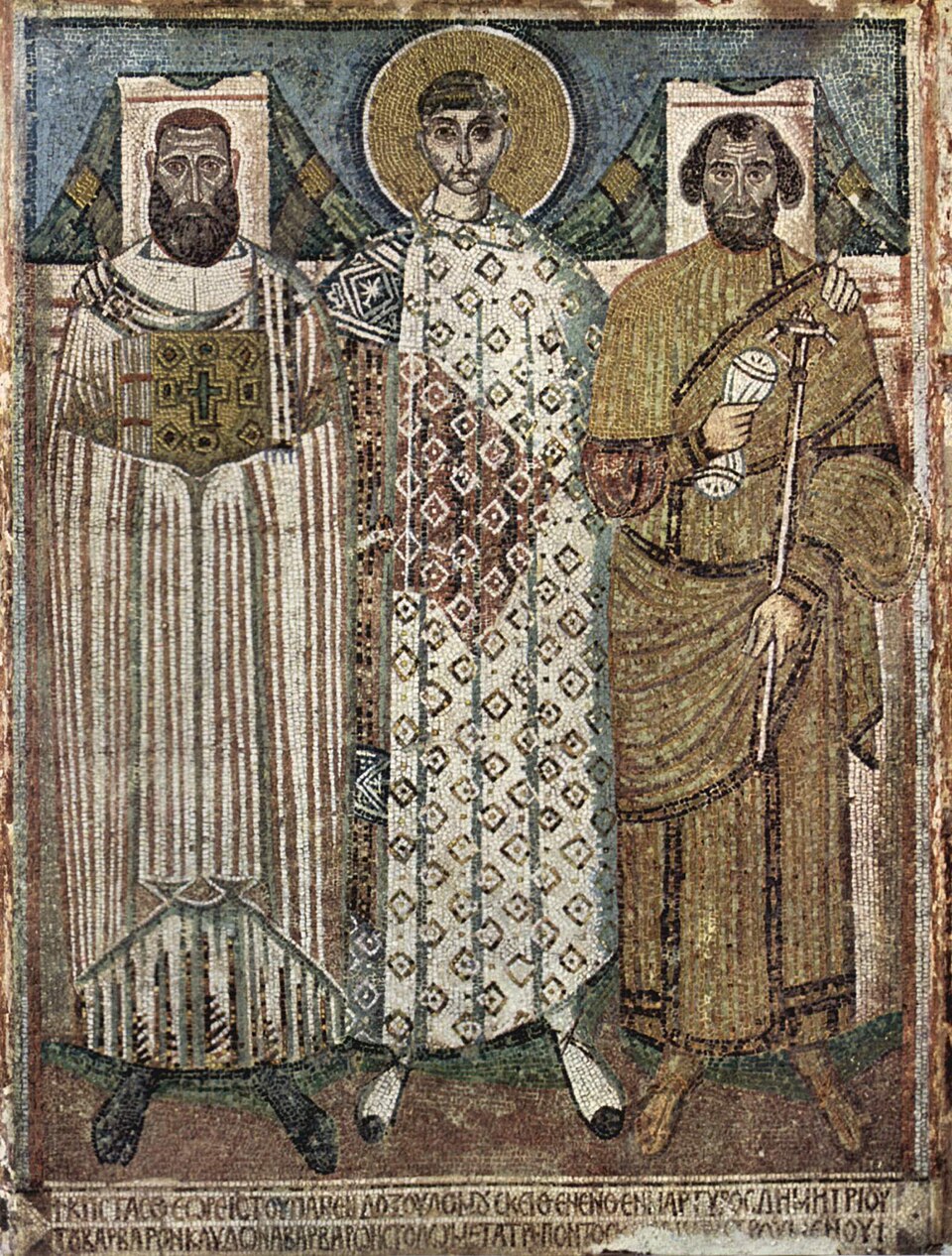
The basilica itself, twice burned and twice rebuilt (notably after the fire of the early seventh century), preserved until modern times a celebrated series of votive mosaics of the fifth to seventh centuries, showing the saint — a beardless young man in the patterned chlamys of a court dignitary — receiving and protecting the founders, the clergy, and the children of the city. Most of these survived the great fire of 1917, after which the church was carefully restored; the mosaic of Demetrius standing between the bishop and the eparch who rebuilt his church, with its verse inscription naming "the all-glorious martyr Demetrius," is among the supreme monuments of early Byzantine art and the stored image of this entry.
Defender of Thessalonica: the Miracles
Demetrius's veneration is inseparable from his role as the heavenly defender of his city. In the two books of the Miracles of Saint Demetrius (Miracula sancti Demetrii) — the first collected about 610 by John, archbishop of Thessalonica, the second compiled by an anonymous cleric later in the seventh century — the saint appears again and again upon the walls, turning back the enemies of the city: in famines and plagues, and above all in the great Avaro-Slavic sieges of Thessalonica (the assaults of the 580s, of 615–618, and later), when the city, cut off and outnumbered, was delivered, the citizens believed, by the visible aid of their martyr, seen in the arms of a soldier upon the ramparts. These narratives, composed to glorify the saint, are at the same time the single richest source for the settlement of the Slavs in the Balkans and the history of Thessalonica in the dark-age centuries, and are read by historians for that reason no less than by the faithful for devotion. From them the martyr emerges as what he has remained: not only a sufferer of the past but the living guardian of a Christian commonwealth, the soldier-saint whose sword is drawn for his people.
Relics and later history
Because his church long held only the myrrh, the history of Demetrius's bodily relics is complex and much disputed. Relics venerated as the saint's were carried westward in the Middle Ages and came to rest at the abbey of San Lorenzo in Campo in the Italian Marche, where they were kept for centuries; in the twentieth century, after investigation, the principal relics were returned to Thessalonica — the body in 1978 and further portions (including the head) in 1980 — and are now enshrined once more in the basilica of Hagios Demetrios, so that the city keeps again both its myrrh-giving tomb and the relics of its patron. The details and the identity of these relics have been debated, but their return restored to Thessalonica the visible presence of the saint after long absence.
Demetrius and George
The Church joins Demetrius most closely with George the Trophy-bearer: the two are the pre-eminent great-martyrs of the soldier type, young, noble, and slain under the pagan emperors, and the calendar and the icon treat them as a pair — George on 23 April, Demetrius on 26 October, framing the campaigning half of the year; George mounted on a white horse, Demetrius on a red; George most often shown slaying the dragon, Demetrius spearing a fallen man, understood in the later tradition as the gladiator Lyaeus or, in the Balkan icons, as the Tsar Kaloyan of Bulgaria, whose sudden death before the walls of Thessalonica in 1207 was ascribed to the saint. Where George is the universal warrior-martyr of all Christendom, Demetrius is the particular guardian of a city and, through Thessalonica, the special patron of the Christian peoples of the Balkans.
Feast and commemoration
26 October (church date; Old Calendar civil 8 November), a universal commemoration of the Byzantine rite, kept in Thessalonica as the great patronal feast of the city (the Dimitria). The Greek Menaion joins to the martyr's feast on the same day the Commemoration of the Great Earthquake of Constantinople of 740, a deliverance in which the people invoked the Theotokos and Saint Demetrius — the two commemorations share the day's service (see the Great Earthquake of 740). The martyr Nestor, whom Demetrius blessed, is commemorated on the following day, 27 October; the martyr Lupus, his servant, is kept with Demetrius on 26 October in the Slavic and Antiochian calendars (in the Greek usage Lupus is principally commemorated on 23 August); see his entry, Lupus of Thessalonica.
In the Slavic churches the Saturday before 26 October is kept as "Demetrius Saturday" (Дмитриевская суббота), a general commemoration of the departed — and, by a tradition going back to Demetrius of the Don after the battle of Kulikovo (1380), of fallen soldiers in particular; this is a Slavic, not a universal, observance, and (being a movable memorial without a fixed date) awaits the creation of its own soul-saturday movable rule and file before it is carried in frontmatter.
Hymns
Troparion — Tone 3
The whole world has found in thee a great champion in its dangers, O victorious one, who dost put the nations to flight. As thou didst bring down the arrogance of Lyaeus, and gavest courage to Nestor in the stadium, so, O holy Great-martyr Demetrius, entreat Christ God to grant us his great mercy.
Original translation from the Greek
Kontakion — Tone 2
With the streams of thy blood, O Demetrius, God has dyed the Church in purple, granting thee strength invincible and keeping thy city unharmed; for thou art its firm foundation.
Original translation from the Greek
Appointed readings
Epistle — 2 Timothy 2:1–10
1Thou therefore, my son, be strong in the grace that is in Christ Jesus. 2And the things that thou hast heard of me among many witnesses, the same commit thou to faithful men, who shall be able to teach others also. 3Thou therefore endure hardness, as a good soldier of Jesus Christ. 4No man that warreth entangleth himself with the affairs of this life; that he may please him who hath chosen him to be a soldier. 5And if a man also strive for masteries, yet is he not crowned, except he strive lawfully. 6The husbandman that laboureth must be first partaker of the fruits. 7Consider what I say; and the Lord give thee understanding in all things. 8Remember that Jesus Christ of the seed of David was raised from the dead according to my gospel: 9Wherein I suffer trouble, as an evil doer, even unto bonds; but the word of God is not bound. 10Therefore I endure all things for the elect’s sakes, that they may also obtain the salvation which is in Christ Jesus with eternal glory.
Gospel — John 15:17–16:2
17These things I command you, that ye love one another. 18If the world hate you, ye know that it hated me before it hated you. 19If ye were of the world, the world would love his own: but because ye are not of the world, but I have chosen you out of the world, therefore the world hateth you. 20Remember the word that I said unto you, The servant is not greater than his lord. If they have persecuted me, they will also persecute you; if they have kept my saying, they will keep yours also. 21But all these things will they do unto you for my name’s sake, because they know not him that sent me. 22If I had not come and spoken unto them, they had not had sin: but now they have no cloke for their sin. 23He that hateth me hateth my Father also. 24If I had not done among them the works which none other man did, they had not had sin: but now have they both seen and hated both me and my Father. 25But this cometh to pass, that the word might be fulfilled that is written in their law, They hated me without a cause. 26But when the Comforter is come, whom I will send unto you from the Father, even the Spirit of truth, which proceedeth from the Father, he shall testify of me: 27And ye also shall bear witness, because ye have been with me from the beginning. 1These things have I spoken unto you, that ye should not be offended. 2They shall put you out of the synagogues: yea, the time cometh, that whosoever killeth you will think that he doeth God service.
Iconography
Demetrius is one of the two great warrior-saints of Byzantine iconography, and his image takes several fixed forms. In the oldest and most solemn, seen already in the fifth-to-seventh-century mosaics of his own basilica, he is a beardless young courtier, frontal and haloed, in a rich patterned chlamys with the tablion of high office, hands raised or resting on the shoulders of the founders and children he protects — the martyr as patron and intercessor of his city rather than as soldier. From the middle-Byzantine period he is more often shown as a warrior: standing in armour with lance and shield, or, in the mounted type that became especially dear to the Balkan and Slavic peoples, on horseback upon a red horse (the counterpart of George's white), spearing a fallen enemy beneath the hooves — a gladiator, or in the Bulgarian and Serbian icons the Tsar Kaloyan. A third type, the martyrdom, shows him within the baths transfixed by the soldiers' spears, hands lifted in prayer. He is regularly paired with George, the two young soldier-martyrs flanking Christ or facing one another across a composition.
The primary stored image is the great votive mosaic of the seventh century from the basilica of Hagios Demetrios in Thessalonica: the young martyr, haloed and in his jewelled white chlamys, stands frontally between the two founders of the rebuilt church — a bishop in the cross-figured omophorion and the lay eparch (governor) of the city — with the surviving verse inscription below naming "the all-glorious martyr Demetrius." It is at once a portrait of the saint and a picture of his patronage of Thessalonica.
A second stored image gives the mounted warrior type: a Serbo-Macedonian panel icon of the seventeenth century (Pinacoteca Vaticana), showing the young saint in a blue cloak upon a red horse, raising his weapon over a fallen foe trampled beneath the hooves — the "warrior on the red horse" by which the Balkan peoples knew their defender, and the visual pendant to the mounted George.
Disputed questions
- Soldier or deacon; the Sirmium hypothesis. The received tradition makes Demetrius a young official of Thessalonica, but an old and independent strand remembers him as a deacon, and the earliest firm evidence for his cult is associated not with Thessalonica but with Sirmium (in Pannonia), the Balkan imperial capital of the Tetrarchy. Hippolyte Delehaye and later scholars (notably David Woods) argued that the cult originated at Sirmium — perhaps around a genuine local martyr, or by transfer from another figure — and was carried to Thessalonica in the fifth century when the praetorian prefecture of Illyricum moved there, the martial "proconsul of Thessalonica" being a secondary elaboration. The entry records the received portrait while noting that the historical Demetrius, his office, and even the original seat of his veneration are genuinely uncertain.
- The absence of a body. That his shrine long held only the myrrh and no bodily relic is not a later embarrassment but an ancient feature of the cult, remarked in the Miracles themselves; it bears on the debated identity of the relics venerated at San Lorenzo in Campo and returned to Thessalonica in 1978–1980.
- Not to be confused with Demetrius of Skepsis (with his wife Evanthia and son Demetrian; †1st century, feast September 11), a distinct martyr of the Troad.
- Lyaeus and Kaloyan. The gladiator Lyaeus belongs to the passio; the identification of the figure trampled by the mounted Demetrius with Tsar Kaloyan of Bulgaria (†1207) is a medieval Balkan development, historicising the icon by attaching it to Kaloyan's death before Thessalonica, and is not part of the ancient martyrdom account.